Home Blog Page 2224

Fallingwater – a Frank Lloyd Wright masterpiece to see before you die

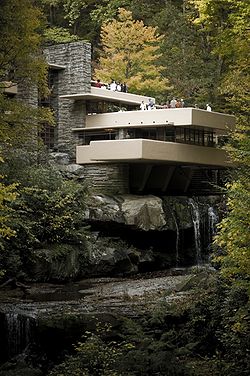
Frank Lloyd Wright’s Fallingwater.

(Updated Sept. 6. 2016)

Fallingwater,” one of Frank Lloyd Wright’s masterpieces, is a perfect place to spend an afternoon at one of the Smithsonian’s Life List of ‘28 Places to Visit Before You Die.’

It was the mid-1930s when Wright, America’s most celebrated architect, designed this ‘weekend’ retreat for the Kaufmann (Department Store) family of Pittsburgh, PA.

Wright, in his mid-60s at the time, was already world-renowned and the house became instantly famous when it appeared almost immediately on a Time magazine cover.

The design “exemplifies Wright’s concept of organic architecture: the harmonious union of art and nature,” according to Fallingwater.org.

During a wet autumn visit, the cantilevered concrete terraces that hover above the waterfalls of Bear Run blew me away. There is even a descending staircase from inside the living room that leads to boulders forming the waterfalls–it beckons visitors to dangle their feet in the cool stream. The house is located in southwest Pennsylvania’s Laurel Highlands about 90 minutes from Pittsburgh.

The American Institute of Architects named Wright “the greatest American
architect of all time,” and in the same year, his Fallingwater home was
voted “the best all time work of American architecture,” according to Artsy.net.

If you go:

Fallingwater
1491 Mill Run Road
Mill Run, PA 15464
Visitor Services: 724.329-8501
URL: fallingwater.org

Hours: Regular season tours 10 a.m. – 4 p.m. (Advance ticket purchase or reservations are essential)
Cost: Regular house tour: $25/adult; $18/ages 6-12 (when purchase in advance online); $27/adult; $20/ages 6-12 (when purchase onsite at Fallingwater)
In-depth tour: $72. Detailed information on these and other special tours click on Tours and Tickets
Driving directions: click here. The house is off PA Route 381, approximately 19 miles south of Donegal (Exit #91) of the PA Turnpike (I-76); or 10 miles north of US Route 40.
GPS: 39.900881, -79.465613

Ohiopyle State Park  Julianne G. Crane

Good on-site parking for RVs, coaches.

Nearby:  
Ohiopyle State Park offers good RV and tent camping at Kentuck Campground.
The Youghiogheny River (rails-to-trail) Trail, a 27-mile hiking and biking stretch (part of the Great Allegheny Passage), is wide, mostly smooth and beautiful the entire way.

To read more about the RV Lifestyle click on RVWheelLife.com

Julianne G. Crane 

Photos: Top: Fallingwater. (Wikipedia.) Bottom: Kentuck Campground, Ohiopyle State Park. (Julianne G. Crane )
Bishop’s Castle — Quirky RV Short Stop in Colorado

Bishop’s Castle is one man’s monumental creative obsession, more than 50 years in the making.

Jim Bishop began his solo project in 1969 on land surrounded by the San Isabel National Forest, high in the Rocky Mountains of southern Colorado. Ten years earlier, at the age of 15, Bishop purchased the 2-1/2 acres for $450.

Bishop was a strapping 25 when he started building what he thought would be a one-room stone family vacation cabin … soon, however, the project took on a life of its own.

He fell in love with building. Each room, staircase and tower came from his imagination, without a blueprint or drawing.

“Everything just seems to work,” he was quoted as saying in a Pittsburgh Post Gazette article in 2006. “What’s real neat about not having blueprints is that if you make a mistake, you call it art.”

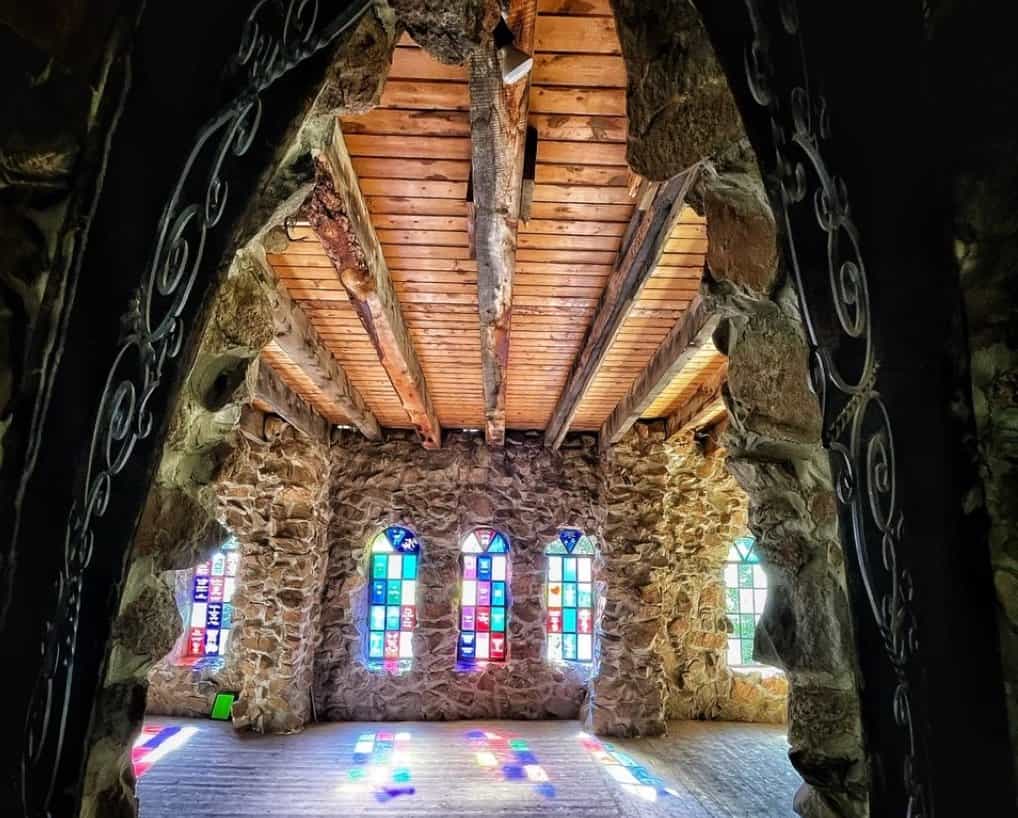
And amazing art it is–including multiple rooms, a grand hall, and a maze of intricate wrought-iron bridges and walkways surrounding its towers, one of which reaches more than 160 feet. There is even a fire breathing dragon made from metal lunch pails.

The castle is a combination of rock, metal and wood. All of the rocks are gathered locally by Bishop using a national forest service “non-invasive rock hauling permit.” This allows him to haul as much rock as he can without the use of heavy machinery or dynamite and without building roads.

If you go —

Bishop’s Castle is located at 12705 CO-165; Wetmore, Colorado.
Directions: Colorado Highway 165 at milepost 12, five miles north of San Isabel.
Phone: 719.485-3040.
BishopCastle.org

Cost: Free; donations to help with future construction are welcomed.
Hours: Daylight hours. Open daily May -October; weekends November-April.
Facilities on site: Gift store featuring a variety of unique items including original ornamental iron work by Jim Bishop.
Caution: Elevation is more than 9,000 feet. Check weather conditions before heading out.

Julianne G. Crane
— For more articles on the RV lifestyle, go to RVWheelLife.com.

Photo: Bishop’s Castle. Source: Wikipedia

BLM Hot Spring – a brief soak or longer stay

By Julianne G. Crane

Hot Spring BLM sign. (Julianne G. Crane)

For those traveling to, or from, Quartzsite — a funky, and oh-so-relaxing, short stop consider the soaking pools at the BLM’s Hot Spring LTVA between Yuma, Ariz., and El Centro, Calif.

The Hot Spring Long Term Visiting Area sits on Bureau of Land Management property adjacent to I-8 near Holtville, Calif.

It boasts an “historic and still active hot spring” that attracts both “local and winter visitors” who come to dry camp and soak in the soothing waters.

Most of those winter visitors are RVers, from Canada and other up-north locations, who are escaping the bitter cold and snow for the milder climate of the southwest desert along the Colorado River.

RVer Jimmy Smith  (Julianne G. Crane)

BLM’s Hot Spring boasts two small soaking pools that may be a bit crude for some tastes, however, both are continuously feed by natural springs. The larger of the two is quite warm at 105-degrees. There is an adjacent rainbow-type shower for visitors to rinse off both before and after soaking. (No soap is allowed.)

Many of the LTVA campers fill containers with the spring water to carry back to their RVs and tents for washing. (No potable water on site.)

If you go

Directions: Exit 131 off I-8 to Holtville, Calif., and travel east on the frontage road approximately one mile to the LTVA.

Hours: Hot Spring pools are open 5 a.m.-Midnight.

URL: BLM Hot Spring LTVA —
http://www.blm.gov/ca/st/en/fo/elcentro/recreation/ltvas/hotspring.html

Facilities: Vault toilets are located near the Hot Spring (suggest bringing own TP). The nearest dump station and drinking water are in Holtville.

Costs: LTVA permits are required from Sept. 15- April 15. (There are two types of permits: long term and short visit. The long term permit is $180 for the entire season. A short visit permit is $40 for 14 consecutive days from date of purchase. Both permits are good at all LTVAs, and permit holders can move from one LTVA to another without additional fees. Permits can be purchased at any BLM field office including: Yuma: 938.317-3200.)

To read more about the RV Lifestyle click on RVWheelLife.com

Julianne G. Crane

Photos: Hot Spring LTVA sign; Bottom: RVer Jimmy Smith soaking in the hot pool (105-degrees) at BLM Hot Spring near Holtville, Calif. (Julianne G. Crane)

Tour America’s Oldest Brewery — D. G. Yuengling & Son in Pottsville, Pa.

By Julianne G. Crane
In 1829, David G. Yuengling, a young German immigrant, pulled his first draft and someone in the family has been brewing hops ever since.

Yuengling’s historic red brick brewery is located on a hillside in the small working class town of Pottsville, Pa., smack in the center of Pennsylvania’s coal mining country.

This highly functional piece of American history produces beer every day and offers an amazing free walking tour that is fun, informative and a pleasant break from any long RV trip.

Stops on the tour include the brewhouse, the hopstore, the hand-dug fermentation caves that were used for storage before refrigeration, and the bottling room where conveyors push thousands of bottles and cans along to be filled by one of the seven current brews.

And, speaking of brews, the tour ends at the taproom where visitors can sample a couple of the company’s products.

While the Traditional Larger accounts for 70-percent of the sales, the Lord Chesterfield Ale is extremely tasty. It is considered Yuengling’s hoppiest brew.

If you go

The Yuengling Brewery is located at 501 Mahantongo St., in Pottsville, Pa., 570.628-4890.

Tours: Mon.-Fri., 10 a.m. & 1:30 p.m.; Sat. (April-Dec. only). Allow at least 90 minutes. Lots of walking on uneven surfaces and stairs. No wheelchair access.

It is near PA-61, off I-81 between Harrisburg and Scranton. About 95 miles NW of Philadelphia.

As with all attractions when you are traveling, call ahead to confirm tour times and days.

URL: www.yuengling.com

Where to find Yuengling on the shelves: Pennsylvania, New York, New Jersey, Maryland, Delaware, Washington D.C., West Virginia, Virginia, North Carolina, South Carolina, Tennessee, Alabama, Georgia and Florida.

Photos: The informative guide, Lisa, gives background on the 180+ years of Yuengling Brewery history in the taproom before the tour. (Middle) Stained glass ceiling in brewhouse. (Bottom) Traditional Lager bottles on the conveyor belt. (Julianne Crane)

Crazy like a fox: Did miner Burro Schmidt uncover riches in hand-dug tunnel?

0


William Henry Schmidt, born in Woonsocket, Rhode Island in 1871 possessed none of the qualifications to become a high desert prospector, but having a family history of tuberculosis, and following the orders of his doctor, he came west and took a job in California with the Kern County Land Company in the Mojave Desert.

By 1906 he had filed some claims of his own in the Copper Mountains. He had one problem: how to transport the ore from his claims to the distant smelter. It required building miles of roads around the mountain, or…
What started as an idea, to carve a tunnel right through the mountain to the Borax road that connected Death Valley with the town of Mojave, grew into a life-long obsession. Working with only a hand drill and a four-pound hammer Schmidt hacked away at the solid granite mountain carving out a five-foot wide and seven-foot tall shaft. With his only friends and constant companions, Jack and Jenny, two faithful burros from which he received his name “Burro” they transported the tons of debris from his diggings.
To finance his project he worked summers on surrounding ranches, but spent his winters living in his cabin, built with scrap lumber, working on his tunnel. When he was only half way through the mountain the railroad was completed through the valley along with convenient access roads. The purpose of his tunnel had become obsolete.
But Burro, instead of starting to work his claims, making use of the railroad to transport his ore, kept digging, and digging. Had this obsession pushed him to the brink of sanity? Or, as the rumor spread, had he discovered the Crystal Room, a lost pocket of rich gold ore? Was he using the digging of his shaft as an excuse to stay up on the mountain extracting a fortune from this lost lode?
Burro continued working on his shaft, 1600 feet straight through the mountain, where he made an abrupt turn and punched through the other side after 38 years at the age of 68. His dedication achieved for him his moment of glory, an article in Time magazine and an acknowledgment by Ripley’s Believe It Or Not.
In his lifetime he sold only 20 tons of ore valued at $60 a ton–$1200 for the incredible amount of earth he removed from the tunnel. Yet when he died, $2700 was found hidden beneath a windowsill in his cabin and caches of gold nuggets have turned up from time to time around his mine and cabin. Some old-timers claimed to have seen Burro’s Crystal Room that he purportedly blasted shut upon the completion of the tunnel.
Access to the tunnel, which you can see and walk through, is by dirt roads either from Hart’s Place on Route Six or through Last Chance Canyon from Cantil. Camping is available at nearby Red Rock Canyon State Park, twenty-five miles north of Mojave on Route 14. Further directions to Burro Schmidt’s tunnel and a map are available from a ranger or from the park’s visitor center.

Check out Bob Difley’s Boondocking and Snowbird Guide eBooks at RVbookstore.com

See the wild ponies of Virginia’s Grayson Highlands State Park

0

Virginia’s Grayson Highlands State Park is a popular place to camp, but it’s also popular for its wild ponies. They were brought to the area years ago to keep some of the vegetation in check, which they did. And they multiplied. Last winter, however, more than half the herd was wiped out by brutal winter weather including heavy snow and sub-zero temperatures. In this short video, learn about the ponies, which, while labeled wild, seems to show little or no fear of humans. You can learn about camping in the park here.

Mission San Xavier del Bac

0

If you are a history buff, you know that in the west, unlike along the eastern seaboard or New England, you don’t see many historic sites chronicling European exploration with dates in the early 1600s or early 1700s.
One of the first Spanish missionaries to visit the west, Father Kino visited the O’odham community of Wa:k (Bac), south of what is now Tucson, in 1692. Though he attempted to build a rustic church as early as 1700, Father Alonso Espinosa began building the first church of any substance in 1756 and Father Francisco Garces arrived in 1768 as its first minister.

The current structure, though added to and rebuilt over the years, was begun in 1776 and wasn’t completed until 1797. It is an outstanding example of Spanish baroque architecture, with elegant arches, domes, twin bell towers (one left unfinished), and inside a priceless collection of Mexican baroque art, frescoes, and wooden carvings.

An ongoing process of restoration begun in the early 1990s is returning some of the luster to the 200-year-old art.

San Xavier’s dazzling white walls have given it the name “The White Dove of the Desert,” and it still serves the Tohono O’odham today with daily masses.
Photography is permitted when services are not in progress. Drive nine miles south of Tucson on I-19 and take exit 92. Turn west for one mile. The church is open daily 8AM to 6PM. Admission is free and donations are accepted.

Check out Bob Difley’s eBooks at RVbookstore.com

Transport yourself to Vulcan–Alberta, that is.

Seems like many RVers are likewise Star Trek fans. Now here’s a place that’s off the beaten path, and out of this world.

The good folks of Vulcan, Alberta, may have been in a wheat farming center of the universe, these days tourism is a mainstay of this town of 2,000, stationed on the edge of the Canadian Badlands, an hour away from Calgary. Realizing the town’s name (older then the series itself) would have some attraction to Trekkers and they’ve more than capitalized on it. From large outside murals based on the Trek theme, to a tourist information center (complete with virtual reality game), and the only place in the universe you can visit the Starship Vulcan (ID number FX6-1995-A), Vulcan is a point to set your star map coordinates to.

Not long ago, Mr. Spock himself turned up in Vulcan, the the roaring appreciation of Trek fans, and fellow Vulcans themselves. He unveiled a new bronze bust of himself, left a handprint in concrete (appropriately in the Vulcan salute), and no doubt shot the town website visitor statistics into orbit. If you should arrive in your personal RV starship, you’ll find plenty of camping opportunities. And if you’ve forgotten your uniform, have no fear, stop by the
Vulcan Tourism and Trek Station–you can use one of theirs for a photo-op. Or contact them by Internet subspace by clicking here. XF6-X6-1995-A1995-A

McTrain Car? McDonalds at Barstow is truly an original

You’ve seen one McDonalds, you’ve seen them all? Evidently there is at least one Mc-Restaurant that breaks the typical mold: Barstow, California off the old Historic Route 66 is unlike any other of the vast sea of franchised Ronald McDonald diners.

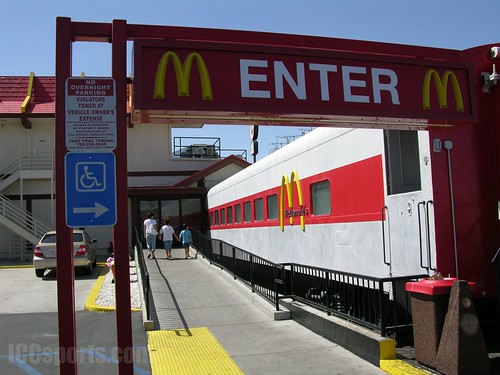
Based on a railroad theme (it all goes along with Barstow’s history), you can gobble your Big Mac in a rail car, if you like. Perhaps a giveaway that you’ve entered an unusual McD’s is the big red, railroad water tank prominently perched near the ubiquitous Golden Arches.

Some older ones may yearn for the days when you could get a real minty milkshake at McDonalds–they called it a Shamrock Milkshake. The Barstow Station McDonald’s is one of those rare stores in the system that sells the Shamrock Shake–but only along about St. Patty’s day.

Visit the Barstow Station McDonalds at 1611 Main Street, just off Interstate 15.

photo iccsports on flickr.com by creative commons license

Cumbres & Toltec Scenic Railroad Ready to Roll

1

With its antique steam engines stoked, the Cumbres & Toltec Scenic Railroad kicks off a season-long celebration of train rides and special events on May 22, 2010, with Opening Day ceremonies at both the Chama, New Mexico and Antonito, Colorado depots.

The Cumbres & Toltec Scenic Railroad is co-owned by the people of Colorado and New Mexico. Its locomotives, cars, buildings, and even its 64-mile narrow-gauge route were all part of the Denver & Rio Grande Railway, making it the most authentic train in all of North America.

A ride on the train is an adventure in time. It chugs up the 10,015-foot-high Cumbres Pass, winds through tunnels and over trestles, and snakes along the 800-foot-deep Toltec Gorge, past waterfalls, mountain forests, and alpine meadows. This popular historic narrow-gauge train engages passengers, photographers, historians, and train aficionados on one of the most scenic and historic rail experiences anywhere.

The trains will run daily through October 17, 2010. Highlighting the year will be a number of planned special train rides, including Sunday themed trains and a host of special themed trains. For more information call 888-CUMBRES (888-286-2737).

Learn more about Scenic Railroads

Connecticut’s RV-Friendly Welcome Centers

2


As an RV-friendly welcome to the state of Connecticut, the Department of Transportation has extended the welcome mat to self-contained RVers. Visitors to the state are permitted one free overnight stay in the rest area at several interstate highway Welcome Centers.

Since most RVers will want to visit the Welcome Centers where travel counselors can provide maps, brochures, and travel and sightseeing information, staying the night to rest and study up on the many attractions and historical sites before moving on is a sensible option.

A bit thumbs up go to the state planners for designating special areas for RV travelers, away from the continuous coming and going of noisy eighteen-wheelers, placing them near picnic tables, barbecues, and restrooms. Most also have dump stations and special pet areas.

The Connecticut State Police monitor the rest stops to provide a safe and secure stay. Overnight stays are permitted at the following Welcome Centers:

On I-84

  • Danbury at exit 2.
  • Southington eastbound between exits 28 and 30
  • West Wellington westbound between exits 70 and 69

On I-91

  • Wallingford southbound between exits 15 and 14
  • Middletown northbound between exits 19 and 20

On I-95

  • Westbrook northbound between exits 65 and 66.
  • North Stonington southbound between exits 92 and 91.

Lake Erie Prehistoric Forest & Mystery Hill

0

If you fondly remember when family entertainment was simpler, the days before CGI sci-fi movies like Avatar and expensive video games that mesmerize the addicted, take a nostalgic visit to the Prehistoric Forest and Mystery Hill on Ohio’s Lake Erie shoreline.

Though considered old-fashioned by the cyber set, the big-as-life dinosaurs set in a jungle-like forest with faux rocks and a contrived waterfall, and the strange gravity defying illusions like water running up hill, still mystify and intrigue visitors.

Young children especially enjoy teaming up for water balloon battles between mom and dad and grandma and grandpa. Two launching platforms, each with a rigged up catapult, loft the balloons through a hole in the roof, toward the other. A direct hit on the opposing roof, of course, showers the “enemy” with water and giggles.

Visit the reptile house to see live lizards, turtles, and snakes. But hurry. Open since 1953, the 2010 season will be its last. The owner is retiring.

Prehistoric Forest & Mystery Hill, 8332 E. Harbor Road (Rte. 163, eight miles east of Port Clinton), Marblehead, Ohio. Open 10AM to dark, every day, Memorial Day to Labor Day. Weekends only in May and September.