

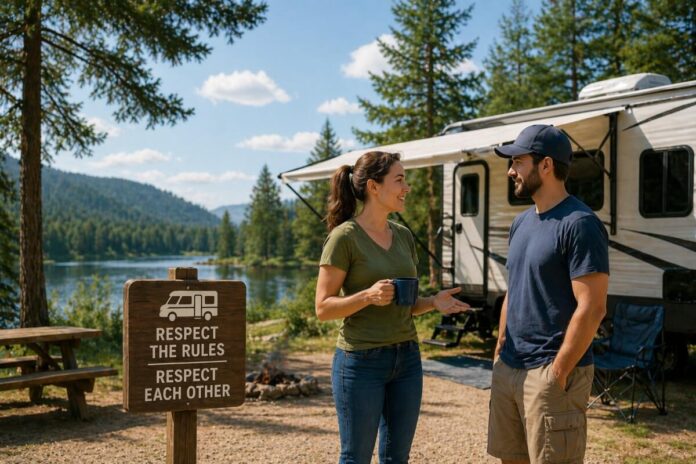
RV camping works best when everybody acts like a good neighbor. Sadly, that doesn’t always happen.
Common troublemakers include barking dogs, loud music, talking loudly after quiet hours, and unsupervised kids. Then there are generators humming late, people cutting through occupied sites, and speeding through the campground.
What’s the best thing to do when a neighboring camper breaks the rules? Well, you have choices.
First things first
The first move is usually the calmest one. Take a look at the campground rules for yourself. Does the camp specifically call out the behavior in question? Remember that each campground formulates its own rules for maintaining a safe and enjoyable stay. Don’t assume that you know the rules. Check first to make sure.
Breathe. If you’re upset or frustrated, you may not be able to respond to the issue in a helpful way. Ask yourself, “Is this really worth addressing?”
Public health guidance on conflict says it helps to separate the behavior from the person. Also, cool off before speaking and focus on solving the problem instead of “winning” the argument. This approach fits campground life well, because most problems are really about noise, safety, or shared space rather than a personal feud.
If the situation feels safe and the behavior is minor, a friendly face-to-face conversation often works best. Keep it short, specific, and respectful. Mention the exact issue, point to the rule if needed, and avoid a lecture.
A calm tone matters because campground etiquette sources repeatedly stress courtesy, quiet hours, leashes, cleanup, and respectful noise levels. In other words, ask for the behavior you want to see instead of turning the moment into a showdown.
When the neighbor ignores you, gets rude, or the problem feels unsafe, remove yourself from the situation. Ask for help from campground staff. Campground personnel and park volunteers are commonly assigned to explain rules, monitor compliance, handle site questions, and take corrective action for minor violations.
Many private campgrounds also state plainly that rule-breaking can lead to warnings or eviction, which is why the office or camp host should be part of the solution when polite asking does not work.
Be kind
For RVers, the best rule of thumb is simple: Start with courtesy, move to a direct request if it feels safe, and escalate to staff if the issue continues. That keeps the campground peaceful, protects your own comfort, and gives the park a fair chance to enforce its policies.
Note: If the behavior is unsafe or illegal, alert authorities immediately.
Your turn
MORE POLLS YOU MIGHT LIKE:
- Which do you most often prefer: a well-lighted campground or a dark one?
- Have you missed out on booking a campsite or campground you really wanted this year?
- To tell or not to tell: Would you tell other RVers about the ‘perfect’ campground?
- What do you do most nights after dinner?
- If the only available campsite was directly next to the playground, would you take it or look elsewhere?
RVT1258

Big one I come across most is newbies burning trash and Styrofoam. Most get it and stop. For the really thick heads I report to the office.
First, talk to management; second, leave a review. Some owners never know there is a problem if not on sight. Reviews are seen by owners and higher-ups they do not like bad ones.
Option 2 and 3.🇨🇦
I try to kind when addressing a problem. Sometimes it’s simply ignorance. When I tell a rambunctious boy that in Boy Scouts I learned to shout out “Permission to enter the camp site please” prior to cutting through they mostly get the picture. In addition it sometimes leads to questions about Boy Scouting (Scouting America)& I share the stories about our High Adventure Boy Scout troop (white water raftng and canoe trps through the Northern Tier High Adventure Base) sometimes it lights a fire within them.
I have no problem with camping next to a playground as long as things quiet down by 10 pm
My Dad once told me he wanted to be buried within earshot of a playground, so he could hear children laughing while he slept his long sleep.
Inform the campground management or host first, if it’s a real problem. Not after you approach the person.
Some people will retaliate since they know who complained.
If it’s more of a minor problem, the person may not realize it. A calm approach will normally suffice.
I think one of the biggest problem is unruly kids screaming and running through other campsites.
Nothing is going to help since the parents don’t see it as a problem. They ignore it.
Had an experience several years ago with a group of loud and over imbibed group of younger campers. It’s midnight with a big fire. Lots of loud talk and laughter. I and other campers went to talk with them and politely ask them to quiet down. No results. Someone called for help. It got eerily quiet when the sheriff arrived. Apparently the sheriff used better language than any of us used. Needless to say, the rest of the night was very quiet.
We had the same type of experience while camping in upstate NY.
A few tenter’s moved in beside us, no big deal. Then more and more came and the all night parties started. The campground owner approached them and all was well, for one night.
It started again the next night and this time the owner was accompanied by the sheriff”s department. Four cars showed up and arguments started.
All of a sudden the tents were coming down and they were escorted out of the campground and banned for life.
BTW, these were not younger people.
It really depends on the severity.
If it’s a “no slinky’s on the ground” or “no hammocks” rule, I’m not going to assume the role of the self-appointed HOA President of the campground, point at the rules list and demand corrective action.
If the infraction is destructive to my health, property or experience, I’ll just leave and let the park rot from their indifference.
In 35-seasons and hundreds of campsites we’ve only had to report disturbances to the camp host or management three times. Twice for very loud music (and on one of those complaints the campers were kicked out of the park. Seems we weren’t alone in complaining). The third was a bunch of drunks breaking glass bottles by throwing them at large rock and trees. Nothing was done. We left the next morning,
My camping years go back 50 years to when I had my children with me. In the early years, I was pretty confrontational. Once I strapped on a fairly large side arm and approached the campsite with a loud music blaring and told them that I didn’t need to hear their music clear over in my camp space. Turn it down.
these days I mostly ignore things like lights and mild noise. The thing that really gets me are loose dogs. I tried the kind. “did you know that dogs aren’t allowed off leash?” if the dog is at all threatening, I go to the staff.
One time many years ago a Class A setup camp in the site next to us. Then other cars arrived and the party began. We were outside and were invited to join the party and we did. Got a nice meal out of it and everyone was friendly. There have been a few instances of what seemed like perpetual dog barking but didn’t know where. When we close up the motorhome and turn on the AC we don’t hear much from outside. Some of the other comments are constructive and worth heeding.
Many campgrounds have no host or management on site. And when calling the Sheriff’s office, they usually have one or two deputies on duty dealing with more important things in a large county. I usually do not confront rude people unless their dog is off leash and in my space. Even then, they are quite miffed. After all, it wasn’t off leash very long! That’s long enough to start a dog fight. Some campgrounds have a “concessionaire” and when someone came the following day to move the people out of my reserved camp site, my trip was already ruined. Those people refused to leave my space, and there was no cell phone service. I have too many examples to mention, mostly ill-behaved kids and dogs.