


Dear Dave,
I replaced the four 6-volt FLA [flooded lead acid] batteries with two 200Ah LiFePO lithium batteries. Every night they seem to shut down and I lose power to everything in the coach, including the refrigerator stops, no propane. I don’t understand why. Nothing is running except refrigerator and two iPhone chargers. Thank you for trying to help. —Eric, 1993 Country Coach Intrigue 38′ with Tag
Dear Eric,
There are a lot of variables that come into play in this situation, the first being the type of lithium batteries. Most LiFePO4 lithium iron phosphate batteries being sold in the RV market have a charge profile of 14.6 volts for about 2 hours. Your Country Coach most likely had a Magnum Inverter that was also a battery charger. Since you originally had four 6-volt batteries, it most likely was set up for a multi-stage charge. It started with a bulk charge of about 16 volts to break up sulfation for several hours, then an equalizing charge, then a float charge.
Battery management system
Most lithium batteries also have a battery management system (BMS) that protects the batteries from overcharging, cold weather charging, and surges.
I have a few questions: Are you dry camping or plugged into power? What happens after the rig shuts down in the middle of the night—how do you get it to power on again? And do you have a battery monitor installed?
If your inverter has the charge profile set to the 6-volt battery setting, the high voltage of the bulk stage charge is too much for your lithium batteries and the BMS will shut down. It could be the batteries drain down slightly and the inverter kicks on in the bulk stage in the middle of the night.
Cold weather
Another variable is cold weather. It is not recommended to charge a lithium battery below 32 degrees. Since you originally had FLA batteries, they would have been in a vented outside compartment and subject to cold weather. If the temperature at the battery is below freezing, the BMS will shut down the batteries and not allow a charge to protect them.
Since you state the refrigerator shuts down on propane when this happens, it makes me believe you are dry camping. When the batteries go into shutdown mode, 12-volt power is not available at the refrigerator so it will stop working as it needs 12-volt power for the thermistor, control module, gas valve, and spark.
Battery charger
Check whatever battery charger your rig has and make sure it is compatible with the charge profile of your new lithium batteries. If you cannot find a charge profile listed on the batteries, check with the manufacturer or provide me the brand and we can find it.
Your batteries should read 14.6 volts fully charged. Use a multi-meter to verify what state of charge (SOC) they are at before going to bed, then check them when it shuts down. My guess is the inverter is kicking on at bulk and the BMS is shutting down.
The BMS is an internal “computer” and not something that I believe you can add. Here is the Expion version I have.

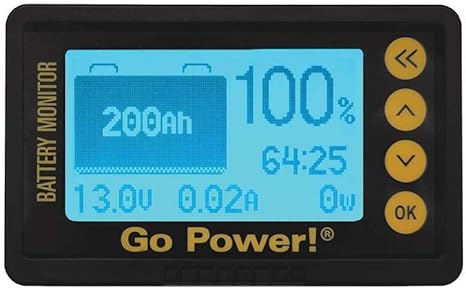
What I would suggest is installing a Battery Monitor System, which is an LED display that shows the charge coming in from either a charger such as your inverter or a solar panel. It will also show the state of charge (SOC) of your batteries so you know exactly what is happening. I recommend the Go Power! model available on Amazon here.
You might also enjoy these posts from Dave
- Can lithium house batteries jump-start an RV engine battery?
- How safe is it to store lithium batteries in an RV?
- Technical follow-up on lithium battery storage in an RV
- Will my RV’s charger be sufficient for new lithium batteries?
Dave Solberg is a leading expert in the RV industry and the author of the “RV Handbook.”
Read more from Dave here.
HAVE A QUESTION FOR DAVE?
Send your inquiries to him using the form below.
RVDT2636

So many typos/errors. This is the first;
” It started with a bulk charge of about 16 volts to break up sulfation for several hours, then an equalizing charge, then a float charge.”
‘Equalization charge’ is a high voltage charge of 15.5-16V (not bulk as stated) meant to break down the crystalized lead sulfate called ‘hard sulfation’. This high voltage causes excessive water loss in LA batteries so inside the charger microcontroller, there is a lockout timer that prevents equalization from occurring more than ~1x/month. IF a LFP battery were to be hit with above a 14.6V charge, the BMS would likely disconnect it relatively quickly for an ‘over voltage’ alarm.
Second;
“If your inverter has the charge profile set to the 6-volt battery setting, the high voltage of the bulk stage charge is too much for your lithium batteries and the BMS will shut down.”
(almost certainly) This is a 12V system, not 6V. The charger in the inverter can’t be set to 6V. The only reason he mentioned 6V was because he used 6V golf cart batteries which HAD to be series connected into a 12V system to work. Other than this, there is nothing about the prior system configuration or the current one that 6V is relevant.
Third;
“ My guess is the inverter is kicking on at bulk and the BMS is shutting down.”
The only way a charging event could cause the BMS to shut down is; a) Over voltage or b) over current. Over-voltage shutoff would not result from a correctly operating charger other than possibly an attempt at equalization charging. If there was a starting voltage surge event, there is likely a problem with the charger AND, the BMS will probably reconnect after a short timeout and would likely continue attempts till successful. Over current would have to be more than 400A (LFP batteries typically allow 1C charging and the batteries are 400Ah). Its unlikely a charger can provide even half of that.
Thank you? Dave! Seems that a 1999 is unlikely to have a customizable charging profile that works with lithium batteries. Thanks again and have a great week!