


Dear Dave,
I would like to start by saying I like reading your newsletters and website. They contain lots of information that’s very helpful to me.
I have been RVing for about 20 years in a 32′ Class A motorhome, but only for a couple days to a month at a time. I usually am at campgrounds that have full hookups, so batteries haven’t been an issue (until my converter went out).
My questions have to do with the batteries when it’s time to replace them. I have sealed lead acid batteries (two house, one starting).
1) Everyone seems to be changing to absorbed glass mat (AGM), lithium, etc. Since I don’t boondock, what do you recommend when it comes time to replace my current batteries?
2) My assumption is that the starting lead battery needs to stay? If so, if I change to something other than lead for the coach batteries, can I still use the battery booster if needed to start the engine? if not, would I need a different type of battery than the ones for coach?
Thank you for being there. —Carla Rose
Dear Carla,
You did not indicate whether your Class A motorhome was gas or diesel. However, you did indicate it only had one start battery so I assume it is a gas model. I do think staying with a maintenance free start battery with good cold cranking amps (CCA) would be best for your engine battery.
Lithium batteries
As you mentioned and also as was stated in a recent post, lithium has become a “craze”. I see more owners simply swap out FLA batteries without thoroughly reviewing their system. We have discussed this many times in previous posts and talked about lithium batteries being able to crank over an onboard generator. And you bring up a good point on “jump-starting” a motorhome using the house batteries.
Before I get into that, let’s address the type of battery that I feel would be best for your application. You state that currently you have “sealed flooded lead acid batteries,” which I assume would be the cheaper auto parts store brands I see quite often.

These batteries are not the best option when it comes to powering most RV needs and can result in sulfation, which is what I believe happened in your case. If the battery becomes sulfated, and it could have been the previous batteries, the converter senses low battery power and runs at the full charge stage of 13.6 volts all the time. This could lead to the converter failing eventually.
Recommend FLA or AGM battery for this use
Since you don’t plan to boondock or dry camp much, you would not see much benefit from lithium batteries and the extra expense. Therefore, I would recommend a good FLA battery such as the NAPA brand #8231 used by Winnebago, or an AGM battery. That would have sufficient power for occasional dry camping and reduced sulfation, and would be much more cost-effective. This will last longer and not require your converter to operate at maximum voltage.
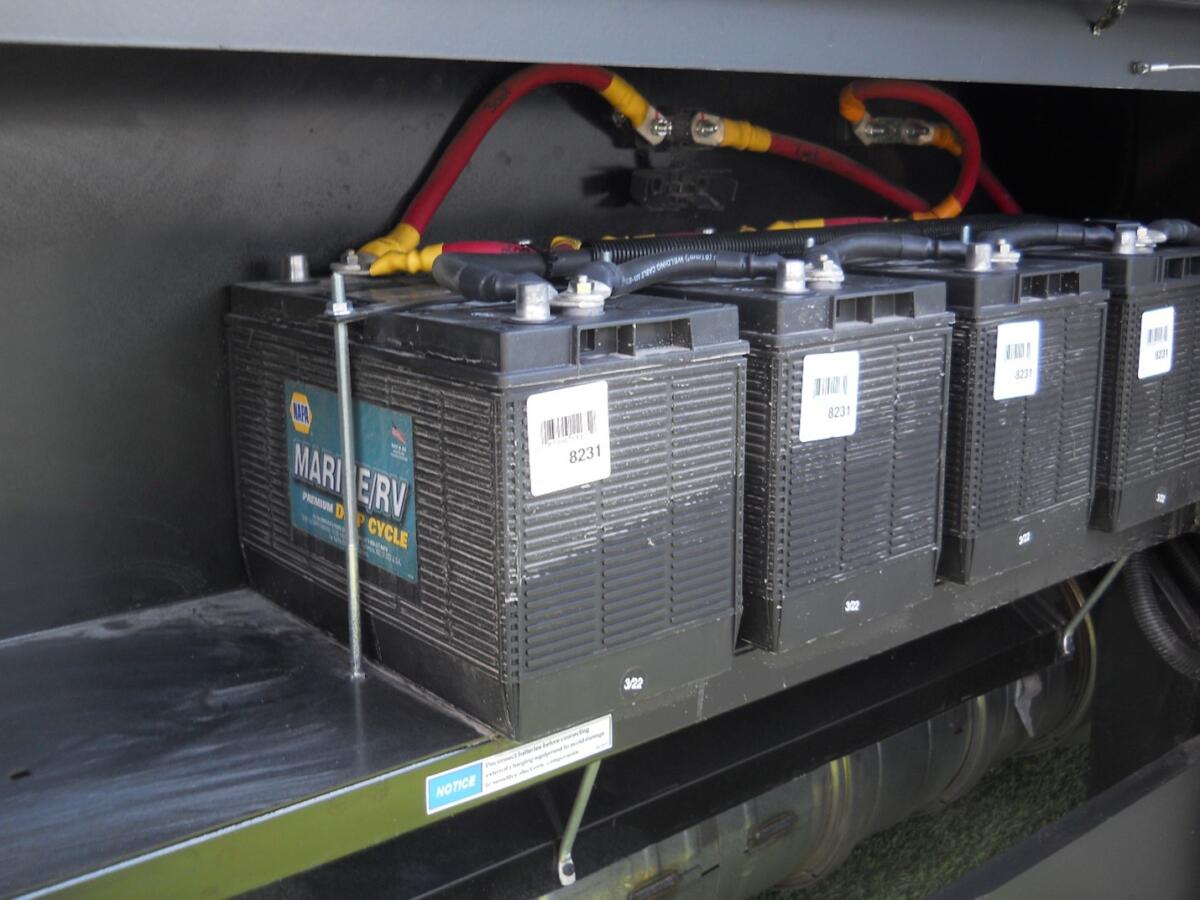
However, you did bring up a good discussion point regarding lithium batteries and the ability to provide enough cold cranking amps (CCA) to start an engine. Most motorized units have a start battery rated in CCA to provide high-voltage cranking power for 30 seconds. Most deep cycle batteries are designed to provide a constant voltage over a longer period of time. There typically is a solenoid called the battery isolation manager (BIM) that controls voltage from the engine charging system and the alternator to the house batteries. It also provides a “jump-start” to the engine battery from the house batteries.
So I sent your question to a few of my lithium battery tech contacts and got some interesting information on not only the battery’s ability to provide CCA but also the BIM that should be matched with new lithium batteries.
Comment from lithium battery tech
Thank you. It probably depends on what cranking amps is required to start the device (vehicle, generator) and how many batteries are installed in the coach. Lithium batteries will have a max current output on each battery that the battery management system (BMS) will shut off if exceeded.
The more batteries, the more current that can be provided. As an example, a single 100 ah battery can output 150 to 175 amps for a given period of time (15-30 min.). Anything above these amounts, the battery would shut down. (BMS shuts battery down to protect the battery.)
Two batteries would be double this amount. If the amps needed to start a device is over this rating, the battery would shut down and the device would not start.
Comment from another battery tech on battery isolation manager
Another contact suggested the battery isolation manager (BIM) needs to be replaced to match the lithium batteries.
It really depends on how many batteries you have in the system. But if you have minimum of four batteries, which is pretty typical for a motorhome setup, you can jump-start the engine batteries in a pinch. With the BIM, this is really the only way to do that safely, as well. So if they do switch to lithium, they will want to upgrade the BIM to the lithium version. Here is a link to the BIM we recommend.

Description of the BIM
If the coach battery resting voltage exceeds 13.4 V, then the BIM will disconnect. A resting voltage greater than 13.4 V indicates a fully charged battery. Note that “resting voltage” means that no current is flowing to the coach battery.
The BIM will disconnect if the alternator voltage exceeds 14.4 V. This protects the coach battery from overcharging. The LiFePO4 Battery Isolation Manager will disconnect if the voltage difference between the alternator and the coach battery is less than 0.1 V. If the voltage difference is too low, then there is a negligible charging current, and no need to connect to the coach battery.
The BIM will disconnect if the alternator voltage drops below 13.3 V. If the alternator voltage is too low, then it cannot adequately charge the coach battery, so there is no reason to connect.
Another example of doing your homework before swapping out FLA batteries with lithium.
You might also enjoy this from Dave
Will my RV’s charger be sufficient for new lithium batteries?
Dear Dave,
I switched from two regular batteries to two LiFePO4 batteries. I have a 2020 Salem Hemisphere 26BHHL trailer. Can my trailer converter maintain/charge these batteries? Also, can I cut a hole in the floor in a remote area for a small 4-inch computer fan to shove extra heat under the floor to keep the lines from freezing? — Jim, 2020 Salem Hemisphere 26BHHL
MORE POSTS FROM DAVE ON RV BATTERIES
- Is one 300 Ah lithium or three 100 Ah batteries better? What size converter?
- Will WFCO Auto Detect charge RV’s lithium batteries?
- Will WFCO Auto Detect charge RV’s lithium batteries? —Part 2
- Can different type and age RV batteries be mixed? Can I add a lithium battery?
- Everything you need to know about charging RV batteries
Dave Solberg is a leading expert in the RV industry and the author of the “RV Handbook.”
Read more from Dave here.
HAVE A QUESTION FOR DAVE?
Send your inquiries to him using the form below.
##RVDT2615

Another very informative battery discussion Dave, thanks!