

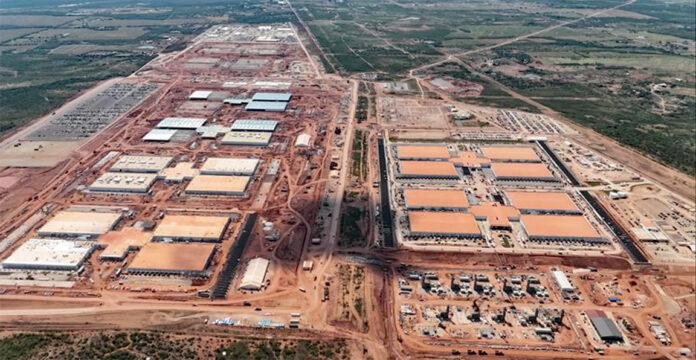
If you’ve been wondering why some RV parks seem unusually full, the answer may have nothing to do with vacation travel. In some parts of the country, America’s booming data center construction industry is creating unexpected demand for campsites.
In Eastern Iowa, some longtime campers say they’re finding favorite RV parks filled—not with vacationers, but with workers helping build massive new data centers. Many are living in motorhomes and fifth wheels for months at a time while the projects are underway.
It’s a local story, but it may point to a broader trend that RVers could begin seeing in other parts of the country.
When workers become long-term campers
A recent report by Iowa television station KCRG found that several campgrounds near Cedar Rapids are operating at or near capacity because of workers building nearby data centers.
One campground owner told the station that about 85% of the park’s sites are occupied by construction workers. Some are expected to remain for several years as additional phases of construction continue.
That’s made it harder for some traditional campers to find space, even during holiday weekends.
For the workers, the arrangement makes sense. Many travel from state to state following large construction projects. Bringing an RV or fifth wheel is often less expensive than renting an apartment or staying in hotels for months at a time.
Iowa isn’t the only place
While the Iowa story focuses on one region, similar housing pressures are showing up elsewhere as artificial intelligence fuels a nationwide data center building boom.
In Texas, where several massive AI-related data center projects are under construction, developers have proposed large RV parks and other temporary housing specifically to accommodate construction workers because existing housing is limited.
Wyoming is facing similar questions. Officials near Cheyenne have debated temporary workforce housing—including RV spaces—to support thousands of workers expected during construction of multiple large data centers.
Those examples suggest RV parks are increasingly becoming part of the temporary housing solution in communities experiencing major industrial growth.
Why RV parks?
Building a hyperscale data center can require thousands of workers over several years.
Hotels often fill quickly. Apartments may already be scarce. In many rural communities, there simply isn’t enough housing to absorb a sudden influx of workers.
For many traveling electricians, pipefitters, heavy equipment operators, concrete crews, and other skilled tradespeople, an RV provides a practical alternative. It offers flexibility, lower costs, and the ability to move to the next project when construction wraps up.
For campground owners, long-term guests can also provide steady occupancy during times that might otherwise be slower.
“The reason a campground is full isn’t always another family on vacation. Sometimes it’s because the nation’s newest technology projects are bringing thousands of workers—and their RVs—to town.”
That doesn’t necessarily mean parks are choosing workers over vacation campers. In many cases, demand is simply high enough that parks fill the sites that whichever customers reserve first. Makes good business sense.
What it means for us “normal” RV travelers
Most RVers probably won’t notice any difference.
But if your travels take you near communities experiencing large-scale industrial construction—especially new AI data centers—you may encounter tighter campground availability than you expected.
If you’re planning a trip to one of those areas, it may help to:
- Reserve campsites farther in advance than usual.
- Call campgrounds directly instead of relying only on online availability.
- Keep one or two backup camping options in mind.
- Consider nearby state parks, county parks, or public campgrounds if private RV parks are full.
The reason a campground is full isn’t always another family on vacation. Sometimes it’s because the nation’s newest technology projects are bringing thousands of workers—and their RVs—to town.
Sources
KCRG-TV9
Morning Brew
The Wall Street Journal
RELATED
- Data centers are creeping closer to RV parks, campgrounds—and bringing noise with them
- Iowa campers squeezed out as data center workers fill RV parks year-round
- Will campsites fill up this summer? Early bookings offer a clue
- Campspot names top 10 campgrounds for 2026
- AARP recommends best campgrounds along America’s most iconic drives
- How to automate RV campsite bookings for 2026 to get hard-to-book spots
RVT1269b

And what about the “quality” of those “transient” campers. I bet there will increased law enforcement costs and school costs also. What will be left behind when construction is done?