


By Mike Sokol
Dear Readers,
This is a continuation of a previous article where I discussed the possible spots to place a RV battery disconnect switch. Well, I had more than a dozen readers ask the next logical question about how does putting 6- and 12-volt batteries in various series, parallel and series parallel arrangements cause the voltage and amperage to add up. So I modified my previous graphics a bit, and here we are.
 While it’s certainly possible to create a bank of more than four batteries, for the purposes of this article we’ll stick with 1-, 2- and 4-battery hookups.
Let me note right up front that working with batteries can be extremely dangerous, and not from heart-stopping shocks like can occur with 120-volt circuits. No, it’s the amperage that can get you, either by welding and heating up to cherry-red temperatures anything that gets between your wrench and frame, such as your wedding ring. As I’ve noted before, I witnessed this up close and personal in a car repair shop when I was a kid. No, it wasn’t me, but the other mechanic on duty at the time.
Alternately, you can have a battery explode in your face if you short it out with a big wrench. So if you’re not comfortable taking the proper safety precautions, please hire a professional.
First, a quick review of the two battery parameters we’ll discuss today: voltage and amp/hour capacity. Voltage is simple, since it’s just a measure of electrical pressure and your RV wants 12 volts. Nope, 6 volts won’t work and 24 volts really won’t work. We’re looking for 12 volts to power our DC systems, so that’s what we’ll cover here.
Amp/hour (Ah) capacity is basically how many amperes of current a battery can supply for an hour. So a 100-amp/hour battery can supply 100 amperes of current for 60 minutes before it’s totally exhausted. But you don’t want to discharge your expensive batteries much below 50% of capacity or you’ll really cut down their life span. So a 100-amp/hour battery has about 50 amp/hours of current before it’s been depleted to a safe level.
 Here’s the basic single 12-volt battery that probably came with your RV. Doesn’t matter if it’s a flooded-cell, AGM or Lithium battery, the series/parallel equations work for all of them (but a Lithium battery can be discharged down to the 20% level before it’s damaged).
Yes, it’s rated for 100 amp/hrs at 12 volts, so your RV electrical system is happy. However, this may not be enough run time of your residential refrigerator or microwave when boondocking (operating without hookups), so many RV owners opt for adding more batteries.
 In the second example we simply add another 12-volt battery that has a 100-Ah capacity in parallel with the first battery. And you can see that the 12-volt potential stays the same, but now there’s twice as much amp/hour capacity. It’s like carrying a spare gas tank for your RV that doubles the amount of fuel. In this case you’re doubling the amount of available electrons to do work. Hence, a pair of 12-volt/100-Ah batteries in parallel become a 12-volt/200-Ah battery bank. Still with me? Now it gets a little more complicated.
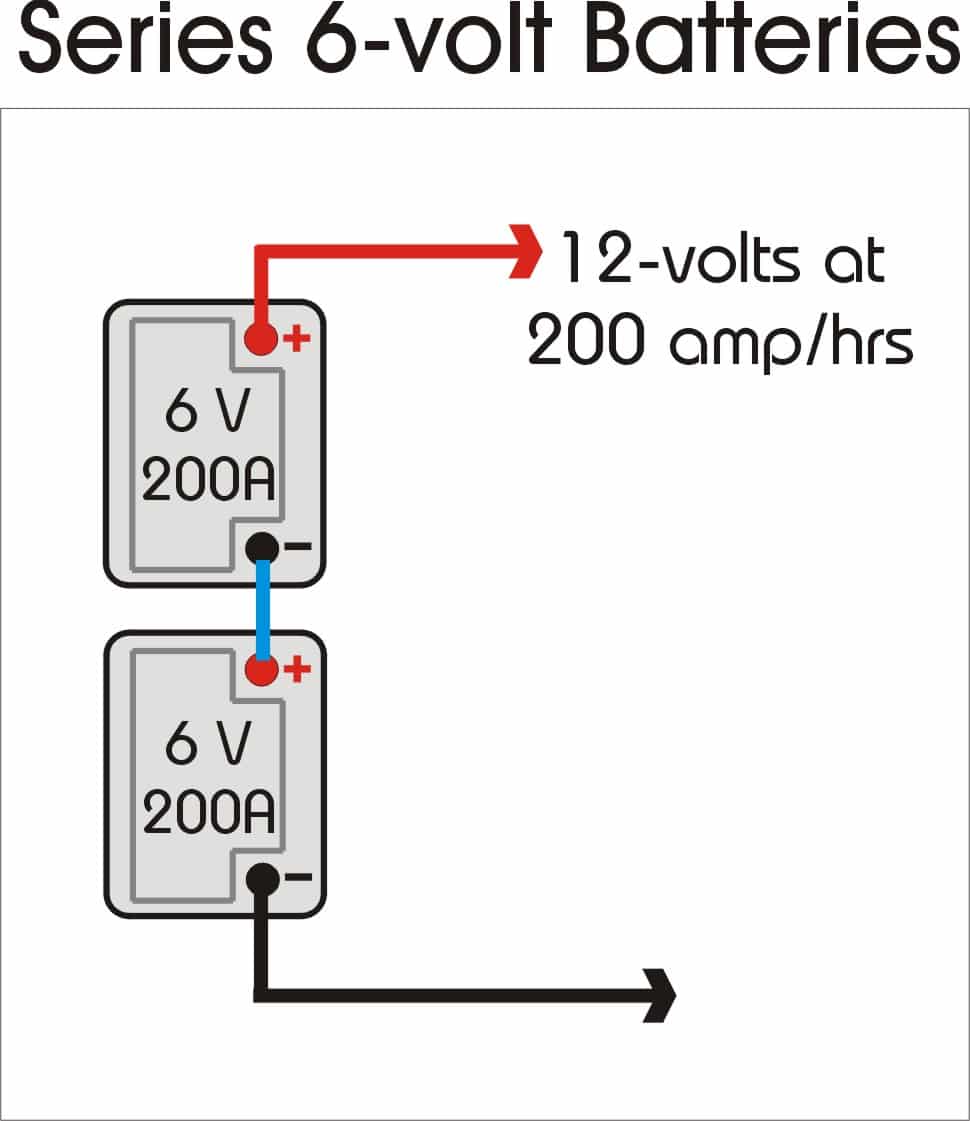 What if we take a pair of 6-volt batteries that are rated for 200 Ah each and want to make them produce 12 volts instead of 6 volts. Well, you just stack them up in series like D-cells in a flashlight. And the voltage does indeed add up, so 6 volts plus 6 volts equals 12 volts of potential. However, the total Ah capacity does not add together, it stays the same as a single 6-volt battery. So in our example the two 200-Ah batteries in series make 12 volts, but the amp/hour capacity remains at 200 amp/hours. But that 200-Ah capacity can double the run time of your appliances compared to the single battery that came with your RV, so it’s good thing.
 Finally, let’s assume you’ve won the lottery and just bought four 6-volt batteries with 200-Ah capacity each. As you can see, first we stack a pair of them in series to create 12 volts of potential, then put the series stack in parallel so the Ah capacity doubles. So four of the 6-volt, 200-Ah batteries become a 12-volt/400-Ah battery bank with 4 times the capacity of the original single 12-volt battery that came with your RV. Of course, you also need room to mount them, etc., but that’s not part of this article.
This article was originally posted on RVtravel.com in August, 2019
Comments have been closed
Mike Sokol is an electrical and professional sound expert with 40+ years in the industry. His excellent book RV Electrical Safety is available at Amazon.com.
##RVDT1156;##RVT912


This explanation helped me a lot… I understand something of the hook up of the batteries and amperidge much more now than I ever did although I’ll probly not be able to repeat it tomorrow
Rita, should we send you a test to see how much you retained? (Just kidding…)
A friend told me to run our tv ect. use a 1200 volt inverter from my 2 inline batteries instead of my noisy generator. will this drain my batteries quickly ?
Is there a benefit to two 6v verses two 12v
Loved the picture of the burnt ring. I started an apprenticeship in the electric forklift industry in the early1970s. ! 1st & longest trainer I worked with was a WW2 vet whose job was keeping the lights & power going in bombers over Japan. 1st thing I learned was watches & rings in the toolbox. If asked why he would show you his arm tattooed from from a Spandex wristband-XXXs all the way around! That’s what happens when you find hot terminals! Retired now but demanded the same of all my trainees.