


Dear Dave,
My RV’s refrigerator has two outside vents. The top vent has a piece of board just inside the cover. Is this normal? Picture attached. —Richard, 2023 Forest River FR3 34DS

Dear Richard,
Since you indicate the refrigerator has two vents and the “top vent” in the picture is on the side, that indicates your refrigerator is in a slide room as there could not be a top or roof vent like a traditional floorplan.

Here is an example of a Sunstar that has a refrigerator in the slide room. The lower vent cover is the intake air and also access to the control module, gas valve, burner assembly, and other operation components of the refrigerator. Also, since your RV has the two vents, it has an absorption refrigerator that runs on either propane or 120-volt power.
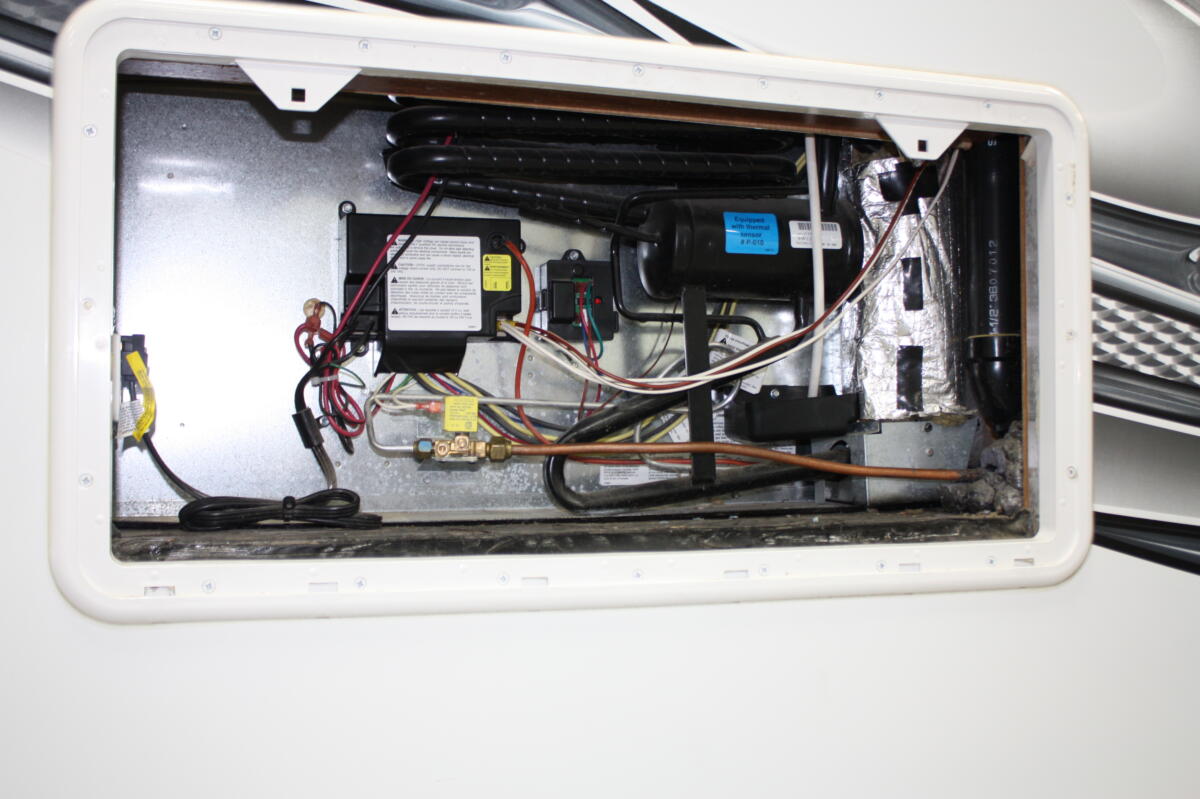
Here is a photo of what the lower vent should look like with the cover off.
The brochure for your 2023 FR3 34DS shows a Class A Ford F53 gas chassis and a 12-cubic-foot (CF) Norcold absorption refrigerator standard. This refrigerator was in the driver side slide behind and to the left of the dinette. There is no option listed for a residential or 12-volt compressor-type refrigerator.
How a standard absorption refrigerator works
Your standard absorption refrigerator heats a rich liquid solution of ammonia, hydrogen, water, and sodium chromate—either by a flame on the propane mode, or heating element on 120-volt power—to create a vapor and other chemical reactions that we won’t go into. However, what happens is the heated solution and vapors travel through the cooling unit at temperatures above 200 degrees. That heat needs to be removed from the back of the refrigerator compartment or the vapors will not return to a liquid and then return to the bottom of the cooling unit and continue the cycle.
Since heat rises, the lower air vent allows outside ambient air to enter, which will always be cooler than the hot air in the back of the refrigerator compartment. This air is naturally drawn in and flows up over the cooling unit coils and helps cool the solution in the lower section of the cooling unit.
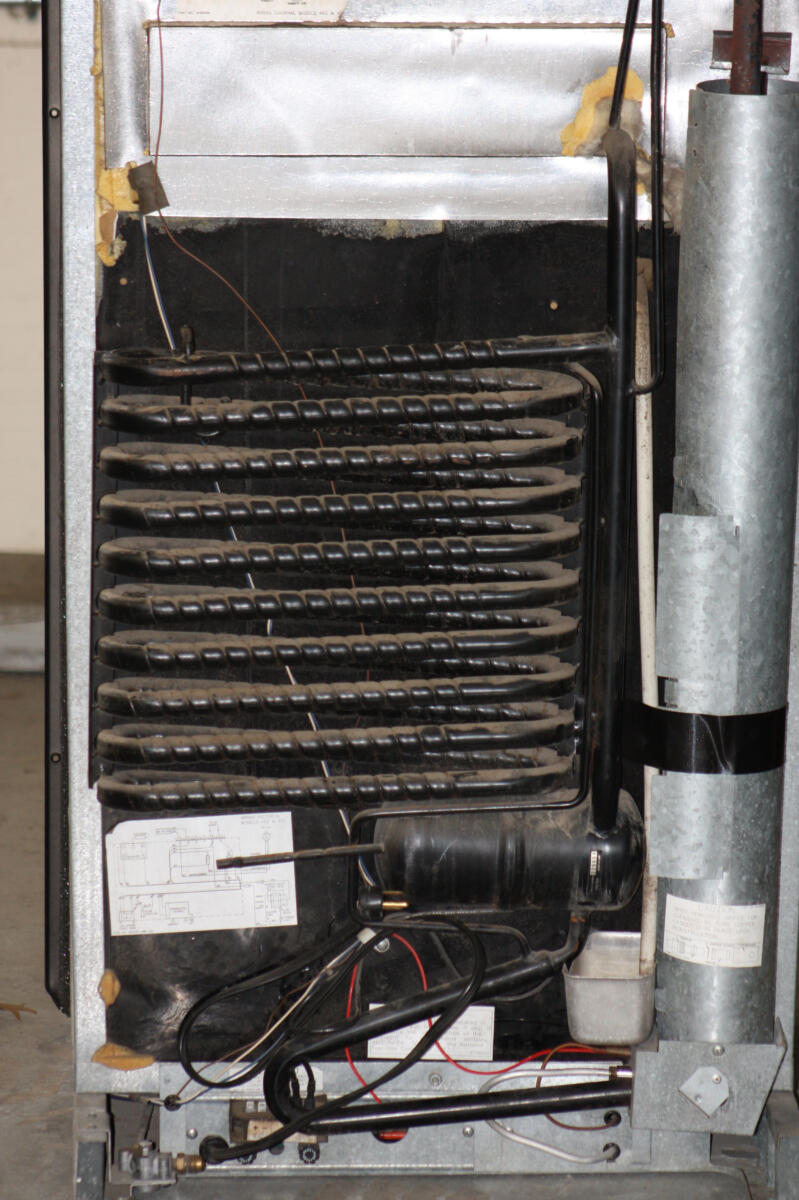
The vent at the top of the slide room allows the hot air to exhaust or vent as the airflow from the lower vent enters and is drawn up to the hotter air. When the refrigerator is in a kitchen floorplan without a slideroom, the back of the refrigerator is open to the ceiling and the vent is on the roof. This, in my opinion, allows a superior airflow design and allows the heat to exhaust and the refrigerator to perform more efficiently.
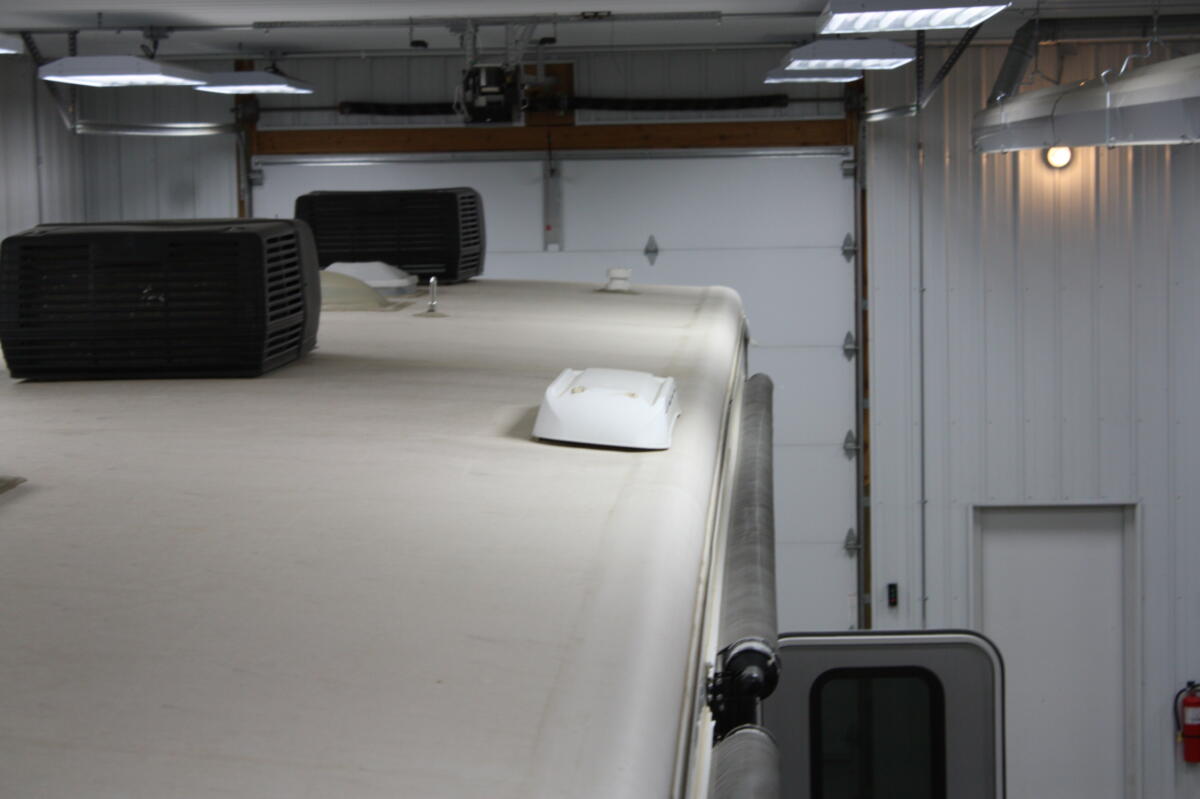
Placement of vent for refrigerator in slide room
Since your refrigerator is in the slide room, obviously the vent cannot go straight to the roof and cannot be mounted to the roof of the slide room since it might be operated when the slide room is retracted. So those models need to have the vent on the side of the slide room wall. Some manufacturers add 5” fans to the top of the cooling unit to help pull outside air in from the bottom vent, over the cooling unit coils, and out the side vent.
If your unit still has the standard absorption refrigerator, the panel installed in the upper vent should be removed as it will block the exhaust and should not be a factory installed item. However, I have learned to never say never. Someone could have installed this thinking they were helping to reduce moisture leaks, maybe?
The only other reason to block the upper vent opening is if there was a 12-volt compressor-driven or residential refrigerator installed that did not need the venting. According to the brochure and all the info I have found, this was not a factory option—so it might be a dealer modification.
If your rig does not have the absorption refrigerator, but rather has a 12-volt or residential fridge, then the upper vent would not be needed and should be blocked. However, I do not know why they would leave a gap at the top rather than blocking the entire opening to prevent water from coming in. It is sometimes a strange industry we’re dealing with!
You might also enjoy this from Dave
Replaced RV’s absorption refrigerator with a 12-volt; remove vents?
Dear Dave,
I last wrote you about replacing my old Norcold fridge. I went with your suggestion of a simple 12V DC option from Norcold for two main reasons. First, it fits. 🙂 Second, I have eight 200-amp wet batteries, a good solar charger, and two huge 4×8 solar panels—so I have the power. I replaced my hot water tank system with a tankless one and now I am wondering about the roof vent which was for the fridge (and maybe the hot water, not sure) when running on propane.
So, my question is: Now that I have tankless hot water and soon a 12V DC fridge, what about the huge vent on top of the roof? Should I just leave it? Should I cover it over? Or do you have a suggestion? As always, thanks Dave. —Larry, 1996 Winnebago Luxor
Dave Solberg is a leading expert in the RV industry and the author of the “RV Handbook.”
Read more from Dave here.
HAVE A QUESTION FOR DAVE?
Send your inquiries to him using the form below.
##RVDT2421

If it was this way when new, someone removed the top vent. I see no reason to remove or block the top vent if a compressor unit is installed.
BTW, heat does not rise, HOT AIR produced by the heat does.
While I agree with Dave about absorption vs compressor, I’d like to speculate on another ‘why’ assuming the refrigerator is absorption. In our slide room dual absorption frig installation there is a panel installed at a 45° angle above each frig. The goal is to direct heat to the upper side vent rather than flowing up to the slide room roof. While I won’t discuss whether or not this panel adds any value to heat exhaust, it might be that the panel blocking most of Richard’s vent has slipped out of place. It was supposed to be at a 45° angle.
Sometimes a baffle is added such as in the picture to direct convection air through the coils and prevent the air flow going around instead. Obviously that baffle is blocking too much of the vent. Nevertheless installing an absorption refrigerator in a slide makes for a terrible installation and shouldn’t be done. I would never buy a unit with the refrigerator in a slide.
With a 4 slide MH, where do you propose to put the refer? Our refer is in the kitchen slide and performs flawlessly. In fact, it rarely gets above 36 degrees on the lowest setting on a 90 degree day. Tiffin installed it correctly.
Thank you, Dave! 🙂 Always much that can be learned here, and today is no exception! Thanks again, have a great week, safe travels, amd safe stays! 🙂
This is the way that the refrigerator manufacturer shows how the baffle should be installed. The installation instructions list a specific dimension above the fins for the baffle to be installed when in a slideout.
Why would you say the upper vent is not needed?
you still have heat of compression even with a compressor fridge. It may not be nee ded but it certainly won’t/can’t hurt