

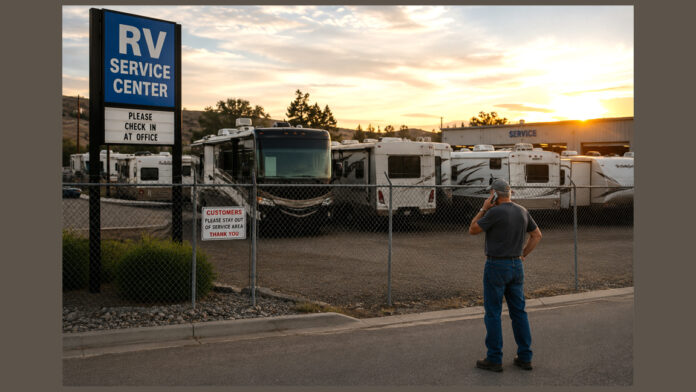
RV repair delays have become so common that many owners almost expect them now.
The rig goes into the shop for what sounds like a simple repair. A refrigerator issue. Slide problem. Air conditioner failure. Maybe an electrical gremlin nobody can quite pin down.
Then the waiting starts.
A week becomes three weeks. Three weeks become two months. The RV sits in the same spot behind the service fence every time you drive by. Phone calls start sounding familiar. “Waiting on approval.” “Waiting on parts.” “Waiting to hear back from the manufacturer.”
And somewhere in the conversation comes the explanation most RV owners have heard by now: There are not enough technicians.
That may be true. But one mobile RV repair company says the industry’s service headaches go a lot deeper than simply not having enough people turning wrenches.
In a recent guest piece published by RVBusiness, an independent mobile RV technician argued that many RV repair delays actually begin long before a technician ever starts the repair itself. The bigger problem, she says, often involves warranty approvals, manufacturer paperwork, parts bottlenecks, incomplete documentation, and a repair system that has become increasingly tangled as RVs grow more complicated.
And, honestly, a lot of RV owners will probably read that and think: “Yeah. That makes sense.”
Why modern RV repairs can bog down so easily
Anybody who has owned a newer RV for very long already understands how many companies are packed into one coach.
The RV manufacturer may have built the unit itself, but the refrigerator came from one supplier. The leveling system came from another. The air conditioner from somebody else. Add in solar gear, inverters, electronics, slide systems, tank sensors, multiplex controls, lithium battery systems, water heaters, and smart app connectivity, and suddenly, troubleshooting one failure can involve a small army of vendors.
That is part of what makes modern RV repair feel so different from a few years ago.
The actual hands-on repair might only take a few hours once somebody finally gets authorization, finds the part, confirms who is paying for what, and tracks down the documentation needed to diagnose the problem in the first place.
“Sometimes the actual repair only takes a few hours. The waiting is what eats up the calendar.”
Meanwhile, owners mostly just see the calendar pages turning.
Why “technician shortage” may not tell the whole story
That disconnect may explain why so many RVers get frustrated hearing the phrase “technician shortage” repeated over and over.
Because from the customer side, it often does not look like anybody is actually working on the RV at all.
And, to be fair, dealerships really are struggling to hire and retain qualified technicians. That part is real. RV systems have become far more complex than they used to be, and finding people who can troubleshoot electrical systems, solar charging, inverters, smart controls, and appliance integration isn’t easy.
But the piece argues that the industry may be oversimplifying the problem when nearly every repair delay gets blamed on staffing shortages alone.
A lot of the slowdown, the tech says, happens in the background. Warranty claims. Photos. Emails. Approvals. Questions bouncing between manufacturers and suppliers. Waiting for parts. Waiting for responses. Waiting for somebody to decide who covers the bill.
RVers have seen enough of it by now that many have simply adjusted their expectations downward.
Why mobile RV repair keeps growing
That may also help explain why mobile RV repair has exploded in popularity.
A growing number of owners would rather pay somebody to come out to the campsite than leave the RV sitting at a dealership for weeks waiting to move three spaces forward in line.
Not every repair can happen that way, obviously. Some larger warranty jobs still require dealer involvement. But many RV owners have discovered that smaller independent repair operations and mobile techs can sometimes move faster simply because they are working through fewer layers of scheduling and authorization.
And increasingly, owners are learning to do at least some troubleshooting themselves. Not necessarily because they want to become part-time RV technicians, but more because they are tired of losing the camping season while waiting for an appointment.
That is probably one reason RV repair YouTube channels, owner forums, and Facebook troubleshooting groups (like RVtravel.com’s, with more than 100,000 members) have become so popular. Many RVers no longer assume the dealership will always be the fastest—or even the best—source of answers.
Why RV owners increasingly feel they are on their own
None of this means the RV industry is uniquely bad. Modern vehicles, boats, farm equipment, and even home HVAC systems have all become more electronic, more specialized, and more dependent on supply chains and manufacturer support.
But RVs may be especially vulnerable because they combine so many different systems from so many different suppliers into one rolling package that also bounces down the highway like during an earthquake every time it moves.
That reality may be why the “technician shortage” explanation no longer fully satisfies many RV owners.
From their perspective, the real problem often feels bigger, messier, and far more complicated than simply not having enough mechanics in the shop.
Source:
RVBusiness guest commentary
RELATED
- Diesel technician shortage could mean longer waits for RV repairs
- RVers discuss the pros and cons of using truck shops for RV repairs
- RV transporter spills the truth: ‘Dealers don’t do repairs until RV is sold; If buyer doesn’t point it out, it doesn’t get fixed’
- Hard to trust RV dealers’ service work. Camping World returns RV with mouse nest
- How capable are you or your partner in making repairs to your RV?
RVT1261b


I’m glad my RV is out of warranty – that way, I can usually fix it myself, find the right parts the first time, and not depend on anybody else. If I can’t do it, I’ll find a mobile mechanic that can, and again, I’ll find the right parts and have them waiting on him when he shows up. I don’t trust the dealers to have my repairs done in a timely manner or to tell me the truth for any questions I may have. Unfortunately, if you’re not somewhat handy, an RV can be a real can of worms. Sad state of affairs.
US public schools still educate for going to college instead of Tech Schools. Car dealers, agriculture tractor dealers, truck stops, all are short mechanics. We’re short electricians, plumbers, welders, heavy construction equipment operators, etc.
The rise of mobile RV repairmen is filling that void. It would be helpful if the RV industry would supply wiring diagrams with every model produced. Same goes for plumbing.
Some of the challenges are of our own making. RVs have so many frill options making them complex.
More support for my position of not ever buying a new RV. Our latest ‘new to us’ is only a couple of years old so that’s close enough. And the previous owners filled us in on their warranty headaches.
Had my 1st manufacturer RV warranty claim a couple years ago. Gulf Stream advertises a 3-year structural warranty, but declines to explicitly define ‘structural’. Tried to say an exterior wall panel falling off wasn’t ‘structural’. It took months to settle the claim. And for only about 1/3 of my actual repair cost at an authorized dealer. I paid in advance so my RV was not held hostage. According to the manufacturer, the dealer could have done it for pennies on the dollar during a coffee break. The biggest problem with warranty repairs isn’t necessarily the dealer’s garage. It is the worthless paper the manufacturers provide with rigs and no responsibility for shoddy assembly in the factory
After dealing with warranty work at a local Camping World and body repair work from a tire blowout at a small business RV shop that took weeks in both cases, I will use a mobile RV tech to repair our RV (even if it is sitting at our home) if I can’t do it or figure it out myself. YouTube has helped me diagnose and repair many problems and upgrade our RV.
If all new repairs require warranty approvals and all used repairs required insurance approvals, I could agree to the significance of approval delay but that doesn’t explain the larger percentage of repairs that require no outside approvals.
Unfortunately, the shortage of competent Service Managers creates the senseless mismanagement of technicians, bay scheduling, parts procurement and work order processing.
“Waiting” is just a fancy word for “Doing Nothing” and the number of units waiting is testimony to how well a Service Manager embraces doing nothing….
This is the primary reason why we’ll never buy another RV. RV dealer service sucks. Cummins service sucks too, but that’s a different story. Our 10 year old campervan has the bugs worked out. I know it inside out, and I, or my trusted local mechanics and techs can fix/replace anything on it. Should outlast us at this rate. If it’s totaled, we’ll switch to other forms of entertainment. RV life has been good, but there are other ways to enjoy life out there that just as good or maybe even better as we age.
I bet that every RV owner has their version of the waiting game. Our local Spartan service center, that also charges an hour of labor ($240) for any warranty approval, got us an appointment for routine maintenance only to find out it’s really just a place in line. The actual service won’t occur until later. We worried about our batteries while waiting. Seeing a row of electrical hookups, I asked about plugging in the MH and was told that costs $50/day. “Can I bring it back when you’re ready to service it,” I asked. “Then, you would be placed at the end of the line and you would still have wait,” they answered. Needless to say, we won’t be going back unless there’s no other alternative.
We were blessed, last summer on the way to the York, PA Airstream Rally, we made a reservation at the Mothership service department for a plumbing and gas hinges situation. On a country road, a truck was driving the opposite way on the center line, so I swerved to the right, and scraped the guardrail, damaging my lift mechanism. We called in our problem, visited the Mothership, and the Technician said “be here before 8 AM.” All the repairs were finished by 3 pm. The Technician reminded us, this is the factory, we have all the parts, we have a machine shop that can build anything that ever went on an Airstream, and we have all the blueprints from day one. Trouble is, they are in Ohio, and we aren’t.
While it is true that an RV is subjected to bouncing and twisting, so is a car and it doesn’t fail or fall apart. Electrical and some mechanical equipment built for the military and space are secured to shake tables and subjected to various amplitudes and frequencies. They pass or fail. Failure requires rework or redesign.