

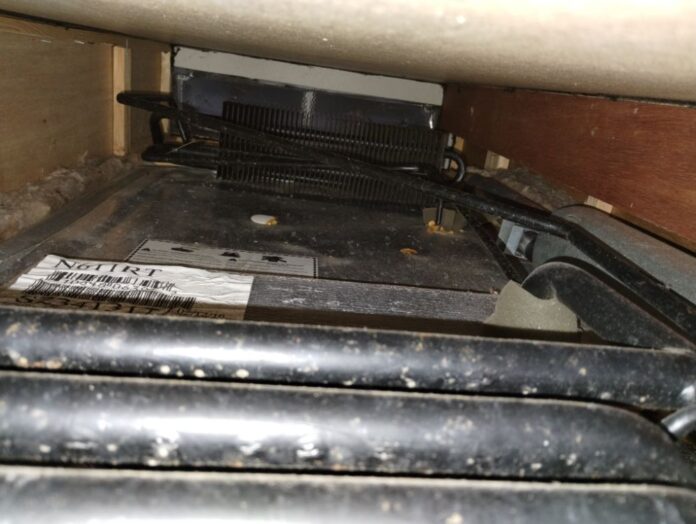
Two- and three-way RV refrigerators (propane/electric) require airflow. This is common knowledge to most RV technicians, but it’s often unknown to consumers and overlooked by the manufacturers (cough, cough).
Fair warning: I do sling around some technical language in this post, which I’ve italicized for your benefit, but you don’t need to memorize all the terms to get the main point: Airflow is critical, and it’s a straightforward (but time-consuming) DIY fix.
It’s all about the airflow! More airflow = more cooling
RV absorption refrigerators depend on heat dissipation. The ammonia refrigerant absorbs heat from your freezer and refrigerator compartments and exhausts that heat through your absorber coils and condenser fins. Ambient air traveling up and across the backside of your refrigerator transfers that heat to the ambient air. It’s all about the airflow!
Without airflow, the system doesn’t work. Without airflow, you get a warm refrigerator, an iced-up freezer, and eventually a failure of the entire cooling unit due to blockages from an overheated boiler.
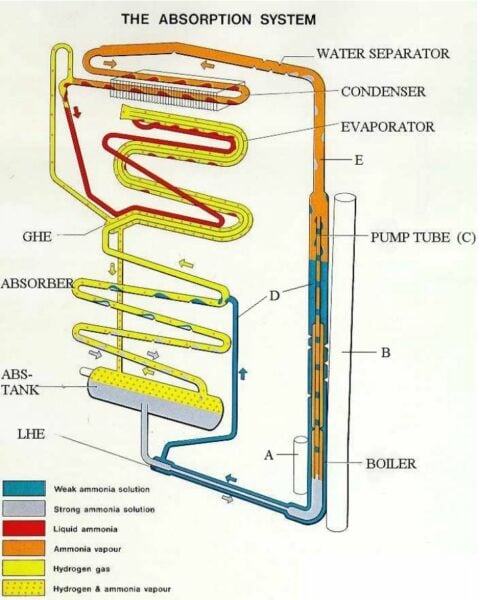
You don’t want to know how much it costs to replace your 3-way refrigerator (absurdly expensive) or to repair the cooling unit (not as expensive, but still painful). I quoted one double-door 3-way RV refrigerator replacement with a $7,000 MSRP! It’s one of the most expensive appliances to repair on your RV. So let’s avoid it, shall we?
As I said, airflow is critical. Most RV refrigerators rely on convective free air flowing over the cooling unit. Heat rises, remember? Therefore, refrigerators have a lower sidewall access vent and an upper vent, which encourages airflow through the stack effect. In a conventional installation, the upper vent is through the roof; in a slide-out, the upper vent is on the sidewall.

In a slide-out installation, the shorter vertical distance between the two vents reduces the power of the stack effect, ergo, less airflow. Fridge manufacturers specify a minimum ventilation height and may require thermostatically controlled cooling fans on the backside of the cooling unit, which push/pull air through the system. If you have a fridge in a slide-out without these fans, there are several cooling fan kits available in the aftermarket.
RV refrigerators depend on insulation and baffles to control airflow
The problem with air is that it’s lazy. Like water, air takes the path of least resistance. Ideally, we want air flowing directly up and over our absorber coils and our condenser fins, like a waterfall in reverse. What we don’t want is recirculating air, vortexes, or bypasses. To wit, RV manufacturers are supposed to add insulation, baffles, turning vanes, block foam, and other devices to re-route air where we want it to go. They’re like traffic controllers.
Unfortunately, the details are often skipped. Ideally, an RV absorption refrigerator should have the following:
• 0” clearance on the bottom, sides, and top.
• 1” clearance at the back, where a continuous baffle extends from the bottom of the absorber coils to the bottom of condenser fins and does not block the surface area of the vents.
• Minimum ventilation height, with and without powered cooling fans.
• Minimum lower and upper vent free air sizes.

Details vary by manufacturer, of course, and you should refer to the Installation Manual. Unfortunately, in reality, baffles may be omitted, insulation can collapse or fall down, and baffles may contain large air gaps.
If your absorption refrigerator isn’t cooling well, I suggest removing the lower sidewall vent and peering upwards with a flashlight. What can you see? If you have an upper-sidewall vent, take it off, too. Some airflow problems are easy DIY fixes. Insulation might have fallen away, and you just need to stuff it back into place. But if the fridge is, say, missing a baffle entirely, you’ll need to completely pull the fridge out of its cabinet and properly reinstall it.
RELATED
- I don’t like absorption refrigerators, but I can’t get away from them!
- RV ‘Gremlins’, Part 3: The secrets of RV absorption refrigerators
- Residential-type vs. absorption refrigerators in an RV
- Expert maintenance tips for RV water heaters and refrigerators
RVDT2690

Thank you for the discussion, Andrew! Interesting stuff and extremely valuable in educating owners on how to trouble-shoot refrigerator-cooling problems. Even if they cannot effect the necessary repairs on their own, they can speak in a more educated and cogent way to service writers and technicians. It may both speed the repair and reduce the service department’s temptation to hoodwink the customer. Have a great day and safe travels!
How about a picture of a unit WITH a baffle?
Can you show a picture of what the baffle looks like before and after installation? Thanks
another “tech” article with half the information. where is a baffle located. how can a DIYer add a baffle, and where. If the air is lazy, can we add fans to speed the air up? lots of unanswered questions
I agree with your comment. It would have been a lot more useful article if the required baffle was drawn in red on the photo, like other articles I’ve read in this newsletter. Incomplete information. I guess the author wants to be sure you seek out your/or a Service advisor.
Enjoyed the article, good information to ponder.