


The Aransas National Wildlife Refuge is a must-see RV Short Stop for those meandering along the Texas coastal bend.
Aransas National Wildlife Refuge
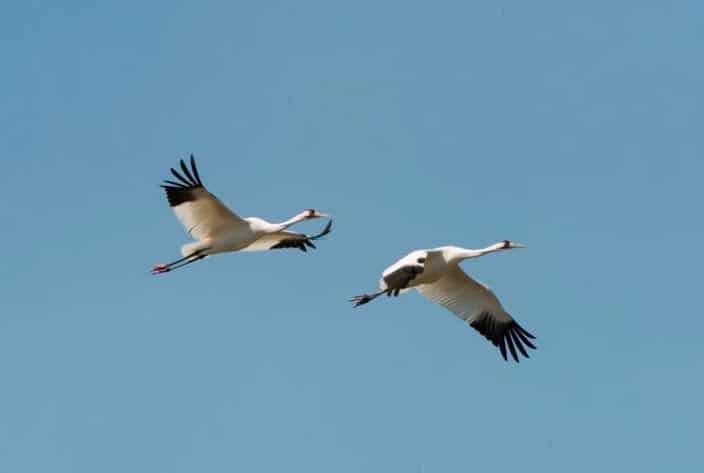
The Aransas National Wildlife Refuge, managed by the U.S. Fish and Wildlife Service, “is best known as the wintering home of the last wild migratory flock of endangered whooping cranes.” It also serves as a breeding ground and sanctuary for other migrating birds and native wildlife, including Kemp’s ridley sea turtles.
Each autumn the Wood Buffalo-Aransas flock fly 2,500 miles south from Wood Buffalo National Park in Canada. They winter on the Gulf of Mexico near Rockport and return north each spring to nest and raise their young.
“The cranes come here because it is where their parents brought them, and where the parents of their parents brought them,” says Whooping Crane Biologist Rari Marks with the International Crane Foundation (ICF). “A migration route is not instinctual for these birds. It must be learned from other whooping cranes.” The ICF works worldwide to conserve cranes and the ecosystems, watersheds, and flyways on which they depend.
“The great expanse of productive salt marsh in this coastal region support the survival of whooping cranes. In years with lots of rain, wolfberries are plentiful and can be a main food source. Blue crab, a favorite prey, are abundant in tidal creeks and ponds,” says Marks.
16-mile auto tour

The Refuge’s 16-mile auto tour loops its way through coastal habitats teaming with diverse plant and native wildlife. Take time to stretch your legs at picnic areas and stroll along several miles of walking trails. There are multiple observation platforms and stunning views of the San Antonio Bay and wildlife habitat. A couple of places of special interest along the route include the observation tower and Jones Lake.
Observation tower
In addition to crane watching, the observation tower offers a panoramic view of the Bay and Mustang Lake. The 40-foot tower is “fully accessible with gently sloping ramps.” Adjacent to the tower is a boardwalk across the tidal flat to the Big Tree Observation Deck. The public has fishing access April 15–October 14.
Alligator in Jones Lake

On your way to the observation tower, do not pass up Jones Lake. Less than 1/4 mile down a paved path is a platform overlooking the lake. We hit the jackpot with this “potential” alligator hangout—a huge bruiser was almost completely submerged on the far side of the lake. It did not take long to spot its quarry. A pack of non-native feral hogs, at least two sows and a dozen piglets, were foraging along the water’s edge. We were riveted. Watching through binoculars, it took less than ten minutes for one young brown swine to lag behind the pack. Then with a mighty splash and snap, the alligator erupted from the water and lunged for the piglet. Chalk this near-death encounter up to the invasive pigs. The alligator slipped back into the water and followed the pack.
If you go:

Aransas National Wildlife Refuge
1 Wildlife Circle
Austwell, TX 77950
361-349-1181
www.fws.gov/refuge/aransas
GPS coordinates for the refuge’s main entrance are: 28.313449,-96.804022
Click here for fees and directions.
Just beyond the self-pay station, the Visitor Center is on the left. Stop in for orientation. Remember, as the rangers caution, “the refuge is wild and you may encounter venomous snakes, alligators and biting insects.” Dress appropriately and “stay on marked trials.” One last piece of advice: Take binoculars and a camera with telephoto lens.
— Julianne G. Crane
To read other RV Short Stops, click here.
For more RV lifestyle articles by Julianne G. Crane, go to RVWheelLife.com.
##RVT1048

I live not far from there, thanks for giving this beautiful park it’s due.
Aransas National Wildlife Refuge is a little off the beaten path, making it all the more exceptional once you get there. The U.S. Fish and Wildlife Services manages “more than 560 refuges spanning the country, The National Wildlife Refuge System protects iconic species and provides some of the best wildlife viewing opportunities on Earth.” This is not an over statement. – We saw both magical whooping cranes and hunting alligators in their natural habitat, all within a short distance of each other. Thrilling.
If you’re wanting to see whooping cranes, they seem to like Goose Island State Park in Rockport, TX. They like to hang out in the field across the street from “the Big Tree”. The best time to see them is January to March. Campsites are available and fishing. https://tpwd.texas.gov/state-parks/goose-island
Aransas National Wildlife Refuge has a lot of water birds but you need to go at different times of the day, on different days. Every day is different and the birds will go to different areas of the park.
I agree with you Madison. Love Goose Island State Park. I mentioned the exact spot you are referring to in the RV Short Stop post on April 2 — https://www.rvtravel.com/rv-short-stops-whooping-cranes-big-tree-texas-rvt-1046/ .