

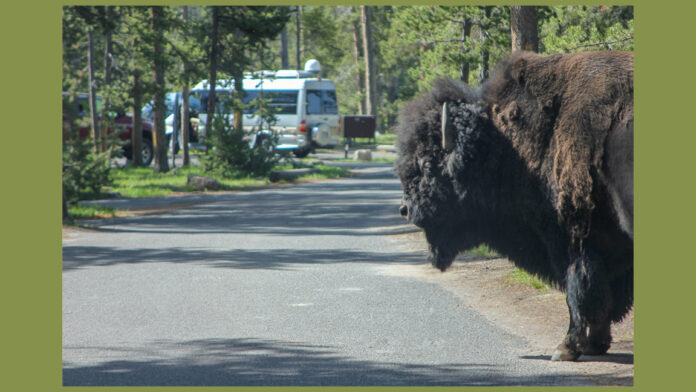
It’s easy to assume experience counts for everything. Many of us have rolled into dozens of parks over the years, know the drill, and figure the “rookie mistakes” don’t apply anymore. But national park mistakes RVers make still show up every season—and rangers say some of them can turn serious faster than people expect.
A former ranger speaking with Business Insider laid out a familiar pattern: visitors arrive unprepared, underestimate conditions, and forget that parks aren’t controlled environments. That may sound like it’s aimed at first-time tent campers. But look a little closer, and you’ll see how often it applies to RVers, too.
That hard-sided RV doesn’t make you wildlife-proof
There’s a quiet assumption out there: If you’re in an RV, wildlife is someone else’s problem. Rangers would tell you otherwise.
Bears don’t distinguish between a tent and a trailer if there’s food inside. Bison don’t care that you’re in a Class A. And smaller critters—raccoons, rodents—can make a mess of things if food is left out or compartments aren’t secured.
In many parks, the same rules apply across the board:
- Store food properly.
- Don’t leave trash accessible.
- Keep distance from animals.
The mistake isn’t ignorance. It’s familiarity. The more often people visit parks, the easier it is to relax the rules, and that’s when trouble starts.
“We’ll have service”—until you don’t
Another one that trips up RVers: assuming connectivity.
Cell service in national parks can be spotty at best and nonexistent at worst. That’s not new. What’s changed is how much we rely on it. Navigation, campground updates, weather alerts—many of those now live on your phone.
When service drops out, the consequences can pile up:
- Missing a closure notice
- Taking a wrong turn with no easy turnaround
- Arriving at a full campground with no backup plan
For RVers—especially those in larger rigs—that last one can turn into a real headache in a hurry.
Closures and conditions hit RVers differently
Rangers often warn visitors to check conditions before heading out. For RVers, that advice carries extra weight.
A hiker can turn around on a narrow trail. A 36-foot trailer? Not so much.
Seasonal closures, road construction, rockslides, and even temporary restrictions can leave big rigs with limited options. And in some parks, there’s simply no good place to turn around once you’re committed.
That’s where a quick check before you roll in can save a long, stressful afternoon.
“Unprepared” doesn’t always look like you think it will
When rangers talk about unprepared visitors, they usually mean hikers without water or proper gear. But RVers have their own version of that problem.
Running low on fuel in a remote park. Assuming dump stations will be open. Forgetting how limited propane or generator use can be in certain campgrounds.
None of these feel like big mistakes—until they stack up. Then they become the kind of problem that can cut a trip short.
Familiar places can still surprise you
The thread running through all of this is simple: Experience doesn’t make you immune.
If anything, it can make it easier to skip the basics. You’ve been there before. You know how it works. Until something changes—and in national parks, something always does.
Even seasoned visitors slip into the same habits: assuming conditions haven’t changed, or that the rules don’t quite apply this time.
That’s the moment where “rookie mistakes” stop being rookie.
What this means for RVers
None of this is complicated. It’s just easy to overlook.
- Check conditions before you arrive.
- Plan for no service.
- Treat wildlife like wildlife, not scenery.
And remember that driving a bigger rig doesn’t just change how you camp—it changes how small mistakes play out. Because in the end, the difference isn’t whether you’ve been to a national park before. It’s whether you’re still paying attention.
RELATED
- Strange wildlife sightings happening across national parks
- Park Service gets real with photo guide to wildlife poop
- Instagram photo filter warns tourists when they’re too close to wildlife
- You don’t have to be dumb for a park wildlife mishap
- North Carolina coyote attack reminds us: Don’t feed the wildlife
- Humorous public safety video laughs at ‘tourons’
- Why are so many tourists stupid?
RVT1258

On our last trip to Yosemite, we had a lovely, shaded campsite – until I realized that our solar panels weren’t generating anything. No hookups, of course. We ran out of power in 3 days. Fortunately, a drive around the campground generated enough to keep us going for another day or two. I look at campsites more closely now!
Thank you for the discussion of the vicissitudes inherent in national park campgrounds, Russ and Tina. I wonder if U.S. Army Corps of Engineers campgrounds are similarly afflicted? We find them consistent in terms of utilities and dump stations, but certainly cell sevice is varied, both generally and by carrier. We carry a supply of DVDs to sate any desire arising for video distraction in the event of too poor a signal to stream video. Have a great day and safe travels!