

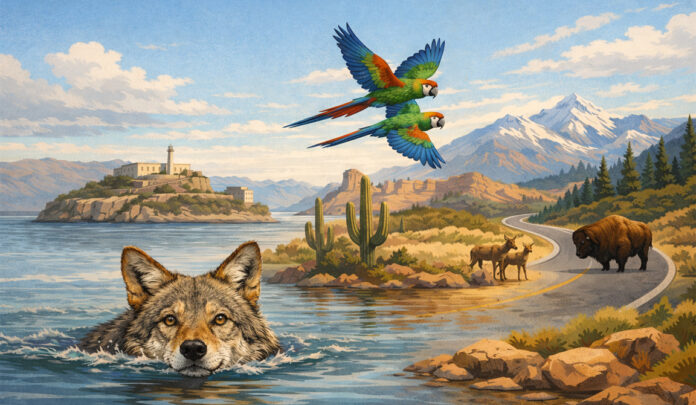
If you spend enough time around national parks, sooner or later you’ll hear a story that sounds made up. A coyote swimming to an island prison. Tropical parrots turning up in the desert. Wolves strolling past stopped traffic as if the road were theirs. These moments are rare, unpredictable—and part of what makes America’s parks endlessly fascinating for travelers who slow down long enough to notice.
For visitors who return to the same parks year after year—or linger long enough to explore beyond the highlights—these oddball wildlife moments are part of the reward. National parks aren’t static exhibits; they’re living places where animals wander, adapt, and occasionally do something no one saw coming. The more time you spend in them, the better the chance you’ll come home with a story that doesn’t sound quite believable.
A coyote where no one expected one

That sense of surprise was on full display recently when a lone coyote was spotted on Alcatraz Island—after apparently swimming there from the mainland. The crossing is more than a mile of cold, fast-moving water, a journey few would expect a land-based predator to attempt.
The sighting turned an already iconic site into the center of a new kind of national park puzzle. Alcatraz is home to sensitive seabird nesting areas, and park managers had to weigh the coyote’s welfare against the potential impact on wildlife that had been there first. It was a reminder that even carefully managed places can still deliver the unexpected.
When the desert gets a splash of the tropics

Hundreds of miles south and east, another surprise unfolded when brightly colored macaws—birds more often associated with Central America—were spotted inside Texas’ Big Bend National Park. Against a backdrop of rugged mountains and scrub desert, the tropical birds looked wildly out of place.
For birders, it was a once-in-a-lifetime sighting. For everyone else, it was a vivid example of how animals don’t always follow the maps in field guides. Whether driven by storms, habitat pressures, or sheer chance, wildlife occasionally turns up far from where anyone expects it to be.
The animals that stop traffic without trying
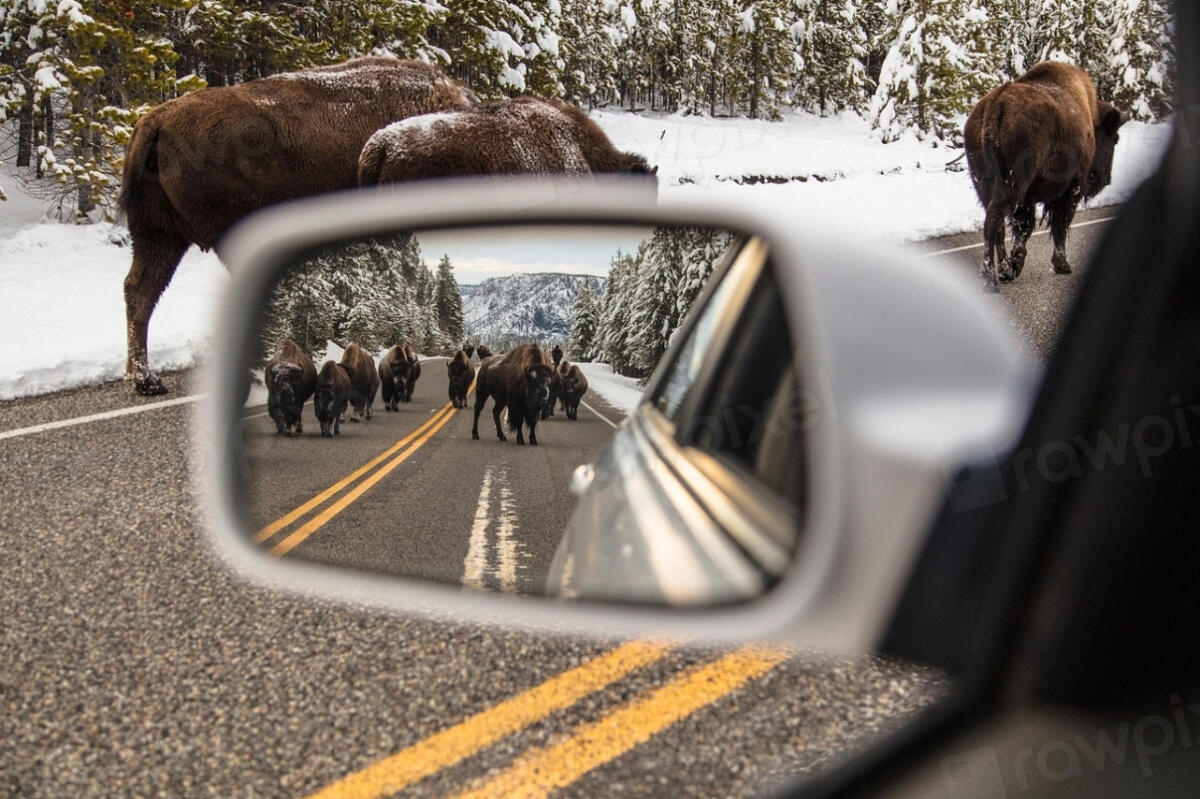
Some of the most memorable wildlife encounters happen not on a trail, but from the driver’s seat. In places like Yellowstone National Park, wolves, bison, and elk routinely bring traffic to a standstill—not because they’re putting on a show, but because they’re simply going about their day.
For visitors, those moments can feel spontaneous and intimate. For park staff, they’re part of an ongoing balancing act between access, safety, and respect for animals that have no interest in human schedules.
Rare creatures, right place, right time
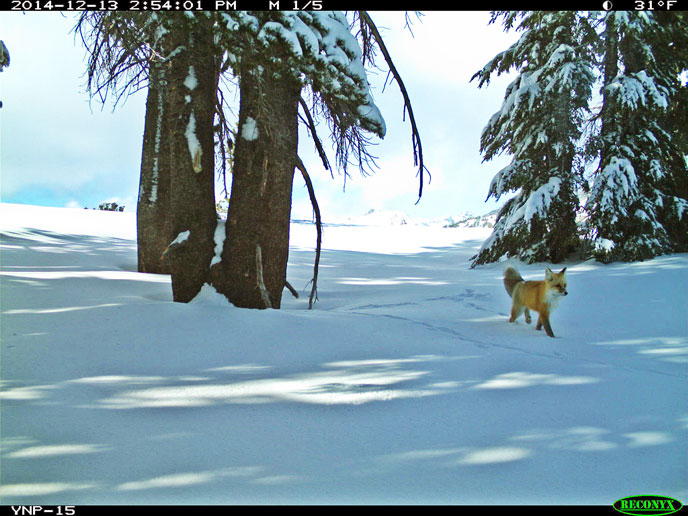
Other surprises come quietly, captured on trail cameras or spotted by a single lucky hiker. In recent years, elusive species like the Sierra Nevada red fox have been documented inside Yellowstone National Park, while unusually colored elk have drawn attention near Rocky Mountain National Park.
These sightings don’t make headlines every day, but they reinforce the same idea: National parks remain places where nature still operates on its own terms.
Why the surprises keep coming
With millions of acres under protection, national parks serve as refuges, corridors, and crossroads for wildlife. As animals adapt to changing climates and landscapes, their movements don’t always match our expectations. That unpredictability is part of the bargain.
For visitors, it means every trip carries a small element of mystery. You might arrive with a checklist, but the moment you remember years later could be something no one planned—a shape crossing the road, a flash of color in the sky, or a story that begins with, “You’re not going to believe this…”
RELATED
- Get ready to smile! The 2025 Comedy Wildlife Awards are here
- Park Service gets real with photo guide to wildlife poop
- Instagram photo filter warns tourists when they’re too close to wildlife
- You don’t have to be dumb for a park wildlife mishap
- North Carolina coyote attack reminds us: Don’t feed the wildlife
- Humorous public safety video laughs at ‘tourons’
- Why are so many tourists stupid?
RVT1247b

Yet another unaccredited piece of AI art. Sigh.
Hi, Andy. We discussed it this morning, in fact, and decided that if it’s obviously AI-created, it’s not necessary to identify it as such. Is there a law or requirement of some sort that says anything created by AI has to be so labeled? I don’t know, but would like to know so we will identify every AI-created correctly. Thanks! 😀 –Diane
P.S. I just did some research on this. It looks like you’re more up-to-date on this subject than we are. Thanks for the heads up, Andy. Have a good evening/night. 😀 –Diane
Thanks, but I wasn’t even thinking about this from a legal point of view as much as I was remembering Chuck’s many declamations against AI taking over the news biz (with which I happen to agree) and the importance, if AI is used (and it has its place), that at least it’s clearly ID’d as such. No matter how “obvious” something might appear, why leave readers guessing? Alternatively, if we give human artists and photographers credit for their work, why not do as much for AI?
👍👍 I think that AI is not only taking over the news biz, Andy, it’s taking over the world.🫣 Parts of it are good, parts not so good. Just my personal (albeit old-fashioned) opinion. –Diane
I sure would like to pet some of these!
I get my stitches out next week from the last time.
Sometimes animals will “”migrate”” into an area that has food, shelter, few/no predators and breeding opportunities. The coyote is an expert at adapting as are deer, wild pigs and turkeys.
Many times this adaption is a detriment to the existing species, with the animals causing significant disruption/damage to existing populations. Reference crop damage from deer and wild hogs, vehicle vs. deer strikes and consumption of pets and other small animals.
No easy answers here…
Mike
Since retiring and hunting, camping and driving by the woods. I have seen many wildlife I’ve never seen. Diane seems cranked up today. The said thing about AI and technology is we now see pictures of nude people with our family’s faces pasted to a body that isn’t theres and the one thing our politicians are interested in is there next reelection. This isn’t the world I want.
We spotted a Moose swimming across Glacier Bay in Alaska last September while on an expedition cruise.
I’d rather see a regular feature of wildlife photos than any pets.