

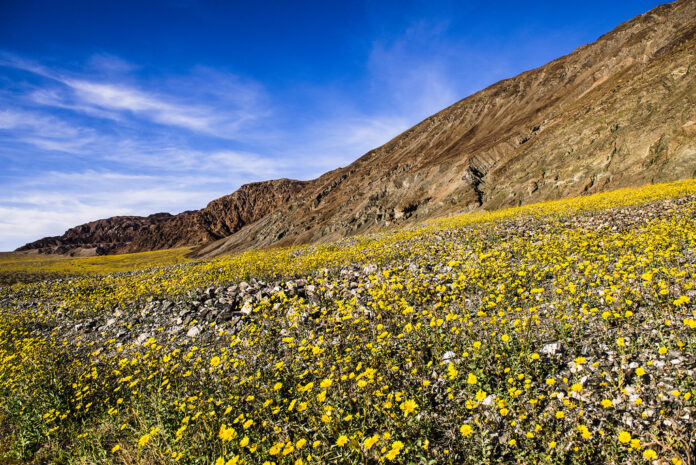
Superblooms in Death Valley? That seems like an oxymoron to me. However, early signs indicate a rare superbloom for the area this year, 2026.
The National Park Service says sprouting is already visible in places. What’s more, if conditions continue to cooperate, Death Valley could experience peak displays between late February and early April.
What’s a superbloom?
A superbloom isn’t a single-species display. Instead, it’s a broad, landscape-scale response when dormant seed banks scattered across the desert suddenly germinate at the same time.
Key ingredients are above-average fall and winter rains, cool enough temperatures to let seedlings survive long enough to flower, and relatively gentle winds so blossoms aren’t stripped away.
Because seeds can lie in the soil for years, a single wet season timed right can trigger a remarkable, but short-lived, explosion of color. The Park Service explains that rain timing, repeated moisture events, and temperature all matter. In fact, wind and heat can shorten a great bloom’s window.
Why 2026 looks promising
Reporting from meteorologists and park biologists point to a wetter-than-average late fall/winter across parts of California and Nevada. These moisture-filled soil seed banks are in many low basins. Park observers have already spotted dense patches of desert gold and sand verbena along the south end of Badwater Road. This is an early and encouraging sign.
Death Valley has seen superblooms in the past (e.g., 2016, 2005, 1998), when similar conditions lined up, so the pattern isn’t new. It’s just rare. If you’re planning a trip, expect peak conditions to shift with the weather. However, late February through early April is the likely sweet spot.
Where to go
For 2026, the best places to view Death Valley’s superbloom are the low-elevation basins and fans where rain pooled and seeds germinated. This includes the south end of Badwater Road and the flats a few miles south of the Badwater Basin.
Other well-reported viewing corridors include areas near Furnace Creek, stretches between Mud Canyon and Hells Gate, and the low washes and fans off Highway 190 where past superblooms happened.
These spots are easy to access from the park’s main roads. They provide large, wide vistas that photograph beautifully.
Always follow NPS signage and stay on designated pullouts and trails—stepping on plants crushes tiny plants and ruins future seed production.
Three RV-friendly campgrounds nearby
Furnace Creek Campground
The park-run Furnace Creek Campground is the most convenient base for the Badwater area and central valley access. The campground offers a mix of RV sites (including some full-hookup sites) along with easy access to the Furnace Creek visitor services. In addition, it’s a short drive to many prime bloom locations. Reservations are strongly recommended.
Stovepipe Wells Village RV
Located along Highway 190, Stovepipe Wells has a handful of full-hookup RV sites and a larger dry-camping loop. It’s a handy staging spot for sweeping valley views. This campground is well-placed for exploring sand- and poppy-filled flats to the west and central valley areas to the east. Expect high demand and limited hookups during a superbloom.
Panamint Springs Resort
This private, small resort sits on the western edge of Panamint Valley and offers several full-hookup RV sites along with basic services. Panamint Springs is a great pick if you want a quieter base with quick access to western-side canyons and higher-elevation blooms as the season progresses. Amenities are modest but useful, with showers, a camp store, and fuel available.
Practical tips for a superbloom visit
• Arrive prepared: Cell service is spotty, and gas and water can be scarce. Top off and carry spare water.
• Park conditions shift quickly: Check Death Valley National Park alerts and follow seasonal road closures or pullout restrictions.
• Peak bloom windows: Superblooms are short, and crowds can spike. Plan your visit midweek or very early/late in the day for calmer parking and cooler temps.
• Don’t pick flowers or drive off-road to get closer. The park enforces rules meant to protect fragile desert soils and rare plant populations.
Safety notes
Death Valley is extreme. Even in spring, temperatures can climb fast, and steep grades around the park can stress brakes and drivetrains. There have been reports of vehicle fires and mechanical incidents on long descents. Inspect your brakes, cooling system, and tires before traveling. Consider a lighter load or an alternate route if you’re towing a heavy rig. Carry a basic emergency kit and extra fluids, and know where the nearest services are before you leave the main highway.
Also remember: Leave no trace and keep your dog leashed. Pets are restricted in many park areas.
Have you personally witnessed a desert superbloom? Tell us about it in the comments below.
MORE IN DEATH VALLEY TRAVEL:
- After a decade-long closure, Scotty’s Castle reopens for tours in Death Valley
- If Death Valley was named in the winter, why is it called Death Valley?
- Death Valley isn’t dead: The magic of the life inside our great national park
- Roadside stop near Death Valley is an unexpected delight. (This story is delightful, too)
RVT1249

Gail, nice writeup.
We’re going to make a real effort to get out there this year.
One minor input: Panamint Springs is not on the edge of Death Valley, it’s on the edge of Panamint Valley. There’s very big/steep climb/descent along CA-190 that must be crossed between Panamint Valley and Death Valley. BTW, Panamint, though a bit less scenic, is still my personal favorite; less crowded by far.
Good to know! Thanks, Gregory. Enjoy the “nature show!”
We will actually be visiting DeathValley NP from March 2-7, so here’s hoping to see the super bloom in full, er, bloom!
We are going out at the beginning of March, hopefully finding a boondocking spot at The Pads. Can’t wait!