

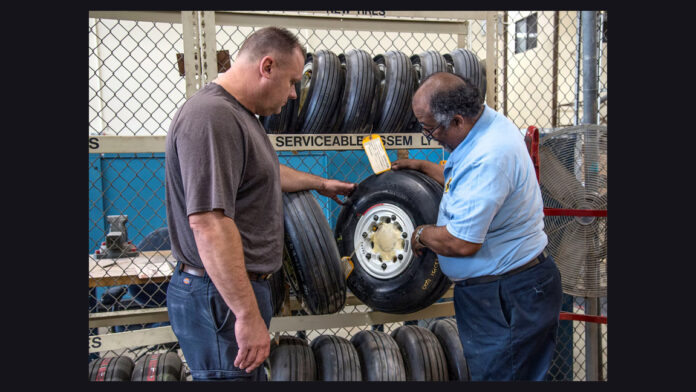
It doesn’t matter if you’re a motorhomer or flavor your RV as a towable, we all have something in common: We have to buy tires. There’s a certain amount of anxious suspense as to just where, when, and how tariffs will affect us. Forget where the rubber meets the road—think about how the rubber may hit your budget with tire tariffs.
Tire tariffs the topic of industry survey
A trade magazine for tire dealers, Modern Tire Dealer, wanted to get a pulse from its readers as to their thinking about how tariffs may affect their industry and, by extension, tire buyers. You may find the results interesting—if not downright dreadful.
Modern Tire Dealer’s survey was conducted on April 3. Six days later, President Trump surprised the nation by pausing tariffs on most nations for 90 days. But that same day, the U.S. Treasury Secretary, Scott Bessent, came out with information. Forget the 90-day pause on most countries—automobile and auto parts tariffs were still going forward. Tire tariffs are a reality.
The survey results are based on the participation of more than 300 readers in the tire industry. Their “votes” speak for themselves.
Are you going to pay more?
Perhaps affecting RVers the most is this: How will tire dealers deal with the higher costs brought on by tire tariffs?

How do tire dealers feel about tariffs?
Other survey questions dug into the mood of business retailers.

Tire tariffs crystal ball gazing
The survey also put tire dealers into the position of doing a little future forecasting.


At first blush, we didn’t think much about the effects of all of this. After all, we don’t drive a motorhome with those giant “rubber donuts.” But, hey. Guess we should have thought harder. Our travel trailer is a dually. Six wheels!
RELATED
- How will RVers be affected by latest tariffs?
- Shades of COVID: Tariffs threaten toilet paper supply amid rising costs
- How new tariffs will impact the RV industry
##RVT1205b

Simple solution: Buy American made tires! That may not be possible in every case, but the U.S. still has a robust tire mfg industry.
This source may help buyers understand how to know where tires are made: AllAmerican.orgg
Even if tire manufacturing were moved back to the US, the majority of raw materials to produce the tires are imported – so no break on pricing. And one estimate I saw stated it would take 3 to 5 years to locate manufacturing sites, buy the land, build the factories, employ and train the employees (at 5 times the pay) compared to making the tires where the raw materials are sourced. It’s estimated that manufacturing the tires locally would be priced close to the tariffed (also called Foreign Import TAX) price.
Exactly…where do fools think rubber comes from? Americans need to stop listening to the lies and rhetoric coming out of DC.
Tires are mostly synthetic rubber now. Approximately 1/3 of the world’s synthetic rubber is from the U.S. and it’s growing. Having domestic production is a strategic necessity…but I understand some seem to think relying on Asia for our needs and literally our defense is OK. 🙄
Facts, not rhetoric. Current knowledge…not foolhardiness. Read the new links I posted above.
OK, so I guess you benefitting from slavery is acceptable again because it is happening in another country. Got it, I’ll put you down as a YES on slavery as long as it remains out of sight, and thus it will be out of mind.
Right on
You are spot on Cancel…same with pollution…can’t pollute here but it’s ok to have China make our stuff and pollute all they want.
Nailed it!
Very good, I’ll put you in the Pro-Slavery column also. ✔️
Done.
😆
“3 to 5 years to locate manufacturing sites, buy the land, build the factories, employ and train the employees (at 5 times the pay)” Thank you Tom for making the point of tariffs! …jobs, jobs, jobs with great pay! 🇺🇸
“It’s estimated that manufacturing the tires locally would be priced close to the tariffed (also called Foreign Import TAX) price.”
That’s the whole point….it evens the playing field.
Exactly!
1. I posted a link to U.S. tire production above. Lots of production in the U.S. and the goal would be to bring more back.
2. Here are two more links regarding Synthetic Rubber production. One delves into the U.S. STRATEGIC need to have its own domestic source. The other talks about the global market, of which U.S. producers of synthetic rubber already have 1/3 of the market.
https://www.acs.org/education/whatischemistry/landmarks/syntheticrubber.html
https://finance.yahoo.com/news/synthetic-rubber-market-surpass-usd-140000472.html
Everything is going up in price. Fafonomics at its best. One of the worst, if not the worst, economic decision in modern American history. Worse than smoot since we should have learned the lesson already. A purposefully crafted recession to grab more control and profit off of it.
Perfect example of our Kakistocracy affecting RVers.
Except for 1 thing, Smoot happened after the collapse. Correlation not causation but keep the Red Herrings coming.
I buy Cooper brand been made in America but they were just bought out by Good Year so we’ll see.
Tire companies moved production overseas for more profit and lack of support of American workers
Same here.
I think maybe one of the major causes other than cheaper hourly wages is the fact that most other countries have national single payer health care. This relieves the companies from a large “tax” in the form of providing health insurance for the employees.
The issue goes beyond where the tire is made, it involves where the rubber is coming from. I am not aware of any domestic rubber plantations so there will be tariffs on the imported rubber.
And here I thought that tariffs were paid by the country selling to the USA, lol.
Does anyone still believe that?🇨🇦
Why does Canada have such high tarrifs on American imports? I don’t disagree with your comment, Leonard but if you are worried about prices in Canada, why won’t your leaders drop those same tarriff taxes on US imports, for Canadians?
Gander/Goose?
Every country, it seems, that charge high tarriffs on US imports are now telling us it is bad for US to do the identical thing.
This is a serious question Leonard, I hope you answer it for all of us that want to export products to Canada without having to charge Canadians that very same tarriff tax you say is so bad.
Well said! I hope Leonard answers!
🤔 5 days…no response.
Many countries are making offers and deals with the U.S. to avoid tariffs. Personally I think it’s the smart play. Another alternative is buying used tires. We have a shop near us that sells them. We’ve bought 2 sets and have been very satisfied.
Tire manufacturing plants in the US have both domestic and foreign ownership, but all rubber is imported. But, a tire is only 41% rubber both natural and synthetic, so I don’t think tariffs will affect the tire market much. That is, as long as you stick to Goodyear/Cooper. It’s sad so many tire companies have sold out to foreign entities. Continental, BFG, Michelin, Bridgestone…just the state of America I guess.
Tariffs, which might cause temporary increase in some costs, will be in place until countries reduce their own tariffs to facilitate a level playing field. 70+ countries are already negotiating to make this happen. US has been subject to extremely unbalanced trade for decades.
Since the Japanese captured Indonesia in 1942, most rubber used in the U.S. is synthetic rubber produced by American petrochemical companies in the U.S.–Houston, Baton Rouge, etc. Today, of the 32 million metric tons of rubber produced in the U.S., 2/3 is synthetic. So, it is tariffs on foreign OIL, not foreign rubber, that will have the largest impact on tire prices. And, since the U.S. EXPORTS 4,000,000 barrels of oil every day, the biggest beneficiaries of all these price increases will be American oil companies . . . . again!
The tariff debate is the topic-of-today.
With that said, tires purchased in 2018 for our RV cost me $1,268.55.
December 2024, those same tires cost $2,295.65.
This was the price increase before tariffs were the topic at the dinner table.
Inflation since 2018 has been 27.4%, making the 2018 adjusted inflation price today $1,615.57. Clearly, tire cost has increase even after factoring inflation into the calculation.
American business owners share how tariffs are affecting them. 🇺🇸https://www.theepochtimes.com/article/made-in-america-entrepreneurs-see-opportunities-in-global-tariffs-5842569?utm_source=Goodevening&src_src=Goodevening&utm_campaign=gv-2025-04-20&src_cmp=gv-2025-04-20&utm_medium=email&est=FlC2ha1j%2FcpqM87F6Ml5OQ1yzW2dgjOQl54vGyMDzhpjO%2BsTE7RaH%2F%2B%2FNDIG%2BqCt
Thank you for the news, Russ and Tina! We hoped to find a recently replaced, used tire to carry as a spare to Alaska, allowing us to limp the RV to a safe location to await the arrival (in several days) of a replacement tire. Given our tire size (305 70R 22.5), we have found nothing. Thus, I have begun contemplating replacing our steer tires early and taking the better of the replaced tires as our unmounted spare. Now, I should have less sticker-shock if this is the executed plan. 🙂 Have a great day and safe travels!