


By Cheri Sicard
In the video below, we join Ashley, aka The Tennessee Wanderer, for some handy tips about camping with a cat. Ashley and her cat, Rupert, (and a dog too) travel in a tiny restored fiberglass U-Haul trailer. If she can make camping with a cat work in that tiny space, I think anyone can.
In the video, she shares some things that worked for her and some that didn’t.
Ashley’s top 7 tips for camping with a cat
#1 Harness training: Ashley says this is a must. She did a good job, as we see video of Ashley walking her cat on a leash right alongside her dog. In the video, she gives some suggestions on harness types as well as some training tips.
The first time she used the harness that cat was NOT happy, and there is a hilarious photo in the video of that occasion. However, now that he is used to it, the cat happily walks on a leash and knows that when the harness goes on, he will get to go out and explore.
Ashley does advise taking it slow before you head out on the road to get your cat acclimated to all the changes. This is the harness/leash set that she uses and recommends.
#2 Crate training: Crate training is important, especially for travel days, as you don’t want a loose cat running around while you are trying to drive. However, Ashley’s cat yowled nonstop. She eventually trained him to behave while being loose in the vehicle.
I am still skeptical and think I would have pursued crate training more. But it probably depends on the cat.
#3 Backpack carrier: While Ashley says they have outgrown this with time, this backpack cat carrier was especially useful when they were starting out. She would use it to get Rupert used to going out in the neighborhood. If you have a small cat, the backpack can even stand in for a crate.
#4 Create a space for your cat: Even though her trailer is tiny, its top bunk is reserved for the cat. That’s where he hangs out—he has a bed and blanket, scratching post, and toys there.
#5 Cat gear and gadgets: Since her camper has no heater, Ashley carries a USB-powered heated blanket for her car and a USB-charged watering bowl.
A cat box is important, and the right odor-reducing cat litter is super-important in such a small space. Ashley recommends Dr. Elsey’s Ultra.
#6 Make sure the cat gets plenty of exercise: If you have harness-trained the cats, take them for walks. Ashley also got a 25-foot cable lead so that Rupert can be tied outside and join in the fun at the campsite. She can play with him outside while on this long lead. He has space but can’t run away.
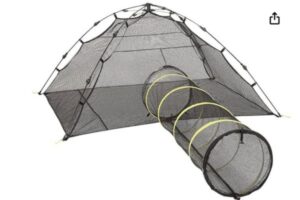
#7 The Catio: Ashley says this is one of the best inventions ever for those traveling with cats. An enclosed mesh tent with a mesh tunnel is especially helpful if your cat is not leash-trained. But even if it is, the Catio provides a safe outdoor space where your cat can play outdoors and enjoy the scenery. When not in use, it all folds flat into a small pouch.
RELATED
- Unusual uses for cat litter when RVing
- Cat-astrophic problem: Where to put the litter box in an RV?
- RV pet care: 14 OTC medicines that are safe for cats
- Every cat owner should know these 6 signs of heat stroke in cats
RVDT2852

We have two cats (and a golden retriever). Neither cat wants anything to do with being outside of a house or an RV. They’ll just watch from safety, thank you.
The biggest issue with cats period, is the litter box placement and litter tracked outside the box. We have workable solutions for both our larger stationary seasonal use RV and our ‘rolling hotel room’ little RV. But every RV seems to be unique in finding such a space.
Harness and lead will help recapture your cat, if they do escape.
I’m thinking air tag might be nice.
We travel with the cat litter repacked into recycled juice plastic bottles.
No spill and easy to handle.
Have current vet records on hand, some RV parks require them.
I’ve driven across country with a cat who was harness and leash trained. When driving, I kept her on a shorter leash attached to a seatbelt in the back seat. She loved sitting up on the back ledge. Because she was already wearing her harness, it was easy to attach a longer leash to go for walks at rest stops.