

By Cheri Sicard
Switching to a diesel truck or RV can bring up a lot of questions about fuel. What’s the difference between all those diesel types at the pump? What about additives?
In the video below from RV Miles, Jason Epperson breaks down the basics of diesel fuel, so owners can keep their engines running smoothly for years to come.
About diesel
Diesel fuel wasn’t always what it is today. Rudolph Diesel, the inventor of the diesel engine, originally envisioned it running on coal dust. He even experimented with vegetable oil. Eventually, the petroleum industry stepped in, and petroleum-based diesel became the standard.
It all starts with crude oil. Refineries heat crude oil, separating it into different products through distillation. These products include gasoline, kerosene, and, of course, diesel. For every 42-gallon barrel of crude oil, refineries produce about 11 to 12 gallons of diesel fuel. The cost of crude oil plays a significant role in the price consumers pay at the pump.
Have you noticed that diesel usually costs more than gasoline? This wasn’t always the case. Before the early 2000s, diesel was often cheaper. However, regulations to reduce sulfur content in diesel fuel increased refining costs.
One advantage of diesel is its energy density. Diesel packs about 15% to 20% more energy per gallon than gasoline. This means a diesel vehicle can travel farther on a tank of fuel compared to a gasoline vehicle with the same tank size. The increased fuel economy often makes up for the higher price of diesel.
Navigating diesel fuel types: A buyer’s guide
Standing at the fuel pump, one might wonder what type of diesel to choose. Number 2, Number 1, a blend, or something else entirely? Let’s clarify the options.
Number 2 diesel—The standard choice
Number 2 diesel is the standard, the fuel that most engines are designed to run on. Think of it as the “number two pencil” of diesel fuels—reliable and widely available. However, it has a weakness: It contains wax that can solidify in cold weather, leading to diesel gelling. Diesel gelling can cause engine sputtering, difficulty starting, and even complete engine stalling. No one wants that.
Number 1 diesel—The cold-weather alternative
Number 1 diesel is thinner and doesn’t contain the wax found in Number 2 diesel. This makes it suitable for very cold temperatures. However, it burns hotter and faster, which reduces fuel mileage.
It’s best to avoid running straight Number 1 diesel unless it’s extremely cold (below -30°F). Typically, Number 1 diesel is only found in very cold regions.
So, how do you prevent gelling in the winter? In colder areas, fuel stations usually blend Number 1 and Number 2 diesel. This provides a winter blend that protects against gelling.
Anti-gel additives are another option. These additives can be poured into the fuel tank to prevent gelling. Many people use them with every fill-up. However, if fueling up in a cold area where winter blends are already available, they aren’t usually necessary.
Consider using anti-gel if traveling north after filling up in the South during the winter. Also, keep some on hand during unexpected extreme cold spells.
Biodiesel—Understanding blends (B5, B10, B20)
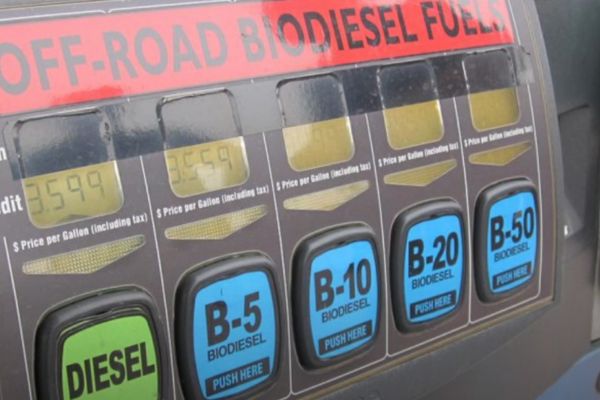
Biodiesel is made from vegetable oils and animal fats. It’s often blended with regular diesel and labeled as B5, B10, or B20. The number indicates the percentage of biodiesel in the blend. For example, B20 contains 20% biodiesel.
Biodiesel can be less energy-efficient and suffer from instability issues. For this reason, it’s typically used in blends with regular diesel. Regular diesel can contain up to 5% biodiesel without any special labeling.
Engine manufacturers haven’t always been enthusiastic about biodiesel. Some have restrictions on using blends with more than 5% or 10% biodiesel. For example, Mercedes-Benz Sprinter vans had issues with B20 blends for a while.
Biodiesel can also spoil, so it’s not a good idea to let it sit in a tank for more than a month. If you’re storing an RV, fuel it up with regular diesel before storage.
Renewable diesel (R99, R100)—The advanced biofuel
Renewable diesel is different from biodiesel. It’s chemically equivalent to petroleum diesel and can be used at full strength. It’s often labeled as R99 or R100.
Renewable diesel is made from the same sources as biodiesel, but it undergoes a more extensive process. This process removes the faults of biodiesel. Many claim it’s even better than regular diesel. It’s primarily found on the West Coast.
Premium diesel—Enhanced performance and protection
Premium diesel contains additives that improve lubricity, act as detergents, and enhance cetane levels. These additives can provide several benefits.
The process of removing sulfur from diesel reduces its lubrication properties. Lubricity improvers help restore and maintain the necessary lubrication, protecting fuel pumps and injectors. Detergents help clean fuel injectors and prevent deposits from forming. Cetane enhancers improve fuel combustion, leading to smoother engine operation, increased horsepower, and slightly better fuel mileage.
Cetane is a measure of how quickly and easily the fuel ignites under compression. While these additives offer advantages, it’s not a good idea to use premium diesel and additional additives. Doing so can raise the cetane level too high, which can cause problems.
Off-road diesel (red diesel)—What to know
Off-road diesel, also known as red diesel, is dyed red. It’s identical to regular diesel, except it’s untaxed and intended for off-road use only. Using it in on-road vehicles is illegal and can result in fines.
Optimizing your diesel experience: Fueling tips and additives
To get the most out of a diesel engine, it’s helpful to understand fuel additives, the best places to fuel up, and how to avoid common mistakes.
Diesel additives are often considered a must-have due to the reduced lubrication in modern diesel fuel. One additive that gets good reviews is ARCHOIL® diesel treatment, especially for Ford trucks with CP4 pumps, which are known to have issues.
There’s an informative video from Repair Geek that tests various diesel additives and demonstrates how they improve scoring on metal (aka metal wear scar). It’s worth checking out to see the science behind these products.
The diesel supply chain is structured in such a way that the diesel fuel itself tends to be very similar from brand to brand. However, diesel at different stations will have slightly different additives. Just because a station carries a certain branded gasoline doesn’t mean the diesel is the same brand.
The most important thing is to buy fuel from stations that regularly sell diesel. Avoid stations with a single, rarely used pump or those in areas with low diesel traffic. Fuel that sits too long in underground tanks can degrade, leading to oxidation and water contamination.
RELATED
- Gas vs. diesel: Which is better?
- Gas prices are climbing, but diesel is jumping faster. Here’s why it matters
- EPA removes some DEF sensor requirements for diesel equipment
- Pilot starts pumping B99 diesel fuel
- Poll: In your RV or tow vehicle, do you use diesel or gasoline fuel?
RVDT2892

“For every 42-gallon barrel of crude oil, refineries produce about 11 to 12 gallons of diesel fuel”
Not really. A barrel can produce about 11 gals (25%) of a category called “Distillates.” That category is then further processed into diesel, heating oil, kerosene, and jet fuel. So on average, the amount of diesel made from a barrel of oil will only be a portion of the 25% of a barrel that is “distillates.”
A very informative article clarifying an oft misunderstood product. I read on my bottle of anti-gel that it is recommended NOT to use it in the summer. My research states it won’t hurt the engine but it’s a waste of money and to stop using winter anti-gel when temperatures stay consistently above the freezing point.
A friend in my car club has an old Mercedes diesel sedan that runs on a “biodiesel” blend of his own making. He is an airline mechanic who saves jet fuel drained from aircraft tanks when they sit unused too long. He also has an agreement with several fast-food places to pick up their used french-fry oil. He filters both ingredients to remove water, organic debris, and other solids, then mixes them in a specific ratio to make his biodiesel blend. The Mercedes is his year-round daily driver to and from the airport and emits no black exhaust, unlike the modified diesel trucks that “roll coal”. And he doesn’t have to pay $6.00/gallon for his fuel!
Inventor Rudolph Diesel powered his engine with peanut oil. Diesels are very versatile on forms of oil to run on. The challenges are having the diesel fuel flow to the injectors. There’s minimal concerns running B-2 to B-5, provided you change fuel filters on schedule. And the biodiesel benefits are lubricating the engine internals and a cleaner burn reducing air pollution concerns.
Pre-DEF diesel engines can more easily capitalize on higher Bio-Diesel mixes because they lack post 2010 anti-pollution crap/electronics which require burning more fuel as well. My older farm tractors and trucks run on about anything in Bio-diesel.