

By Cheri Sicard
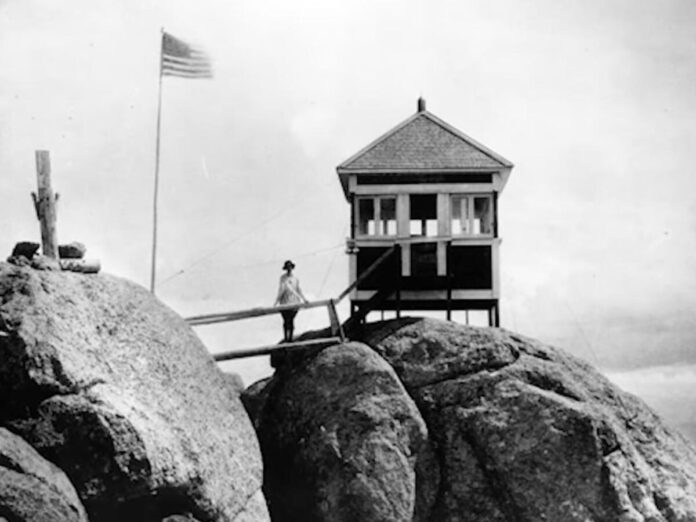
Fire lookouts, or towers, hold a special place on America’s public lands. They began as practical tools for spotting smoke, yet over time, they became symbols of forest protection, wildfire history, and life in remote mountain country. Their story runs from the 1910 Big Blowup to today’s smaller but still active lookout system, where human eyes remain a trusted backup when newer tools fall short.
In the video at the end of this post, the team from National Park Diaries takes a brief look at their history.
Life inside a fire lookout tower
At 6 a.m., a fire lookout starts the day with first light on the peaks, a cup of coffee, and binoculars pointed at the horizon. From a tower set high above the forest, that person scans for smoke and reports anything that could turn into a wildfire. In many ways, the lookout serves as the first warning system on the landscape.
Early lookouts did more than report fires. If smoke appeared, they often climbed down, grabbed tools like shovels and pickaxes, and headed out on foot or horseback to help contain the blaze.
How the Big Blowup changed wildfire detection
The history of fire towers is tied to the Big Blowup aka the Great Fire of 1910, a massive fire that burned more than 3 million acres in Washington, Idaho, and Montana. It remains one of the largest wildfires in U.S. history. At the time, the U.S. Forest Service was only five years old, and the disaster helped build support for an organized wildfire system built around two ideas:
- Fire suppression
- Early detection
A riveting book by Timothy Egan, The Big Burn, tells the story of the fire and is highly recommended by RVtravel.com publisher Chuck Woodbury, who fought fires for the U.S. Forest Service during his college summers.
Towers fit that second goal above. They gave forest managers a way to find fires faster and try to stop another catastrophe before it spread.
By the 1930s, more than 5,000 fire towers had gone up, including about 600 built by the Civilian Conservation Corps. Some were standard Aermotor Company steel towers, while others looked very different. Fire towers could be wooden, stone, ground-level huts, or even platforms in trees. Some rose hundreds of feet, while others blended into the terrain.
For a strong visual record of that era, the U.S. Forest Service’s historical fire tower photo collection offers a remarkable look at the people and structures behind the system.
From mirrors to radios, then into decline
From the 1930s through the 1950s, fire towers reached their peak. Communication improved from mirror-based Morse code to telephones, then radios, which made reports faster and more dependable. During World War II, lookouts also watched for enemy aircraft.
By 1964, only about 250 towers were still in use. Remote sensors, satellites, 3D cameras, and drones reduced the need for such a large tower network. Still, fire towers never disappeared. When cameras fail or aircraft can’t fly, someone still needs eyes on the fire.
Pinpointing a fire with two towers
A lookout’s most important tool, after the tower itself, is the Osborne Fire Finder, invented by William Osborne in 1911. It’s a fire location device based on sight lines and geometry, related in principle to older tools like astrolabes and sextants.
The device includes a circular map, a fixed compass ring, and a rotating sighting arm. Once the lookout lines up the sights with the base of the smoke, the tool gives a direction from the tower. For better accuracy, a second tower takes its own reading. Then the two lines are triangulated to find the fire’s location.
After that, the lookout calls the report in. Land managers decide whether the fire should be monitored or suppressed.
Why fire towers still matter
Fire towers are fewer now, and many full-time lookouts have been replaced by volunteers. Even so, the basic system still works much like it did a century ago. High vantage points, sharp eyes, and a direct report can still make the difference. That lasting role is why these towers remain both historic landmarks and working parts of wildfire detection.
RELATED
- Why mile markers still matter on today’s highways
- Following Lewis and Clark’s route in an RV
- Ralph Nader and the transmission shift P-R-N-D-L sequence
- Discover the 575‑mile stagecoach and wagon route, the Overland Trail
- The untold story of the hobos who traveled America for work
RVDT2871
In the summer of 1981, my then-fiancée worked at a fire tower north of Utikima Lake, Alberta. I saw her twice that summer, because I had to drive to the end of an oil company dirt road and then hike 10 miles to get there (she got helicoptered in and out). It was a great job for a university student, because there was nothing to spend money on, so you really could save up, plus you got lots of peace and quiet. For exercise, she got to climb a 100-foot tower several times per day.
Very interesting
I remember going up into a fire tower as a wee lad of probaby about 10-13 yrs. or so. (40’s?) It was in Itaska State Park in Mn. I remember looking at the sighting tool….. I also remember the climb up and down – it was a tall tower!
I wish we’d learn common sense forest management to control wildfires. Harvest the mature and diseased trees, cut firelanes so fires can be stopped. Pine bark beetles, gypsy moths, emerald ash borers, oak wilt, leave dead, dry tinder to feed runaway fires.
Meanwhile, priced lumber lately? Prefer having lower cost lumber than breathing choking smoke (Canada and US) from these fires.