

By Cheri Sicard
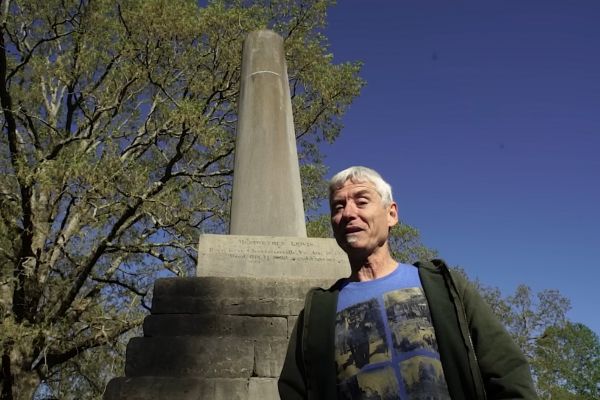
On a sunny April morning in 2019, Slim Potatohead camped in Tennessee and later discovered something surreal: a satellite had captured the moment from above. On April 15, his trailer—with its black strip of solar panels—and his white Jeep appeared in satellite imagery at the Meriwether Lewis Historic Site near Hohenwald. Zooming in, Slim could even spot himself walking near the monument, filming the same moment from the ground.
Slim set out to retrace the Lewis and Clark route across America to the Pacific, but without a boat, his Jeep and camper would have to do. Rubber on pavement replaced paddles, and highways stood in for river bends.
The video at the end of this post documents that journey.
The campground shown in the video also serves as a memorial and burial site for Meriwether Lewis, who died there on October 11, 1809. The monument’s inscription ends on a somber note: “His melancholy death occurred where this monument now stands and under which rest his mortal remains.” Nearby sits the Grinder House, a small log cabin linked to Lewis’s final night.
Slim’s interest goes beyond history for history’s sake. He loves wilderness travel and camping, and he deeply respects the grit of early explorers who documented what they saw. At the same time, he acknowledges the contradiction at the heart of the story: The lands Lewis and Clark traveled through were already home to Indigenous Peoples—often referred to as First Nations or North American Indians.
Following the Lewis and Clark route by road, not by river
This trip builds on earlier parts of the project, including Part 1: Floods, Explorers and a Wonder Dog, and Part 2: Lewis, Clark and Slim. Along the way, Slim blends history with practicality, highlighting campsites, scenic pullouts, and places where the story still feels connected to the land.
The Corps of Discovery set out to find a water route to the Pacific while journaling, mapping, and documenting everything they encountered. Slim frames their journey as an early version of an adventure documentary.
In Chamberlain, South Dakota, he features the Dignity sculpture, honoring an Indigenous woman and the promise of the land. He also recounts the expedition’s tense Sioux encounter on September 28, 1804, along with the vast prairie landscapes, prairie dogs (one of which was sent to Thomas Jefferson), and bison herds so large they once counted 3,000 animals in a single view.
Near the Mandan villages, leaders such as Sheheke (called Big White by Lewis and Clark) allowed the expedition to winter at Fort Mandan. The Missouri River froze on December 2, and by December 12, temperatures plunged to -38° F. A bronze statue now honors Seaman, Lewis’s dog, who made the entire journey.
Before moving on, Toussaint Charbonneau joined the expedition, along with his 16-year-old Shoshone wife, Sacagawea. Kidnapped at 12, she gave birth in February 1805 and then carried her baby as the expedition pushed west.
Great Falls, modern dams, and a wind turbine that didn’t work
Slim later tent-camped near the Missouri at the James Kipp Recreation Area in 2017, part of the Missouri Breaks—though much of the shoreline is now privately owned. For deeper historical context, he turns to original sources like the online Journals of the Lewis and Clark Expedition.
In Great Falls, Montana, Slim visits the Lewis and Clark Interpretive Center at Giant Springs State Park, where historic photos show why the “Great Falls” once meant roaring, impassable chaos. Today, dams and roads have tamed the river, turning a portage that once took weeks into a short drive.
Not every experiment succeeds. Lewis’s iron boat frame famously failed when it leaked and sank. Slim had his own version of that lesson near Helena on September 17, 2019, when high winds (30–40 mph) made his camper-mounted wind turbine unsafe and ineffective. He shut it down and relied on solar instead.
Lemhi Pass, the Missouri’s source, and heading west
As the expedition neared the Rockies on July 19, 1805, Lewis described a “dark and gloomy aspect.” Slim’s challenges were smaller but real—like fixing a broken kettle handle with a drill and rivet gun.
He stops at York’s Islands, named for York, William Clark’s enslaved man, who traveled the entire route without pay. At Three Forks, Slim explains the Missouri’s headwaters, where the Madison and Jefferson rivers converge and guide the route west.
Slim then drives the rough dirt road over Lemhi Pass without his trailer, noting the warning sign against RVs and towing units over 26 feet. A dedication there honors Sacagawea, who helped interpret when the expedition met the Shoshone, including negotiations with a chief believed to be her brother. Near the pass, Slim drinks from a tiny cold spring, described as the true source of the Missouri, then looks west toward the harder miles ahead.
Slim’s camper journey can’t match the risks Lewis and Clark faced, but it reveals something similar: how landscapes change when someone moves through them slowly and pays attention. From Fort Mandan to Great Falls to Lemhi Pass, the trip keeps circling back to the same idea—travel is part history lesson, part personal test.
Unfortunately, Slim has disabled sharing his videos across other websites, so you must click here to watch the video on YouTube. Enjoy!
MORE LIKE THIS:
- Do you know why road signs are all different shapes?
- Vietnam War museums to visit and camp near
- Ralph Nader and the transmission shift P-R-N-D-L sequence
- Discover the 575‑mile stagecoach and wagon route, the Overland Trail
- The fascinating stories behind U.S. city nicknames
- The untold story of the hobos who traveled America for work
RVDT2836


Slim is the Mr. Rodgers of RV travel. He unravels his travel in the most calm and enjoyable way. His videography is superb. This video on Lewis and Clark is one of his best.
I agree! I just love him.