

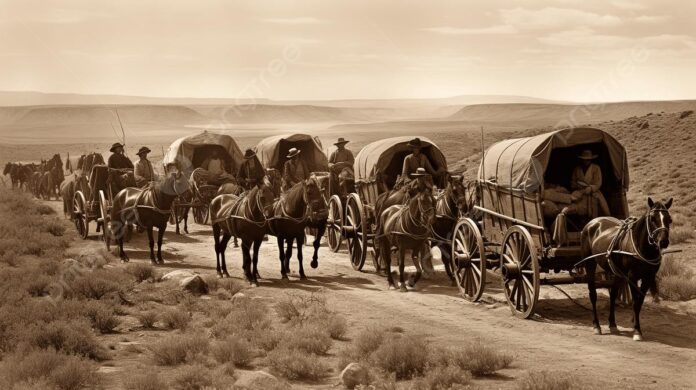
The Overland Trail is a 575‑mile stagecoach and wagon route that winds from eastern Colorado through southern Wyoming. The historic trail reconnects with the Oregon Trail at Fort Bridger, Wyoming.
The Overland Trail is perfect for RVers seeking a blend of open‑road freedom, low‑traffic byways, and living history. Plan to take this route for your next adventure.
A brief historical outline
Early trailblazers
Trappers and explorers like General William Henry Ashley traversed the Laramie Plains as early as 1825. John C. Fremont surveyed near Bridger Pass in 1842.
Stansbury and Bridger
In 1850, Captain Howard Stansbury of the U.S. Army Corps of Topographical Engineers, guided by Jim Bridger, charted a shorter east‑west route that became the Overland Trail.
Stagecoach era
Between 1862 and 1869, Ben Holladay’s Overland Stage Company ran mail and passenger coaches along this line. The Overland Trail provided a secure alternative to the Oregon Trail by avoiding conflicts and harsh terrain to the north.
Decline
Completion of the Transcontinental Railroad in 1869 rendered stage lines obsolete. However, wagon trains and emigrants continued using the trail for years afterward.
Where and how to access it
The Overland Trail begins near Julesburg, Colorado, just off Interstate 76. From there, it heads northwest across the South Platte River Basin. From Julesburg:
Colorado segment
Take US‑138 west from I‑76 to Sterling, CO. Visit the Overland Trail Museum (US‑6 and S. 3rd St.). It has fascinating dioramas and artifacts that bring stagecoach travel to life.
Continue west on US‑6/US‑287 past Fort Collins. Plan to stop at the Fort Collins Museum. You’ll see “Auntie” Stone’s cabin, originally a Camp Collins stage stop.
Wyoming segment
Cross into Wyoming on I‑76, which becomes I‑80. Exit near Carbon County for access to original trail ruts and the North Platte River Crossing (14 miles south of I‑80).
For a scenic detour, head south on County Road 3300 (Bridger Pass Road) off Wyoming Highway 70 near Baggs. This gravel route follows the Continental Divide Trail across Bridger Pass. Note: Check to be sure your RV has safe clearance.
Trail’s end
The historic Overland Trail rejoins the Oregon Trail at Fort Bridger, WY. There is an interpretive site on US‑30, where you can explore reconstructed stage stations and learn about the transcontinental stage lines.
Along the way
Here are just a few of the must‑see historic stops along the Overland Trail:
• Julesburg, CO: Once a busy stage station, today you’ll find signage marking the original stagecoach rest area and the modest town museum.
• North Platte River Crossing, WY: Trace dusty wagon ruts at this well‑documented crossing just south of I‑80. It’s ideal for a quick stop.
• Point of Rocks, WY: See the dramatic sandstone spires that provided landmark guidance for tired travelers. Accessible via a short pull‑off on I‑80 Exit 157.
• Granger, WY: Home to a small historic marker and access to the old stage road.
• Bear River City, WY: Visit the original ferry crossing site where pioneers crossed the Bear River.
• Bridger Pass: Stand where Captain Howard Stansbury first blazed this shortcut in 1850. The elevation here is 7,532 ft., so bring a jacket.
• Fort Bridger, WY: Explore reconstructed stagecoach stations and Fort Bridger Historic Site on US‑30. It’s a perfect spot for stretching your legs.
Tips for an Overland Trail adventure
Here are some tips that seasoned RVers recommend for a successful trip:
• Prepare for gravel: Bring tire repair kits and check your RV’s clearance. Or plan to take your truck or off-road vehicle on gravel roads.
• Plan fuel and provisions: Baggs, WY, is your last major resupply before Rawlins. You should plan to stock up there.
• Check road conditions: County roads can close after heavy rains. Local BLM offices and Carbon County travel sites have updates.
• Respect historic sites: Do not disturb the artifacts. Photograph them instead.
• Embrace flexibility: Weather can change quickly. It’s best to have alternative camping sites in mind.
You should go!
The Overland Trail is unlike the many crowded National Park loop roads. The county and BLM feeder roads along the old trail offer solitude and dispersed camping options. What’s more, you’ll experience big skies, see pronghorn herds, and enjoy dark‑sky camping. (Talk about incredible photography opportunities! This is it.)
You’ll also experience rich history at every turn along the Overland Trail. From authentic cabins at Fort Collins to stage station ruins at Fort Bridger, every stop provides a peek into frontier life.
Following the Overland Trail means you’ll cross rivers, high desert basins, and mountain passes. Hit I‑80 and major highways for easy RV towing. Then detour onto well‑graded gravel roads for a true overland spirit. Or set up camp and plan to take the Jeep out on a day trip along the trail.
Have you traveled all or part of the Overland Trail? Tell us about it in the comments below.
RELATED
- Famous historic trails are essential road trip routes for RVers
- Top 10 fall foliage RV road trips
- One of America’s best road trips: Drive the beautiful Great River Road
- 7 joyful road trip songs to start your journey
RVT1229


A map would have made the good article better.
I agree. I was trying to follow the described route but things weren’t adding up for me.
I-76 doesn’t go from CO to WY between Ft. Collins and Laramie, US 287 does. I-76 goes only from I-80 in NE to CO along the Overland Trail route. An interesting historical site on US 287 just south of the CO-WY border is Virginia Dale. It was a team change-meal stop on Ben Holladay’s Overland Stage Line established in 1862 by the infamous Jack Slade, who named it for his wife. “Infamous” for tying Jules Beni (of Julesburg fame) to a fencepost and shooting five fingers off befor killing him. It was a revenge killing for Beni shooting Slade 5 times and leaving him for dead. Unfortunately for Beni, Slade survived! See Twain’s “Roughing It” for more Slade tales.
We visited the WYO Overland/Oregon trail historical sites several years ago. If you want to find a place where time has stood still – don’t miss Atlantic City, WYO. (Rv not recommended). It is an education. At the time it wasn’t a tourist trap either – don’t know about current times. Great scenery and an historic mine too.