

By Cheri Sicard
Recently, Robin Barrett of Creativity RV noticed the water in the RV park where she was staying tasted a little funky. So, she decided to test the RV park water and what she discovered was shocking, including disturbing levels of sulfate and bacteria, including E. coli. WOW!
In this video (and article), Robin talks about the four potential sources of RV water and the tests she did to determine her RV water safety. She also talked about what she learned about water regulation and safety, a lot of which surprised her.
Robin started her explorations because there was an intermittent gaseous smell coming from her water taps. At first, she thought it was from her RV, but then the park started doing renovations and shutting the water off.
One day, while in the campground office, Robin noticed a public notice of water violations from 2020. What was on the paper was scary, so she got online to look up what was really going on.
The park had dozens of violations over a 10-year period. Some included failure to disinfect and elevated levels of lead, chlorine, and more.
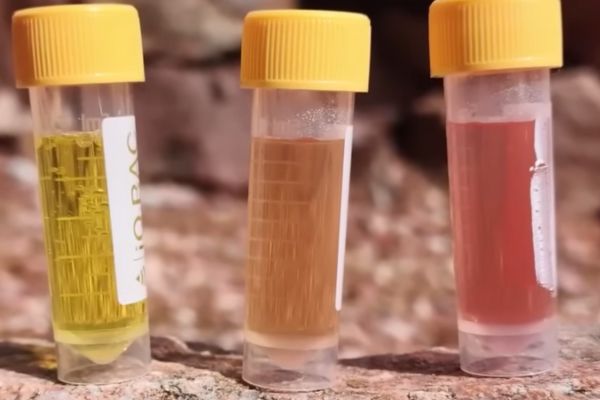
Robin ordered two different water testing kits from Amazon that test for 19 different factors. The results were not good.
In order to make the tests as accurate as possible, Robin tested the water from three different sources:
- Her RV’s kitchen sink
- The faucet in the RV park bathhouse
- From the spigot at the next-door empty RV space
She ran the water through the 19-test panel as well as tested for bacteria and E. coli.
Overall, the water was decent, EXCEPT in three categories:
- The pH level was way off.
- The water had sulfur levels that were off the charts.
- Bacteria and E. coli showed up in the empty space spigot test.
The sulfur levels would explain the nasty smell. And while sulfate levels in water are not regulated, high levels can be dangerous to certain people, especially infants, the elderly, and people who need a low-sodium diet. High levels can also act as a laxative and give you diarrhea.
When it came to bacteria and E. coli, the water in Robin’s kitchen sink was fine, but the water from the empty space next door tested positive. Robin suspects that previous occupants probably used the water spout to directly rinse out their black water hose. Ewwww!
Sources for RV park water
Robin incorrectly thought that water from the campground must be regulated. She discovered that RV park water can come from one of four sources:
- From the city if the park is close enough to city lines, which is normally tested
- A rural pump where the county pumps city water to county properties. This system will have redundancies in quality control, so there usually is no problem with this water.
- From a well
- Water delivered via truck
Robin found that a majority of parks she has stayed at get water via a well or delivery. Safety regulations vary state by state but can often leave the consumer anything but safe.
For instance, the campground where Robin tested the water was in Colorado, which requires them to test the water and report any problems. As she saw on the violation notices, this had not been done.
As their well was not large enough to service the park, they supplemented their water intake with trucked-in water that they brought in themselves, meaning no regulation. In theory, a water vendor would have had more oversight.
If you are concerned about the RV park water quality where you are staying, know that you can look up the results of their water quality online with the city or state.
Beyond that, Robin recommends a Berkey water filter. She repeated her water tests with the filter, and the test results came out much better.
RELATED
- Spring cleaning time for fresh water tanks
- Unusual ways RVers can use old water hoses
- Water pump noises could mean leaks in your RV’s water system
- Why RV water pressure regulators are essential
We NEVER drink RV park water! We can go 5 days using our on board water if we manage it carefully. We always leave home with our water tank full of 65 gallons of soft water from our house. If the need arises that we must refill our tank away from home then we will use bottled water for cooking and drinking. Once home I will re-sanitize the water tank before using it again. More than once we have arrived at a campground where there were notices posted not to drink their water because it was contaminated.
Don’t buy a TDS (total dissolved solids) tester to check your water. It is not that these inexpensive meters don’t work; it is that they don’t indicate what constitutes the dissolved solids in the tested water. And those dissolved solids could be benign, helpful or harmful; or each of the proceeding. No way to know.
1) I tried to find the water quality report for a recent trip to an RV park in Auburn, AL and could only find the municipal report. I don’t know where that CG gets its water.
2) Comprehensive water test kits are expensive and the test for bacteria takes 48 hours. Testing for chemical contaminants and hardness are easier and inexpensive.
3) There are no commercial filters designed for biologically unsafe water. You don’t know if your filters are contaminated. What’s in your fresh water tank?
4) The water least likely to have contaminants is distilled, but it won’t have beneficial minerals.
5) How safe is even your home’s water supply?
Many years ago we were in New Mexico and after a long drive we stopped for the night at a small RV park. It was after dark when I was checking in. I noticed a flyer that the New Mexico Dept. of Public Health has deemed the park’s water supply as unsafe due to e-coli bacteria contamination. Fortunately, we always traveled with at least a half-tank of fresh water in our motor home. When we awoke the next morning I saw the reason for the warning. Horse dung! Lots and lots of horse dung everywhere. On the water spigots, picnic tables…everywhere, It was a miracle I hadn’t stepped in it when hooking up the electric. We checked out and moved to a different park.
We routinely get brown colored water at Thousand Trails parks, so we have a 4-stage filter and use bottled water for drinking. I’m going to buy one of those testing kits on amazon because this is no joke.
I never drink the water but we do dishes and shower with it!
I don’t let my dogs drink it either.