

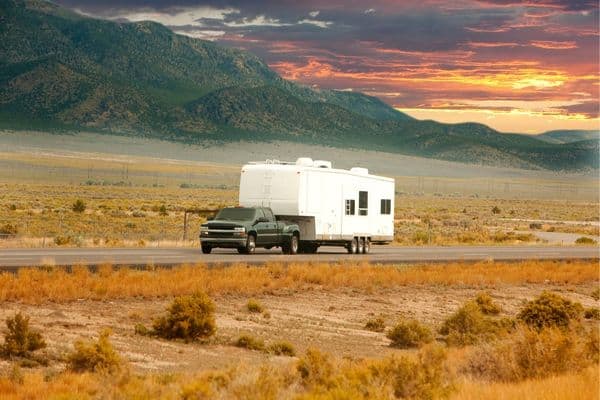
Sean and Kristy Michael, aka the team from the Long Long Honeymoon, have put together an extremely quick but useful video about the downhill side of towing steep grades.
Beginner RVers are definitely the audience this particular video is geared towards. After spending five minutes watching these tips, you should feel more confident about towing steep grades with your travel trailer or fifth wheel. And even though the video is geared toward those towing, the tips can also help those driving motorhomes in the mountains too.
You’ll enjoy gorgeous scenery of mountain passes and steep grades during the video in which the couple talks about towing tips to help you, your vehicle, and your trailer or fifth wheel arrive safely at your destination.
One of the most important points happens before you even leave your driveway. That is an honest assessment of whether or not your tow vehicle has the capacity to safely tow your RV over steep grades. If you hope to safely tow on mountain roads, your tow vehicle must have the ability to get the job done.
Other mountainous driving tips included in the video:
- A discussion of gears, the importance of lower gears, and when to use them.
- The importance of the Tow/Haul mode.
- The importance of using all the tools at your disposal.
- Extending the life of truck and trailer brakes.
If you are at all apprehensive about driving your RV on steep grades, watch the video and get better acquainted with the things you can do to make the experience safe and stress-free.
##RVDT1979

Is exhaust brake only available on diesel powered vehicles?
Good question, I’m also not familiar with exhaust brakes but seems to be a diesel thing, at least that’s what Wikipedia says.
Mostly true, as diesels do not have a throttle plate in the induction system there is nothing to slow the induction of air. An engine is basically an air pump with fuel and ignition. A gas engine uses a throttle plate to measure incoming air, so when you let off the gas pedal the throttle plate closes stopping air movements creating a vacuum in the intake, now the cylinders are working against the vacuum acting somewhat like an exhaust brake just not as good.
No, you can find gas vehicles that have it. We had a F250 gasser with it, but it engaged automatically. We didn’t realize initally that the truck had this feature, it engaged one day and scared us to death…lol Our new truck is a diesel F350 and of course has the manual on/off option.
The highway they showed themselves going up hill on in OR looks like the exact same highway we were on, headed uphill, when we met a wide load coming downhill going way too fast and had crossed over the double yellow into our lane. Luckily the shoulder was super-wide and we escaped disaster by using the entire shoulder on our side. Whew!
Here’s a link from YouTuber RV Love https://www.youtube.com/watch?v=0ie4M3V6hm4 who takes a calm common sense attitude while driving passes. The video takes you over the Continental Divide on Homestake Pass east of Butte, Montana. The road climbs fast and semi drivers have a speed limit of 25 mph on the descent due to a 6% grade which isn’t crazy but throw in the curves and you need to pay attention. My dad always said go down a pass in the same or lower gear you climbed, use the Tow/Haul and you’ll save your brakes. His advice served me well when I got my own RV.
You should shift your transmission into the same gear it would be in the ascend the grade before starting down the grade. DO NOT wait until you are going to fast to downshift, you can damage your transmission or it may not downshift leaving you totally out of control.
My advice for descending long steep grades when towing and using your rigs brakes in addition to engine braking, is to have both the tow vehicle and trailer brakes balanced (all working together when depressing the brake pedal). If the tow vehicle or trailer brakes apply more forcefully than the other, the risk is overheating the tow vehicle brakes or the trailer brakes. All braked axles work best when working together over one or more axles braking unevenly. And too, the rig will stop quicker and more controllable in heavy traffic if making a panic stop when having balanced braking. Brake vibration, brake odors, and/or smoke are signs of overworked brakes.
People sometimes only consider the steepness of the grade and not the length.
The steepness tells you how HARD you’ll have to apply the brakes, the length tells you how LONG you’ll have to apply the brakes.
Both are equally important in calculating a safe speed.