

By J.R. Montigel
If you’re never heard of Eureka or Faro, North Carolina, there’s good reason. They are tiny, out-of-the-way farming communities of no particular importance. But, oh my, you would definitely have heard of them if circumstances one day in 1961 went differently. The towns would have been ground zero of one of America’s most deadly disasters, leveling both communities and others nearby.
On that day, January 24, 1961, one of the most dangerous nuclear accidents in U.S. history occurred in the area, which is near Goldsboro, where a U.S. Air Force B-52 bomber carrying two hydrogen bombs broke apart in midair. The incident came perilously close to disaster and provides a chilling reminder of how such a massive catastrophe could occur at the spur of a moment.
The Boeing B-52G Stratofortress had departed on a routine mission from Seymour Johnson Air Force Base carrying two Mark 39 thermonuclear bombs, each with a yield of about 3.8 megatons — more than 250 times the power of the Hiroshima bomb.
Shortly after an in-flight refueling, another crew noticed the bomber leaking fuel from its right wing. The leak worsened rapidly, and the aircraft lost massive amounts of fuel. The crew attempted to return to base, but structural failure sent the plane spinning apart at about 9,000 feet.
Five of the eight crew members survived after ejecting or bailing out. Three died.
Disaster (barely) avoided
The greater danger involved the nuclear weapons.
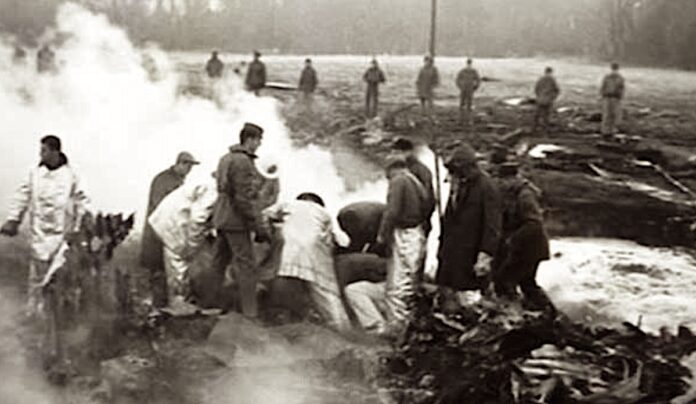
One bomb descended by parachute and landed largely intact in a field. The other plunged into muddy farmland and broke apart, burying parts deep underground. Recovery crews retrieved much of it, but some bomb components remain buried on private property monitored by the government.
Years later, declassified records revealed how close the nation may have come to catastrophe.
Investigators found multiple safety systems on one bomb had failed during the crash. According to later reviews, only a single low-voltage switch prevented a nuclear detonation.
Experts’ consensus was that the weapons were capable of exploding and delivering a nuclear blast sufficient to level homes in a five-mile radius and cause third degree burns and set houses afire within nine miles. Many historians believe that the “Goldsboro Incident” was one of the closest near-disasters related to the Cold War.
The military classified the event as a “Broken Arrow” — an accident involving nuclear weapons that does not create a risk of war. The crash later intensified debate over nuclear safety and Cold War-era airborne nuclear patrols.
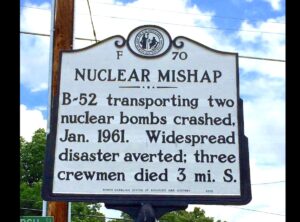
A North Carolina historical marker now commemorates the site in the center of Eureka. The actual site where the bomb entombed itself is in an unmarked farm field 1.5 miles southwest of Faro on Big Daddy’s Road.
Here’s a video that commemorates the 62nd anniversary of the crash.
