

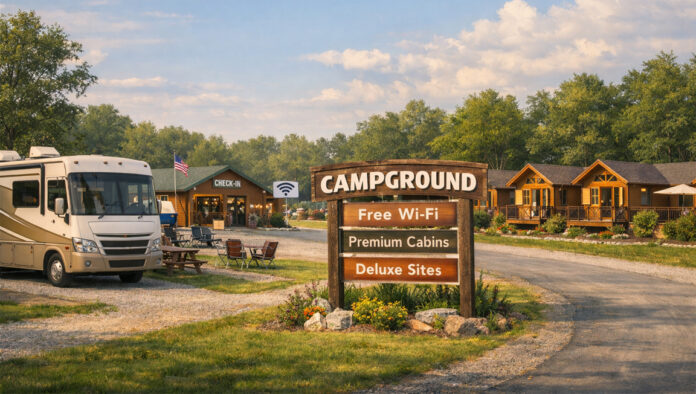
Campground rates keep rising—even for RVers who don’t use the extras. From campground Wi-Fi upgrades to glamping units and luxury amenities, parks are spending more to attract new campers, and longtime RVers are increasingly picking up the tab.
If that sounds blunt, think about the last few years. You roll into a park you’ve used before and the price is up again. The sites are the same size. The hookups work… mostly. But now there’s a shiny new check-in system, a promise of “high-speed Wi-Fi,” and some kind of new “premium” lodging on the edge of the property that looks like it came out of a boutique hotel brochure.
Meanwhile, you’re sitting there thinking: We’re in an RV. We already brought our house.
To be clear, this isn’t an argument against reliable Wi-Fi. Many RVers want it, use it, and depend on it—especially those who work on the road or stay longer than a weekend. Solid infrastructure is part of modern camping. The question isn’t whether Wi-Fi belongs in campgrounds. It’s whether Wi-Fi—and other upgrades—are being used to solve the right problem.
So what’s going on?
Call it the amenities arms race.
A January 2026 industry white paper called The Great Outdoors Disconnect: Why Wi-Fi Won’t Save the Campground argues that a big slice of the outdoor hospitality business has gotten itself into an “amenities arms race”—and that it’s a race parks can’t win.
Reliable Wi-Fi is one thing. Bundling it into a broader push toward luxury cabins, concierge services, and constant reinvention is where costs start to climb.
To attract younger campers, many parks have poured money into faster internet, glamping pods, luxury cabins, app-based concierge systems, and curated “experiences.” None of that is free. Those investments are paid for through higher nightly rates, added fees, and a gradual shift away from traditional RV sites toward higher-margin accommodations.
The problem, the paper argues, is that when campgrounds compete on comfort and convenience, they aren’t really competing with other campgrounds. They’re competing with hotels, Airbnbs, and people’s own homes. And that’s a competition the outdoors is almost guaranteed to lose.
Chasing a camper who may not come back
Here’s where this starts to matter to you.
According to research cited in that white paper, 37% of Gen Z (people born between 1997 and 2012) campers are classified as “at-risk,” meaning they express interest in camping but either never show up or try it once and don’t come back. That’s the highest at-risk rate of any generation measured.
That’s not a knock on younger campers. It’s a business reality. Campgrounds don’t survive on curiosity. They survive on repeat visits. When repeat visits don’t materialize, parks are forced to keep chasing new guests—and that chase gets expensive.
Those costs don’t vanish. They get spread out across everyone who does come back.
Why Wi-Fi doesn’t fix the real problem
The white paper isn’t saying amenities are useless. It argues that the industry has leaned on them as a shortcut—using expensive upgrades to signal “modern” rather than addressing why new campers don’t become regulars. There’s a real difference between investing in infrastructure RVers actually use and pouring money into headline-grabbing features that raise rates without creating long-term loyalty.
Faster Wi-Fi doesn’t solve that. Luxury cabins don’t build confidence. And once the novelty wears off, many first-timers drift away—leaving parks with higher operating costs and fewer loyal regulars.
How this shows up for longtime RVers
If you’ve been camping for years, you’ve probably noticed the effects even if you didn’t connect the dots.
Rates rise even at parks where the core infrastructure hasn’t changed much. Traditional RV sites quietly disappear to make room for cabins. There’s more turnover and fewer regulars who understand campground etiquette. Staff spend more time orienting first-timers, which can leave experienced campers feeling like an afterthought.
It’s not because longtime RVers matter less. It’s because parks are trying to buy loyalty instead of building it.
A cheaper solution most campers already understand
One of the more interesting points in the white paper is that the solutions that actually work are far less expensive than the amenities grabbing all the attention. Programs that focus on basic skills, clear guidance, and normalizing small mistakes tend to turn nervous first-timers into confident repeat campers.
That kind of approach doesn’t require massive construction projects or tech upgrades. It requires time, patience, and a willingness to meet people where they are—something camping has always done pretty well when it’s allowed to do so.
Why this matters even if you’re not the target market
We Boomers won’t be the largest camping demographic forever. That’s just math. But the future of affordable, recognizable camping depends on whether today’s newcomers become tomorrow’s regulars—or whether parks keep raising rates to pay for amenities that never quite solve the problem.
If the industry keeps chasing loyalty with expensive extras, campground prices will keep climbing and the camping many of us prefer will keep getting squeezed. If it focuses on turning first-timers into confident campers who actually come back, that benefits everyone—including the people who never asked for Wi-Fi in the first place.
Sometimes you’re not paying more because camping costs more. You’re paying more because the industry is trying to buy a new customer—and hoping they stick.
RVT1246b

Is it just me, or is the campground art at the top of this article generated by AI? And if it is, why isn’t it labeled as such?
(One clue: who designs an RV park with a site that can’t be backed into without running over the entrance sign?)
Sorry, Andy. Russ and Tiña usually identify A.I.-generated illustrations as such. I didn’t notice that this one wasn’t. It is now. Thanks! Have a good evening/night.🤗 –Diane
😉 !!
They raise rates because they can. Until they can’t , they go into bankruptcy, and another thief puts up a fullfillment/ data center which drives up my utility rates. Bye,Bye the RV world I knew.
Yet the current management keeps trying to sell us on Affordability and lower prices. What a joke.
Well, I’ll take 2.7% inflation over 8% or 9%! 😁
The really big spikes were under the former management and those aren’t going away, which really impacted affordability. All one can hope for is a reduction in the rate of increase, and that’s what we’ve seen. The Federal Reserve targets 2%, so it’s been edging toward that goal. If overall inflation goes negative (deflation) that most likely means we’re in a recession, and no one wants that.
In fairness to BOTH management, the Federal Reserve has a huge role in inflation management and they screwed up BIG time by not taking restrictive policy action much earlier.
Old management lit the fire, stoked the fire and fed the fire and now you are blaming current management for the destruction that fire caused. We get it Ron, you don’t like the new management but gaslighting people who reside in actual reality is so last year. I’ll stick with current management and give thanks for 2.7% inflation, 8% higher wages, projected 5.4% GDP growth, actual 4.6% GDP growth, lowest overall crime rate in 40 years and the lowest murder rate in 125 years. In a very short 3 years from now you can choose to go back to 7% inflation, high crime, lower take home wages and 1.6% GDP growth. We all get to choose.
Best,
CP
“Programs that focus on basic skills, clear guidance, and normalizing small mistakes” seems the key phrase in the article. But can you give examples? What does this actually mean? Thanks for an interesting topic!
One of the bigger cost adders has been reservation fees, which really increase the cost of an overnight or two night stay.
For those of us who have been RVing for decades, remember when you just called and made a reservation, no additional charge? Now that’s rare. We are forced to go online and for the privilege get charged $3 to $7, and even more (had one @$17.70!) So let’s say $5 is an average…on a one night stay in a $50/night park, that’s 10%! 5% for a 2 night stay.
Municipalities are jumping in as well with the equivalent of “room tax.”
And don’t get me started on bad CG WIFI!
More and more RV parks are spending huge sums of money on WiFi yet smarter RVers are providing their own solutions and those solutions are getting better and better. I can’t remember the last time I used campground WiFi…oh, wait, yes I can. I got my credit card number hacked. Is there really value in a campground spending a small fortune on a solution many RVers have already found an answer to?
Mostly because campground wifi was so unreliable, I found my own portable solution. Not cheap, but it-just-works. Why would I go back to guessing what kind of internet connection I might get, have to create new logins (or no-login NO security) with each campground?
I was 100% remote work. My wife retired, but I needed to cover health insurance for two more years. We opted to winter in the south even if I was ‘in the office’ every weekday.
I agree, Tony. 👍
KOA lost my loyalty over this issue. Sure great staff, nice camp store, clean bathhouse. And, (at least in the RV section) rutted roads, loose power outlets, worn out plumbing. Most expensive parks on our route. But really nice glamping cabins just outside the RV sites.
We had stayed at the West Glacier KOA, Montana for years. We called a year ago for reserving our favorite campsite (back in site with only H20/elec for our 24′ RV) and it was over $250 per night. We told them no thanks and found another place to camp nearby.
I’m not sure a better kept or prettier, KOA exists in America. WG KOA is awfully nice. Pricey AF but in our travels we have not encountered another KOA quite like West Glacier.
If $200-$350/night does not offend you too much, this place is worth spending some time at. If ice cream and a little gentle live music are a good way for you to finish up after a day of sight-seeing or hiking, try out WG KOA.
Steve is correct, this KOA prices/values themselves high but for many people searching for high end glamping in 2026, you can get your glamp on at this park, still find nature and reservations are not easy, they are packed full all season for a reason.
😎✌️
Dynamic pricing is likely to keep us out of KOA and anyone else that uses it.
We’ve used KOA as our backup plan for years. Double the price doesn’t work!
👍
I refuse to stay at any campground that participates in dynamic pricing. Really don’t stay at those that try to fee their customers to death. Both models that KOA thrives on. Plenty that don’t so I still have lots of choices without being screwed by those CGs. For those that want to promote that pricing model for camping by patronizing them, be my guest. Stay and pay.
Remember my old saying…KOA means “Keep on adding”. And their answer is if you don’t like our prices “Kiss Our Axx”!
In Utah, our state parks have jumped on this band wagon. What used to be $15 for a dry camping site with lots of room between you and the neighbor have been “upgraded” to W/E sites crammed together for $45/$50 a night. This has happened at a dozen park campgrounds with more in the works. I can see why the younger folk try camping once and never go back. Who wants to be crammed 10 feet away from a neighbor? Even with the best of neighbors, that’s too close. It’s not exactly the peaceful nature experience they are looking for. Camping in RV parks and now our Utah State Parks has really lost its allure.
When RVers stop paying these outrageous prices and stop the silly and unnecessary need to fully hookup every night, the camp fees will decrease.