


Dear Dave,
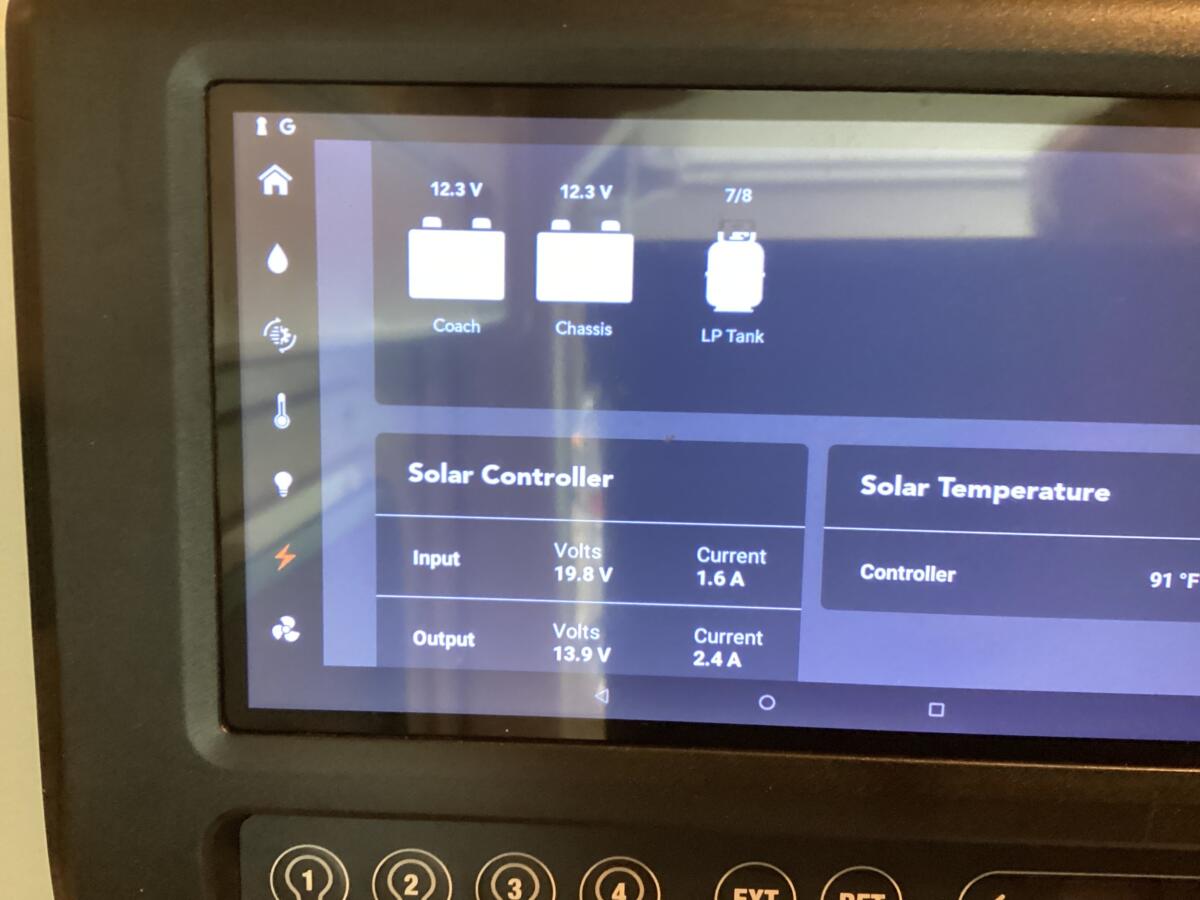
The batteries are slowly draining on this rig I just got two weeks ago. Our trip home was 800 miles. The engine charges the battery. The gen does not, nor does the shore power, nor the solar. I have traced the solar and it shows on the BMPRO control panel that the output is 13.8v 2.2a, yet the battery voltage reads 12.0v right now.
The rig is plugged into shore power and I can hear the converter kick in once in awhile with the interior lights on. As soon as I start the engine, the voltage shoots right up to 14.1v. Any ideas? There must be a common point after the converter that it and the solar have that is fused or broken? —Ed, 2023 Thor Vegas 24.4 on E450 chassis
Dear Ed,
There are several variables that pertain to your battery not charging or slowly draining. First, what is the type of battery and the size? I’ll assume the house batteries are original and most likely flooded lead acid (FLA). If so, since they are at least four years old, they may not be in the best condition.
Next questions
The next questions are: What is the amp hour rating, and one or two batteries?
The photo you provided shows one coach or house battery icon and one chassis battery. However, most of the Class C motorized RVs had two house batteries connected parallel. That is positive to positive and negative to negative, providing a 12-volt bank with double the original amp hours. It would show as one battery on the monitor.
And, finally, what size is the solar panel? If it is a solar panel installed by the manufacturer, most likely it is a 100-watt panel. Then the 2.2-amps shown in the photo are basically a maintenance charge that will not keep up if anything is drawing 12-volt power.
When you start the engine, the engine alternator will start to charge the chassis battery somewhere around 14 volts. You should be able to verify this using a multimeter on the chassis battery. It should read 12.6 volts and then jump to 14+ volts when you start the engine.
Battery isolation manager
Your rig should also have a battery isolation manager (BIM). That is a solenoid that allows the charge from the alternator to go through it and to the house batteries. You can also verify this with a multimeter placed on the house battery. It should read 12.6 volts if fully charged and not getting a charge from the solar panel or plugged into shoreline power.
When you start the engine, the house battery should jump to 14+ volts. If not, the BIM might be bad. Some BIM solenoids will also provide a charge from the house batteries via the converter to the engine battery. This can be verified by using a multimeter on the chassis battery without the engine running and then plug into shoreline power. This will energize the converter and should provide at least 13.2 volts through the BIM.
House batteries
Now let’s take a look at the house batteries and what is happening there. If they are FLA batteries, a fully charged bank should read 12.6 volts with nothing charging them. I don’t trust the monitors installed; rather, use a multimeter at the battery with the solar panel off and not plugged in. This chart shows the State Of Charge (SOC) depending on the voltage.
| Voltage | State of Charge (SOC) |
| 12.6 | 100% |
| 12.5 | 90% |
| 12.42 | 80% |
| 12.32 | 70% |
| 12.20 | 60% |
| 12.06 | 50% |
| 11.9 | 40% |
| 11.75 | 30% |
| 11.58 | 20% |
| 11.31 | 10% |
| 10.5 | 0% |
Now plug the shoreline cord into a verified 120-volt/30-amp power supply. You can use a 20-amp, but make sure nothing else is on, such as an air conditioner or refrigerator, so you don’t overload the circuit. If the battery bank was below 12.6 volts, the converter should provide 13.8 volts, or close, to charge the battery bank. You can verify this at the house battery with a multimeter. When the battery bank reaches a fully charged 12.6 volts, the converter should drop to 13.2 volts, which is a maintenance charge.
If you are not getting these readings, the converter could be weak, your shoreline power might not be at 120 volts, or your cable from the converter to the battery might either be too long or not the right size wire or “gauge” and you are getting voltage drop.
You might also enjoy these posts from Dave
- What does 50% State Of Charge (SOC) of a 12-volt battery mean?
- Do I need a trickle charger for my engine battery when I have shoreline power?
- My RV’s new house battery will only charge when driving. Why?
- No power from RV house battery. Could it be bad battery disconnect switch?
- RV engine battery goes dead periodically. What is best booster?
- My batteries don’t charge when connected to shoreline power. How can I test my converter?
DAVE HAS ANSWERED MORE THAN 1,200 readers’ maintenance and repair questions. Read a directory here. There is so much to learn!
Dave Solberg is a leading expert in the RV industry and the author of the “RV Handbook.”
HAVE A QUESTION FOR DAVE?
Send your inquiries to him using the form below.
RVDT2950
