

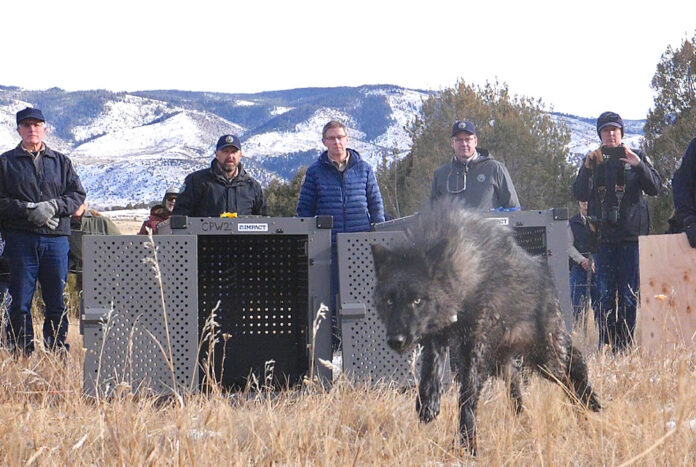
If you are visiting Colorado and think you hear the howl of a wolf, it’s possible you are correct. But it would be a rare instance if so. Colorado Parks and Wildlife (CPW) experts released five gray wolves onto public land in Grand County Monday in a historic effort to create a permanent, self-sustaining wolf population and fulfill voter approval to re-establish gray wolves in Colorado.
The gray wolves were captured in Oregon, where CPW veterinarians and biologists evaluated them to determine if they were fit for relocation to Colorado. Criteria for release included the age, sex, health and body condition of each animal.
Each gray wolf was weighed and measured. Staff collected genetic material – tissue and blood samples – before fitting each with a GPS satellite collar for tracking upon release by CPW staff. Then, the wolves were given vaccines and were placed in crates and flown to Colorado for release back into the wild.
Colorado’s new wolves:
2302-OR: Juvenile female, black color, 68 lbs., Five Points Pack
2303-OR: Juvenile male, gray color, 76 lbs. Five Points Pack
2304-OR: Juvenile female, gray color, 76 lbs., Noregaard Pack
2305-OR: Juvenile male, black color, 93 lbs., Noregaard Pack
2307-OR: Adult male, gray color, 108 lbs., Wenaha Pack
Note: All wolves captured, collared and released in Colorado will use the same naming convention: The first two numbers (23) will indicate the year the animal was captured. The second set of numbers informs biologists of the wolf’s gender (males will have odd numbers, females even) and the order in which it was collared. The “OR” suffix indicates the wolves came from Oregon.
CPW will repeat the process until at least 10 to 15 wolves have been reintroduced in Colorado by mid-March 2024. As outlined in the Colorado Wolf Restoration and Management Plan, CPW hopes to release 30 to 50 wolves over the next 3 to 5 years using wolves captured from nearby northern Rockies states from several different packs by trapping and darting them in the winter.
Gray wolves are listed both by the state and federally as an endangered species in Colorado by the U.S. Fish and Wildlife Service (USFWS). The U.S. Fish and Wildlife Service has designated the Colorado wolf population as experimental under the Endangered Species Act. This provides management flexibility that would otherwise be prohibited.
CPW’s reintroduction program builds on work started by the USFWS in 1995 when that federal agency began restoring gray wolves in the Western U.S., starting with an experimental population released in Yellowstone National Park in Montana. Wolf reintroduction efforts eventually spread to Wyoming, Idaho, New Mexico and Arizona.
The new wolves will be managed by CPW using the Colorado Wolf Restoration and Management Plan, approved by the CPW Commission in May 2023, after more than two years of extensive statewide stakeholder meetings and outreach via a series of public hearings.
Ultimately, CPW plans to recover and maintain a viable, self-sustaining wolf population in Colorado while balancing the need to manage interactions between wolves, people and livestock.
This project marks another milestone in the long CPW tradition of species recovery in Colorado. These include the black-footed ferret, one of North America’s rarest mammals, the 1999 effort to reintroduce the lynx, the Rocky Mountain bighorn sheep, the greenback cutthroat trout, and many more.
Making history
“Today, history was made in Colorado,” said Colorado Governor Jared Polis. “For the first time since the 1940s, the howl of wolves will officially return to western Colorado. The return of wolves fulfills the will of voters who, in 2020, passed an initiative requiring the reintroduction of wolves starting by Dec. 31, 2023. What followed were three years of comprehensive listening and work by Colorado Parks and Wildlife to draft a plan to restore and manage wolves that included public meetings in every corner of the state and was inclusive of all points of view and weighed the needs of a wide range of communities with a deep interest in the thoughtful outcome of this effort.”
“Pulling off a successful first wolf release in Colorado touched all corners of our agency,” said Reid DeWalt, Assistant Director for the Aquatic, Terrestrial, and Natural Resources branch of CPW. “This has been two years of work to approve the plan plus another year of work to secure our first source population and get us to this release day. We are grateful to the Oregon Department of Fish and Wildlife for working with our agency on an agreement for up to 10 wolves and for all the CPW staff who contributed to this historic day.”
“It was an honor to participate in this historic effort,” said CPW Wolf Conservation Program Manager Eric Odell. “We were thrilled to have great conditions for capture and early success in Oregon. Weather conditions and information on pack locations provided by Oregon Department of Fish and Wildlife staff combined to help us capture five gray wolves on day one of capture operations in northeast Oregon and release them earlier today on Colorado’s Western Slope.”
##RVT1136b

Interesting article. Not sure why we need to re-introduce Apex predators in our parks, and the statement that the “wolves will be managed” is questionable. Maybe some polar bears next? 😀 🙂
The health and quality of the “prey” populations in the release areas are improved by the natural predators. Much as when a fire is a natural way of nature to restore areas.
Correction: THE apex predator is……Man!
Wonder what all the ranchers and cattlemen think about this. And what happens when the packs outgrow their specific areas ? Open hunting season??
Weren’t the wolves in Colorado long, long before the ranchers? Just saying.
Thank you, RV Travel. They tried to reintroduce red and gray wolves into Tennessee. The party-line is that it failed. I hope that is right, coyotes are a big enough problem without adding wolves to the equation. I’m not sure why Colorado wanted to reintroduce wolves, but I rarely get there anyway.
Because it was put to a public vote, and the voters who know NOTHING about ranching, thinking it was KEWT, voted for it…Living in a ranching community at the time, I know how this will end. Dead wolves. Ranchers protect their animals, thus their income…btw, I voted against it.
What is going to happen when the wolves start killing livestock or even a human out camping alone or hikeing. Wolves 1 humans 0 no recourse?
They have set up compensation in those events.
Stop and think about WHY the wolf population was eliminated from Colorado years ago.
Maybe because of the mighty $. Cheap grazing land by ranchers.