

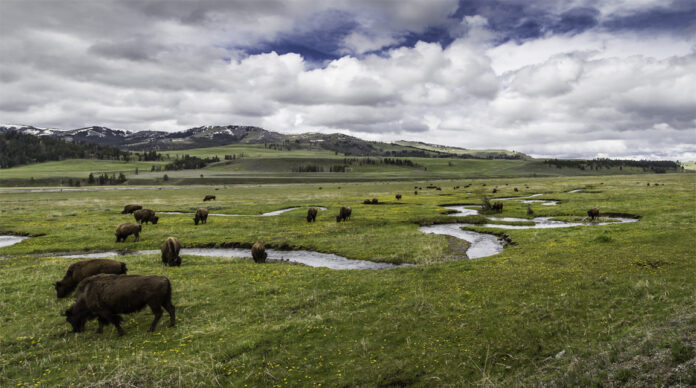
Theodore Roosevelt said, “The extermination of the buffalo has been a veritable tragedy of the animal world.” While they didn’t quite reach extinction, it was close. Because of that, each year millions of tourists view these magnificent creatures with awe in Yellowstone National Park. But the bison presence isn’t an easy thing. Too many bison in the park’s confines can lead to problems. What will happen to Yellowstone’s bison?
Environmental impact statement tells the tale
 Today, June 6, the Park Service published its Final Environmental Impact Statement (FEIS) for a Bison Management Plan. We now have an answer to the question. The FEIS presents a broad range of actions for managing bison inside the park. The Services says the plan allows them to manage bison based on new scientific information and changed circumstances. A major part of the plan includes exploring ways to increase the transfer of bison to American Indian Tribes, and to continue working closely with Tribal Nations and agency partners.
The plan aims to preserve an ecologically sustainable population of both wild and migratory bison. At the same time, the Service would work with partners to deal with major problems. Problems like brucellosis transmission, human safety, and property damage. And finally, the plan works out taking care of the responsibility that the Park Service has to relevant Tribes.
What happens to Yellowstone’s bison? Here’s the goal
For more than 20 years the Park Service has been working with other concerned parties on the Interagency Bison Management Plan. The plan aims to cover several important objectives:
- Maintain a wild, free-ranging bison population
- Reduce the risk of brucellosis transmission from bison to cattle
- Manage bison that leave Yellowstone National Park and enter the State of Montana
- Maintain Montana’s brucellosis-free status for domestic livestock.
The FEIS also considers the bison management actions likely to occur on lands outside the park in Montana, and it maintains the Service’s commitment to working with the state, Tribes, and other federal partners to balance bison management efforts. The Park Service acknowledges it does not have jurisdiction or control over actions such as hunting or tolerance for bison beyond the park boundary.
Three alternatives
This Final Environmental Impact Statement has three “alternatives,” the second of which the Park Service favors.
- The National Park Service (NPS) would continue managing bison under the existing Interagency Bison Management Plan (IBMP), approved in 2000. This would maintain a population range of bison similar to the last two decades (3,500 to 5,000 bison after calving). It would continue hunt-trap coordination to balance population regulation in the park by using harvest and hunting opportunities outside the park. It would increase the number of brucellosis-free bison relocated to Tribal lands via the Bison Conservation Transfer Program. And finally, it would work with the State of Montana to manage the already low risk of brucellosis spreading from bison to cattle.
- Preferred Alternative: Bison would be managed within a population range of about 3,500 to 6,000 animals after calving. The emphasis would be on using the Bison Conservation Transfer Program to restore bison to Tribal lands and Tribal treaty harvest. It would encourage public hunting outside the park to regulate numbers.
- The NPS would rely on natural selection, bison dispersal, and public and Tribal harvests in Montana as the primary tools to regulate numbers, which would likely range from 3,500 to 7,000 or more animals after calving.
Tomorrow, June 7, 2024, the Notice of Availability of the FEIS will be published in the Federal Register. That will initiate a 30-day wait period. After the wait period, the NPS will sign and publish a Record of Decision, detailing the selected action. The fate of Yellowstone’s bison will be made clear.
You can find the FEIS and additional information here.
##RVT1160b


We live in Montana, it is hard for us to get excited about seeing Bison in Yellowstone. A few ranchers in our area raise them. Just like cattle, they are raised for their hides & meat. If you have never eaten bison you are missing out. Very lean & very tasty. Quite pricey tho.
We live in Montana also. No matter how many decades we’ve cruised the park.. it’s always thrilling to see the Bison herds especially in the Lamar Valley. They are magnificent beasts with a rich history. Who can’t be excited to see an animal with a blue tongue?? But they can’t be left to propagate without restrictions; they can’t out number the amount of forage available in the Park. Once they leave YNP borders is the perfect opportunity to reduce their numbers by several different means. And the meat is tasty when cooked properly.
I’m sorry to hear that another magnificent creature is getting in the way of our insatiable appetite for pleasure and profit. Madness.
Thank you, Russ and Tina! 🙂 Wow! They have “worked” on the plan for more than 20 years!?!?! That is a lot of meetings! While I worked in the federal government meetings were the best way to avoid work and be at work. 🤔😯 In any case, this stuff essentially is none of my business. We don’t run cattle any longer, live about 2000 miles away, and the next time I am in Yellowstone will be the first time (ditto for Montana). If the Park Service wants what is behind Door #2, then more power to them. Thanks again, Russ and Tina, and safe travels! 🙂 😎
Thanks for another good report R & T ! I dont have enough knowledge of the situation to form my own opinions on this, but like Neal said, 20 years seems like an awful long time to come up with this management plan.
My father, a career economist with USDA, was determined that we would get to taste some of the early attempts to reduce the wild hordes(late 1950s-early 1960s). He warned us the fat would be greenish (grass finished) and that we might chomp on a bullet. Back before Temple Grandin reformed the meat harvest business, cattle entered a room one at a time where a person stunned them with a sledgehammer between the eyes. Their legs would then be fastened to a chain which hauled them down to the line where a quick throat slash would bleed them out. The system depended on them being stunned. The first time a bison walked into the kill room, the sledgehammer stun merely infuriated it
It began to tear the kill room apart and the bison in the chutes also went crazy & tore the chutes apart. My father told that since this was Chicago the meatpackers merely called in some favors and some “organized crime” hit men came out with machine guns and took the bison down. I don’t know if this is verifiable but it is a family story.
I remember seeing the sledgehammer and chain thing in a movie at a drive-in back in the 60’s, only it was with cows, not bison. Nasty to watch. That’s not what I took my girlfriend to the drive-in for. Ahem . . .
Bison population management, along with all wild animal, management is a controversial subject. I guess human population management, although seldom talked about, would be just as controversial but more imperative.