


At the Caravan Salon in Düsseldorf, Germany, Myles, of Myles RVs, came across something that still feels unusual in Europe: a true fifth wheel RV. Since this is the largest caravan and RV show in the world, it was the right place to spot one. The surprise was not just that it existed, but how different it looked from a typical U.S. fifth wheel, in size, build quality, and price.
A rare fifth wheel at a European RV show
Big towable RVs are not common in Europe. Most buyers lean toward smaller caravans/trailers or motorhomes, and trucks are far less common, too. In four days at the show, Myles only spotted two half-ton trucks, both in this display.
That makes the Fifth Wheel Co. Celtic Rambler stand out even more. It is described as the only fifth wheel manufacturer in Europe, and its units are built more like made-to-order products than dealer inventory. Buyers can tailor them, then wait about six months to a year for the build. The brand also offers the smaller Dream Seeker, aimed at lighter trucks such as a Tacoma-sized pickup or a Volkswagen truck.
Weight matters more than size
The towing numbers are where things get interesting. This fifth wheel has about a 1,300-pound hitch weight, which is a lot for a half-ton truck. In U.S. terms, that usually pushes buyers toward a 3/4-ton truck, even though the total trailer weight stays under 10,000 pounds.
Here is the quick spec breakdown:
| Spec | lbs. | kg |
| Dry weight | 7,275 | 3,300 |
| Gross weight | 9,480 | 4,300 |
| Payload capacity | 2,200 | 1,000 |
So, the overall trailer weight looks manageable, but the payload is the real issue once passengers and gear go into the truck.
The interior feels far more upscale than expected
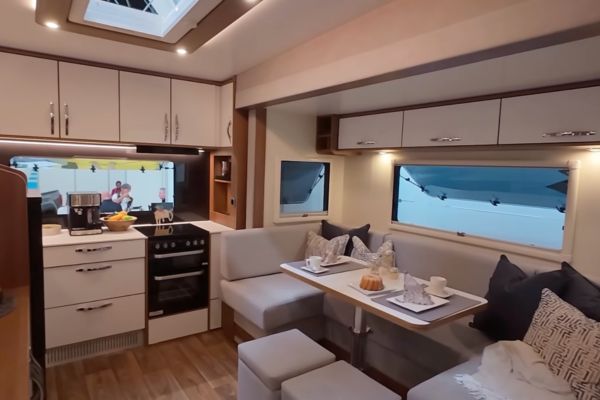
Inside, the Celtic Rambler feels closer to a high-end motorhome than a small fifth wheel. The layout shown had two skylights, two-tone cabinetry, a U-shaped dinette, and materials that looked solid and light at the same time. Myles also found a washer-dryer unit and a dishwasher, which is not something most people expect in a fifth wheel this size.
The kitchen used an L-shaped counter, Corian countertops, a large round sink, a four-burner stove, and double ovens. Meanwhile, the heating system appeared to be Alde radiant heat, not the usual floor vents seen in many U.S. towables.
Upstairs, the bedroom has twin beds that can turn into a king. The bathroom added a full-length mirror, a towel warmer, and a surprisingly roomy shower.
Full fiberglass construction changes the whole conversation
The exterior may be the biggest story. The front cap, roof, underbelly, and even parts of the slide structure appeared to be molded fiberglass. That means fewer seams, cleaner finishing, and a much more polished look than many U.S.-built fifth wheels.
Other European details stood out, too. It uses a cassette toilet instead of a large black tank, likely because weight rules are stricter. It also appears to have independent-style suspension, dual-seal compartment doors, and a 3,000-watt inverter that can run the air conditioner for a time, depending on battery and solar setup.
The price explains why the Celtic Rambler is still a niche product
This is where most buyers would stop and think. The featured unit was listed at around €228,000, and another version showed €157,000. That puts it roughly in the $170,000 to $250,000 USD range, depending on build and conversion.
In short, this is fifth wheel pricing that competes with luxury brands, not entry-level RVs. The tradeoff is clear: Europe offers tighter production, better materials, and far more refined construction, while the U.S. offers many more sizes and prices.
For anyone wondering whether this would sell in the U.S., the answer probably comes down to one thing: how much buyers truly value quality once the price is on the table.
Big Amazon RV gear sale runs through March 31— Check out these deals!
RELATED
- The unusual 2026 Beauer 3X European expanding travel trailer
- This European trailer is built more like a yacht
- 2026 Airstream Globetrotter 30RB—European-style in an Airstream
RVDT2871

At least in Germany, the reason you find so few large caravans has nothing to do with road size (other than older inner cities, most roads are comparable to the U.S. in width). It has everything to do with weight. I’ve forgotten the exact weight point (and it includes both the caravan and tow vehicle if not a motorcoach), but cross that point and there is both a huge jump in registration fees AND requires an expensive enhanced driver’s license. Cassette toilets are common, as are external gray water collection tanks.
One feature commonly seen in Europe on units with slide rooms are rigid (vs awning fabric in North America) toppers. These panels automatically hinge over the outer wall of the slide for travel and become the slide cover when the slide is extended.
Still a “dd”- dumb dinette. Cassette toilet?- Uh, no. Doesn’t add up to 250k. Anyone bet that not one makes it here?
With the quality built into European designed caravans such as this, you could probably pass it along to your grandchildren. Quality over size every time. If money was not the problem, yep, I would buy that over anything built in North America.
Front design looks to be borrowed from Titanium and then Heartland.
The dry weight (which one should never use to calculate pin weight or tongue weight) empty 5’vr pin weight hypothetically is 1,455# (using the rule of thumb factor of 20%). The more conservative approach is to use the gross weight for pin weight at 1,896# (20% x 9480). This is before you add one pound of anything to the pickup cab or pickup bed.
A half-ton pickup would be hard pressed to carry this 5th wheel safely AND loaded up with gear and people. I agree that a current model 3/4 ton would be a safer tow vehicle in this case. That is just me. FYI: my 2018 3/4 ton has a real world payload capacity of 2000# and couldn’t carry this 5’vr safely loaded up with people, gear in cab and bed