

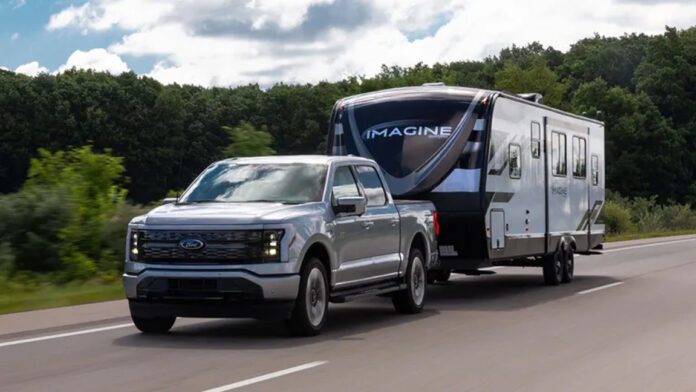
For years, electric pickups have felt just out of reach for many RVers. Prices pushed into luxury territory, and real-world towing raised more questions than answers. Now Ford is signaling a different path—one that could finally pull some RVers into the electric conversation.
The company is working on a new, smaller electric pickup with a target price around $30,000. That number alone changes the tone. Instead of a high-end experiment, this is shaping up to be something closer to a practical tool, at least on paper.
But RVers will zero in on one issue right away…
How does it tow?
A smaller, cheaper electric truck takes shape
Ford’s upcoming electric pickup won’t look or behave like the big, expensive trucks that defined the first wave of EVs. Instead of going bigger, the company is going smaller—closer in spirit to a mid-size or compact pickup than a full-size rig.
That shift is intentional. Ford is reportedly building this truck on a new platform designed to reduce cost, simplify manufacturing, and use fewer parts. The goal is straightforward: Make an electric pickup that more people can actually afford.
It’s also a quiet acknowledgment that the first generation missed the mark for many buyers. Trucks like the Ford F-150 Lightning grabbed attention but struggled with price, weight, and profitability.
This next attempt aims squarely at the middle of the market.
Why RVers might finally take a closer look
A $30,000 price tag puts this truck in familiar territory for many RV buyers. That alone lowers the barrier to entry.
For RVers who don’t tow large rigs, the concept starts to make sense. Think lighter setups—teardrops, pop-ups, small travel trailers, or even just hauling gear to a campsite. In those scenarios, a smaller electric pickup could cover a lot of ground.
There’s also the appeal of simplicity. Lower operating costs, fewer moving parts, and the ability to charge at home all fit neatly into how many RVers already plan their travel.
In short, this is the first electric pickup that feels like it might be built with everyday use in mind—not just headline-grabbing specs.
The concern RVers won’t ignore
Still, there’s a reason many RVers have held back on electric trucks. It comes down to physics.
Towing cuts range. Sometimes dramatically.
Real-world testing shows just how quickly that can happen. When MotorTrend did a test of the Ford F-150 Lightning towing travel trailers, range dropped to roughly 115 miles with a light trailer—and sank to about 90 miles with a heavier RV. That’s a very different kind of trip than most RVers are used to planning.
And that reality doesn’t disappear just because a truck is cheaper. In fact, a smaller, more affordable electric pickup may rely on a smaller battery to hit that price point. That could make range even more sensitive when pulling a trailer.
RVers who travel long distances—or who camp far from reliable charging—will immediately see the challenge. Planning routes around charging stations is one thing in a car. Doing it with a trailer in tow is another.
And unlike gas stations, many charging locations still aren’t designed with trailers in mind. Tight spaces, limited pull-through access, and wait times all add friction to the experience.
That’s the reality Ford’s next, smaller electric pickup will have to contend with—no matter how affordable it becomes.
A different kind of electric truck
What Ford appears to be building isn’t a replacement for every gas-powered tow vehicle. It’s something more specific.
This is likely a truck for shorter trips, lighter loads, and more predictable travel patterns. Weekend camping. Regional travel. Maybe even full-time use for those who stay within a tighter radius.
For that kind of RVer, the equation starts to work.
For cross-country travelers or those pulling heavier rigs, the limitations may still outweigh the benefits.
What this could mean for the road ahead
Ford’s move signals something bigger than just one new truck. It suggests the electric pickup market is shifting toward practicality—away from oversized, high-cost models and toward something more usable.
That’s a step many RVers have been waiting to see. But the key question hasn’t changed.
Until an electric pickup can deliver reliable range while towing—and do it without turning every trip into a charging strategy session—RVers are likely to keep one foot in the gas-powered world.
Ford’s $30,000 truck may bring more people to the edge of that decision. Whether it pushes them across it will depend on how well it handles the one job RVers care about most.
RELATED
- Evotrex-PG5 travel trailer: Supercharger on wheels for EV truck camping
- Slate EV Truck: A $25K EV you can repair yourself
- New Evotrex travel trailer lets RVers roam farther with hybrid system
- New futuristic, power-generating RV debuts; recharges the truck towing it
- GM shuts down BrightDrop electric vans amid slow EV sales
RVT1260b


Sounds like Ford is worried about the new Slate truck. Just trying to keep up Ford?
The point every electric car/truck manufacturer seems to miss is that many RVers may NOT want to tow a trailer. They may, instead, want to use an electric vehicle as a toad. But, to my knowledge, there is not one all-electric vehicle available today that is towable four-down. Until E-vehicles can be towed without a trailer or tow dolly, they will not be very popular with most Class A, B, or C owners. When all van and motorhome owners can tow an E-vehicle four-down and recharge them in a 50A RV park pedestal, they will likely become very popular with RVers!
Yeah, but an EV toad would be very heavy to tow in comparison to an ICE vehicle.
And of course, you know what comes next? Meters at the pedestals for an added charge when you check out.
When it hits the marker – in what year ?– it won’t be anywhere near $30K. It seems that marketing people never heard of inflation.
I’m old school and I admit it. I like my diesel Dmax truck. That said, given current (no pun intended) battery technology, the lack of charging stations and plenty of range anxiety, electric trucks seem pretty impractical at any price point.
I’ll keep my V8 powered gas-guzzling Nissan Armada, for now…
Instead of new vehicles Ford needs to concentrate on building quality vehicles without computer issues. Not one like my 2025 F150 hybrid that had over six recalls plus too many updates and issues. This Thursday they have to drop the gas tank to replace some kind of valve. I’ve been waiting over six months for the bolts for the Max tow axle. Which could be dangerous if it breaks. This truck is less than one year old.
Not everybody is using their truck to tow RVs. I had pickup trucks for years before getting my rv. I used them for household hauling jobs and making runs to the dump. I would also take them tent camping. This little EV truck would have fit the bill perfectly for me back then.
If you camp only in closely-spaced parks, WHICH ALLOW CHARGING your EV… this could work (carefully) for RV-ing.
But really, Ford likely doesn’t care about the RV-EV market. It’s clear to a lot of people that EV’s are best operated as “daily drivers” which can be charged at home, often with solar help. We use our EV that way and it’s grand. But we don’t take long trips or overnight trips in our EV if we can help it. Even if there are plentiful charge stations (rarely true), charging time always dings travel time excessively.
This Ford EV small-truck could be a boon for a local contractor or homeowner who travels 100 miles or less a day and charges at his shop or home at night.
Turn the new truck around. Will it be towable. If that happens it will be a major shift. If its close to the size of a Ford Ranger and is a quality build, I would be interested as I could easily tow it behind our LTV.
I’ve felt that the automotive world is missing a step trying to go full electric. A baby learns to crawl before they can walk. The current battery technology is not advanced enough to allow for fast recharge times and long towing range. In my opinion a hybrid would be a better solution for towing and long distance. Use all electric for short trips and light hauling and add the combustion engine for long trips and towing. An added benefit for boondocking would be having a source of power to run the air conditioning on hot days. Until then I’ll stick with my diesel.
I know this is an RV enthusiast’s newsletter, but I don’t think Ford is thinking about camping use for the $30K EV pickup. My guess is that there is nothing else like it on the market. How many people will fork over $140K + for an ugly Rivian? Ford has had such tremendous success with the Maverick PU that it has copied that blueprint for an EV. Now, by the time it hits the market, which I believe will be a while yet, will it still be priced at $30,000?