

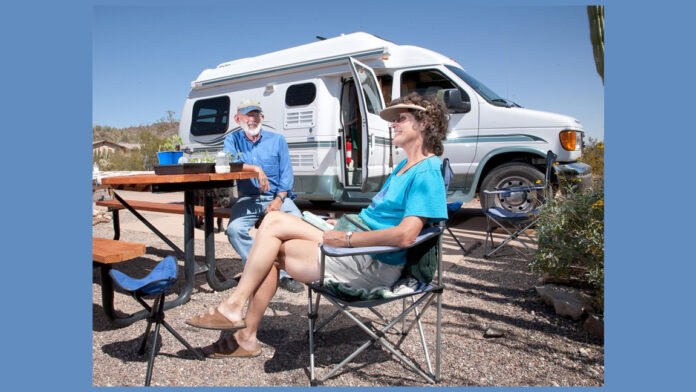
It’s important that older RVers consider and honestly answer specific questions, especially when planning their RV trips.
What kind of questions?
Planning an RV trip as you get older doesn’t mean giving up adventures. It means asking smart questions so you can stay safe, comfortable, and independent on the road.
The five important questions are below. Ask yourself (and your travel buddy) to consider the following queries before you pack up your RV. Keep your answers short and honest. If anything feels uncertain, ask a trusted family member or your doctor for their opinion.
Question #1: Am I comfortable driving this rig?
Think about traffic, mountain passes, long highway stretches, and tight campground roads. If your reflexes, neck rotation, or stamina have changed since your last trip, consider some easy, basic alternatives. Think: shorter driving days, shared driving responsibilities, or even changing to a motorhome or smaller towable, if possible.
Experts on aging stress that age alone isn’t the marker of driving ability. Instead, diminished vision, reaction time, and strength are what matter. Try taking an online assessment like this or ask a professional who can help if you’re unsure.
Question #2: Do my health conditions, medications, or fitness level limit participation?
List all of your prescriptions and whether any of the meds may affect balance, drowsiness, heat tolerance, etc. If you’re unsure, ask your doctor or pharmacist.
Also consider altitude, summer heat/winter cold, or demanding activities on your RV trip itinerary, and whether these could worsen an existing condition. Many clinician guides recommend discussing trip plans and physical expectations with your physician. That way, you have clear medical advice and any necessary documentation or emergency medication.
Question #3: Do I have the skills and experience for this trip?
Be honest: Have you recently driven your RV in mountain terrain, navigated hiking trails, or gone sightseeing in challenging conditions? Can you practice some skills or build endurance before your planned RV trip? What accommodations or alternative plans could you make so that the trip is safe and enjoyable?
Parks and recreation experts recommend matching hikes and activities to recent practice and fitness, not to what you’d like to do. If the destination and activities look more demanding than your recent outings, choose fewer activities or add guided experiences instead.
Question #4: Should I downsize or adapt my RV?
If steps or high thresholds are wearing on you, think about modifications. For example, consider a ramp or extended handrail at the RV entry door, easier-to-open latches, and slip-resistant flooring or rugs.
Many older RVers trade to simpler floorplans or motorhomes to reduce the physical demands of towing and hitching. Others downsize to an RV that’s easier to tow and park.
Question #5: Am I mentally ready to adapt travel plans?
The best trips have a flexible plan. Weather, slow days, and small health blips happen. Be willing to swap a long hike for an easy nature loop or add an extra rest day to keep the trip fun and safe. Veterans of RV life emphasize choosing flexibility as a feature, not a compromise.
Final practical tips
Do everything you can to remove potential stress-points (e.g., pre-book campsites to avoid stressful, last-minute searching; order groceries online and pick them up to reduce the stress of navigating an unfamiliar grocery store).
Conduct a short practice drive with your planned tow and cargo load before the trip. This is especially vital if you haven’t RVed recently.
If answers to any of the previous question lands on “maybe” or “no,” treat that as a cue to adjust the plan. Small changes can preserve independence while keeping safety a top priority.
Can you add to the list of questions older RVers need to ask themselves before setting out on an RV adventure? Please note them in the comments below.
RELATED
- How aging affects our driving
- When is it time to hang up the RV keys for good?
- Starting RV life as a senior—What you need to know
- Comparing the top five best campervans for seniors
- RVing addresses top three concerns—especially for seniors
RVT1246

If you can’t get out of a chair without sliding forward or using your arms to lift yourself give some thought to doing some strength training months before you plan to spend hours sitting behind the wheel of your rig or hiking a trail. Don’t give up, just get yourself ready just like you do your rig. At 77 I know what I’m talking about. I refuse to give in to age.
I totally agree. I am 76 and do have some health issues. I refuse to stop, but have slowed down.
One big thing is to take more frequent rest stops. No need to drive for hours on end.
Even a 15 minute break will make the trip easier and more enjoyable.
We normally limit our daily travel time to 6-8 hours, or about 300 miles.
We used to drive 2 to 3 hours before stopping, now we make shorter but more frequent stops every hour or hour and a half to stretch, switch drivers, and exercise the dogs. It has really made a difference in our enjoyment of the drive itself.
Rock-On SeaDog!
We started RVing full time 5 years ago, when we were 64. We love the adventure, the travel, the wonderful experiences and the many friends we have made along the way. Now, at 69 we’ve had to accept that the rigors of RV life; reservations, repairs, health related logistics have worn us down to the point that we’ve re-acquired a sticks and bricks. We will still RV, but with a smaller rig and less travel related stress. RVing allowed us to see our wonderful country and settle in an area we would never have discovered otherwise.
In our early 70’s, and we’re in the process of changing RVs. Going from a truck camper to a travel trailer, in large part due to the easier set up and larger space the trailer will provide. I’m sure we’ll miss the ability to camp in those small out of the way locations that the truck camper fits into, but we’re looking forward to a shorter tow vehicle and a few more creature comforts that the trailer will afford us. One thing’s for sure…we’re not ready to stop, just changing RVs for the next leg of the journey.
Also, are you signed up with a rescue service like the FRVA that will get you, your spouse, your rig, your pets and even your mortal remains back home should the unthinkable happen? This is particularly important if one of the parties can’t drive the rig.
I am 82 and gave up motorhoming because it became too hard to hook up the outside water, sewer, and power each night. And then un-hook in the morning. I am going to a small trailer that will last the weekend so I don’t have to empty tanks until I get home.
In retirement, how can you have fun if you have to plan the whole trip out?
I come to an intersection and toss a coin, or make a choice, and off to a new adventure.
My husband and I play what we call “Left or Right.” It sounds a lot like your “toss a coin” maneuver, although we play when driving our car, not the RV. I agree that spontaneity is great! Safe travels, David.
I would like to comment on senior RVing. Your 5 questions I believe can also be asked for the passengers in the RV as well. The driver might like to drive 6 hours but not the other passengers. Their abilities need to be taken into consideration as well, and let’s not forget about the pets. So much to consider when we get older and all are important. Thanks for reading.
Charlie M.