

By Dave Helgeson
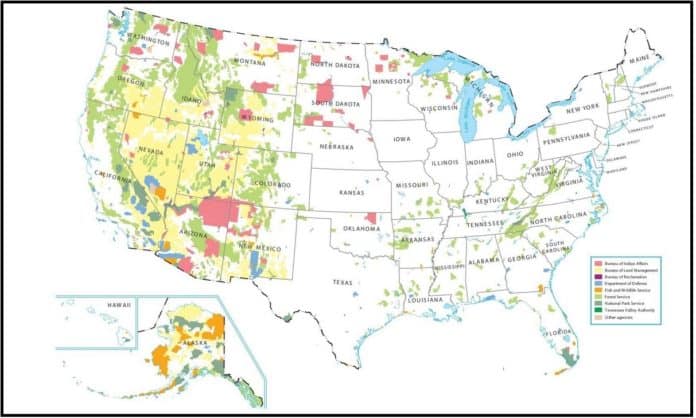
The world of RVing is full of acronyms. Those include: RV (recreational vehicle), FW (fifth wheel), TT (travel trailer), FHU (full hook up), BH (bunk house), and many more. In these days of rising campground costs and campground crowding, there are a host of other acronyms RVers should know about. Those are the acronyms of federal agencies that oversee millions of acres of public land which offer free and low-cost camping.

Here are the acronyms of those federal agencies
- USFS (United States Forest Service)
- COE (Corps of Engineers)
- DOD (Department of Defense)
- DOE (Department of Energy)
- NWR (National Wildlife Refuge)
- TVA (Tennessee Valley Authority)
- DOI (Department of the Interior) – oversees the following federal land agencies that will be of interest to RVers. Their acronyms are:
-
- BOI (Bureau of Indian Affairs)
- BLM (Bureau of Land Management)
- USBR (Bureau of Reclamation)
- NPS (National Park Service)
- FWS (United States Fish and Wildlife Service)
What those agencies offer for free and low-cost camping
Let’s take a closer look at what each agency offers in the way of free and low-cost camping options:
USFS
USFS (United States Forest Service). The USFS, an agency of the USDA (U.S. Department of Agriculture), oversees the nation’s 154 national forests and 20 national grasslands consisting of 193 million acres of land. Each of the forest and grasslands offers developed campgrounds and dispersed camping opportunities.
Visit the “Camping and Cabins” page on the website of the area you would like to visit. There, you will be given the option of “Campground Camping”, “Dispersed Camping”, “Group Camping” and possibly “RV Camping”. USFS campgrounds are typically very reasonably priced and some offer hookups. Dispersed camping (aka boondocking) is typically free.

COE
COE – Officially the United States Army Corps of Engineers (USACE). The Army Corps of Engineers controls more than 450 campgrounds along reservoirs and rivers in 43 states. COE campgrounds offer low-cost nightly rates that are a bargain compared to private RV parks in the same area, making them a favorite of RVers. Free dispersed camping (aka boondocking) is often permitted along accessible areas of the shores, as well.
Click here to view COE areas across the country. Visit the Corps Lake Gateway website to find COE areas that offer camping. Once on the website, go to the state where you want to camp. Then check the “camping” box to view a listing of COE areas that offer camping. Click here for an article offering more in-depth information on COE free and low-cost camping.

DOD and DOE
DOD (Department of Defense) and DOE (Department of Energy). I lump these two together as wherever you find DOD land it will typically be co-managed with the DOE. (Think nuclear testing for the “energy” portion of the acronym.)
Most DOD/DOE land, like the Nevada Test Site aka Area 51, is closed to public access. However, some DOD/DOE land, like the Barry M. Goldwater Bombing Range and the Yakima Training Area, allow free dispersed camping with a permit. Another option for active duty and retired military personnel are military campgrounds across the country which have very reasonable rates.
NWRS
NWRS (National Wildlife Refuge System), under the direction of the FWS, manages more than 560 refuges spanning the country, and some provide camping opportunities. Examples: Pahranagat National Wildlife Refuge, in Nevada, offers a free first-come, first-served lakeside developed campground. The KOFA Wildlife Area in Arizona allows free dispersed camping.

TVA
TVA (Tennessee Valley Authority) manages nearly 293,000 acres of public land to explore along with free and low-cost camping opportunities. Click here to learn more about campgrounds and camping “in the wild on undeveloped TVA public lands.”
Public lands agencies under the DOI umbrella that offer free and low-cost camping
BIA
BIA (Bureau of Indian Affairs). For decades the DOI has encouraged tribes to provide recreational opportunities on tribal land, as this older press release demonstrates, including camping opportunities.
I am not aware of a national listing of campgrounds on tribal land. However, individual tribal websites will typically list developed and non-developed camping opportunities on their reservation under “Recreation”. Options range from full-hookup RV parks, free overnight parking in casino lots, primitive campgrounds, and even dispersed camping.

BLM
BLM (Bureau of Land Management) manages 245 million acres of public land, offering some of the best free and low-cost camping in the West. Options range from developed campgrounds with hookups, to long-term visitor areas (LTVA), to literally tens of thousands of places to disperse camp (boondock) for free. Learn more here. Hands down, the BLM is the go-to land agency for free and low-cost camping options.

USBR
USBR (Bureau of Reclamation) is similar in nature to the COE. The Bureau of Reclamation is primarily a supplier and wholesaler of water to farmers. The Army Corps of Engineers is the authority of waterway infrastructure. The Bureau is focused only on the Western states, while the Corps manages projects throughout the entire United States.
Bureau of Reclamation projects include approximately 6.5 million acres of land and water that is mostly available for public outdoor recreation, including camping. There are 187 developed recreation areas managed by Reclamation which offer a total of 549 campgrounds. Typically, like other federal land agency campgrounds, overnight fees are very reasonable. Free dispersed camping is also typically available along the shorelines of USBR projects. However, they might be under the jurisdiction of another state or other federal agency.
NPS
NPS (National Park Service) manages national parks along with national monuments and national recreation areas (NRA). It currently oversees 63 national parks, 129 national monuments and 40 national recreation areas.
Campgrounds operated by the NPS are some of the most coveted campsites in the nation. They are low-cost and located at ground zero for exploring the iconic sites parks and monuments are known for.
When planning to camp in or near a national park, be sure to check out the park’s website to see what other camping options might be available. A few offer free dispersed camping / primitive roadside camping within the park. Some national parks and monuments websites list free / overflow areas outside their boundaries. Other units operated by the NPS, like national preserves or monuments, allow free dispersed camping within their boundaries. The Mojave National Preserve and Lake Mead National Recreation Area are two examples.

FWS
FWS (U.S. Fish and Wildlife Service) oversees the operation of NWR units across the country. This is what their website has to say about camping. As mentioned under the NWR listing above, what they offer is typically free.
LIBTYFI
One final acronym: LIBTYFI (Leave It Better Than You Found It). Okay, I made this acronym up, but it is one that every camper (RVer, tenter, backpacker, etc.) should know and follow.
Public lands are our lands and it is our responsibility to take care of them. If we abuse them by leaving trash or vandalizing the facilities, governing agencies have little choice but to close them or raise fees enough to cover the cost of garbage removal and restoration. Carry extra trash bags with you during your travels and help keep public lands open by picking up after less-thoughtful campers. Please take their trash with you and properly dispose of it onsite or at your next stop, as this article covers.
Make low-cost camping even lower with a Senior Pass!
Many of the federally managed campgrounds mentioned are already low-cost. However, those of you 62 and over can obtain an America the Beautiful Senior Pass. That typically provides a 50 percent discount on amenity fees like camping, reducing the cost of a $6 per night campsite at a BLM campground like Rainbow Basin/Owl Canyon to $3 per night!
By employing the ABCs of free and low-cost camping, you, too, can discover a cornucopia of camping options on public federal-controlled land across the United States.
RELATED
- Moochdocking 101: How to score free camping and get invited back
- Fairgrounds camping: Don’t overlook these affordable, sometimes free, ‘campgrounds’
- Amazing free Texas camping
- Free Nevada camping near Valley of Fire State Park
- Want to RV on BLM lands? Download free maps for your device today
- Top 10 states for free camping and boondocking
RVDT2738

One more – DNR (Department of Natural Resources)
TPWD (Texas Parks & Wildlife Department) – sort of like belt buckles, Texas just has to make it bigger! 🙂
DNR is a state agency, not federal which is the focus of this article. The are a good source for free and low cost camping though.
Thank you for this oldie, but goodie, Dave! Finding TVA land isn’t especially difficult in and around the Southeast. Finding areas acceptable for camping much more problematic. We avoid the searching and just travel to state parks. Have a great week and safe travels!