


All RVs have at least one 12-volt deep cycle battery that powers roof vents, lights, and some appliances. And although the technology in a flooded lead acid (FLA) battery has not changed much in more than 100 years, there are some myths that have been debunked.
Myth 1: Do not leave a battery on cement for storage or charging
I remember this one from 50 years ago working in a Standard gas station during high school. Leaving a FLA battery on cement would create an electrical drain from the moisture in the cement. Back then, battery cases were made of hard rubber and needed to be stored on wooden pallets or rubber mats.
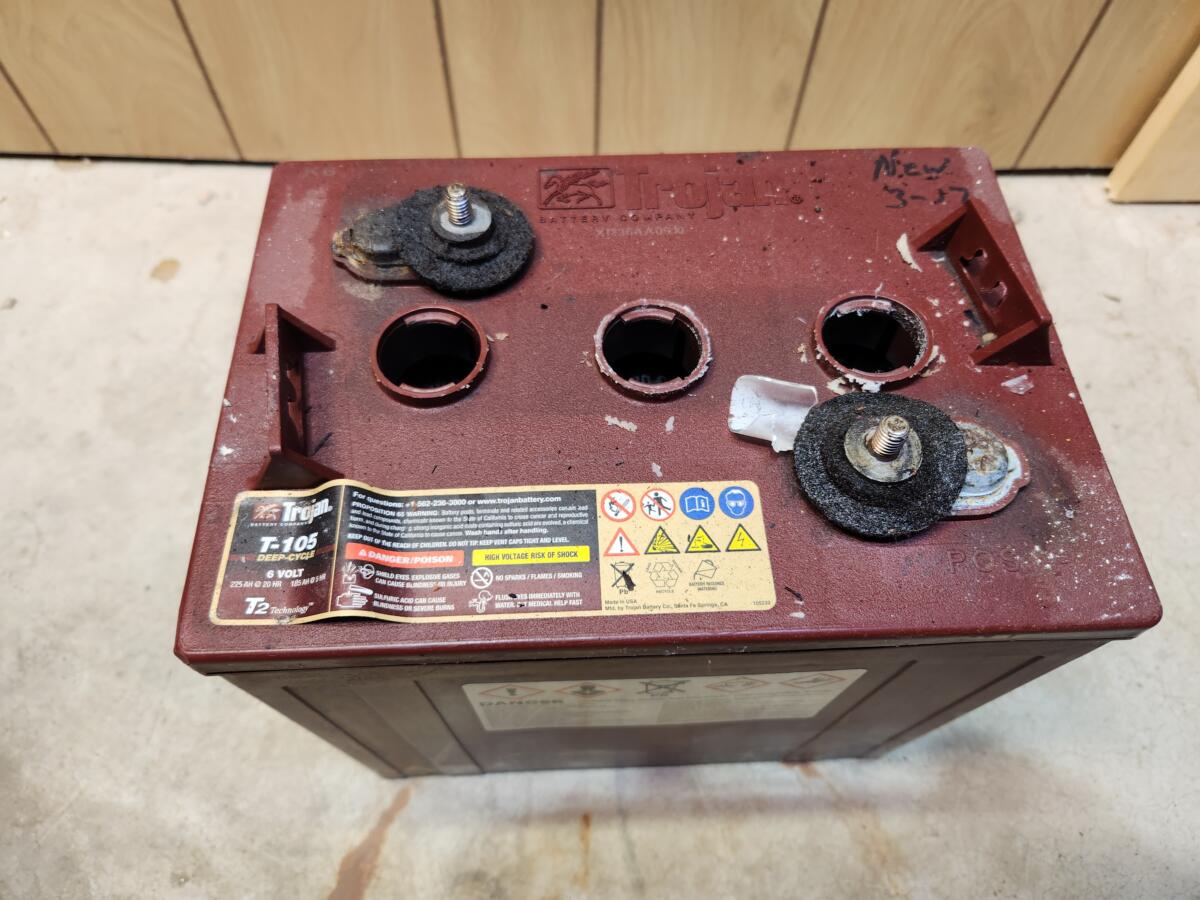
Batteries today are made of hard plastic that are not porous and eliminates the drain from moisture in cement. It is actually a great place to store batteries, as the cement stays cooler than ambient temperature.
Myth 2: Use Coca-Cola to clean battery terminals
I’m sure most of us have tried this in the past. Although it seems like Coke bubbles and cleans the corrosion on a battery terminal, it can cause more corrosion later. The sugar and other ingredients of Coke leave a brown, syrupy substance on the terminal and cable end as well as other electronic wiring and components.
Most RV batteries have several wires or cables connected to the post that provide power to accessories or options. The Coke can also get into the battery cell, which would upset the chemical balance of the electrolyte. It is better to use baking soda and water, which is a neutral substance, and a wire brush.
Myth 3: Use aspirin to rejuvenate a dead battery
Over the years, there have been many stories and forum posts that suggest dropping an aspirin tablet into a dead battery cell and adding water will rejuvenate the battery. Supposedly, the acetylsalicylic acid found in aspirin reacts with the sulfuric acid electrolyte and creates a charge.
According to U.S. Battery, there have been rare occasions with older, non-sealed batteries when the aspirin did create a slight voltage increase temporarily. That was mostly due to adding distilled water and charging the battery. However, the aspirin will break down to create acetic acid that will attack and permanently damage the plates.
J.C. Whitney sold thousands of “Battery Rejuvenating” tablets that were no more than aspirin. They did not work. It ranked right up there with the higher MPG pill they sold!
Myth 4: A 12.6-volt FLA battery can be discharged to 50% or 6.3 volts
It is a little confusing as the State of Charge (SOC) does not follow typical “math”. A fully charged FLA battery should read 12.6 volts at rest. The following chart shows the percent of charge rate.
| Voltage | State of Charge |
| 12.6 | 100% |
| 12.5 | 90% |
| 12.42 | 80% |
| 12.32 | 70% |
| 12.20 | 60% |
| 12.06 | 50% |
| 11.90 | 40% |
| 11.75 | 30% |
| 11.58 | 20% |
| 11.31 | 10% |
| 10.50 | 0% |
An FLA battery should only be discharged to 50% SOC, which you can see by the chart is 12.06 volts. Anything below 10.5 volts is a completely discharged battery that can cause damage.
You might also enjoy these posts from Dave
- What does 50% State Of Charge (SOC) of a 12-volt battery mean?
- My RV’s “larger” batteries are dead. Can I replace them with lithium?
- Can different type and age RV batteries be mixed? Can I add a lithium battery?
- Will RV’s house batteries ‘play nice together’ if I replace chassis battery with lithium?
- Why do new RV batteries show only 3 of 4 lights green on monitor? Plus update
- Is one 300 Ah lithium or three 100 Ah batteries better? What size converter?
- Can different type and age RV batteries be mixed? Can I add a lithium battery?
- Understanding everything about 12-volt house batteries
DAVE HAS ANSWERED MORE THAN 1,000 readers’ maintenance and repair questions. Read a directory here. There is so much to learn!
Dave Solberg is a leading expert in the RV industry and the author of the “RV Handbook.”
RVDT2745

I miss the 16 year old me, reading and dreaming, the J.C. Whitney catalog.
Baking soda is alkaline, so it is not “neutral”.
Excellent information (as always) Dave! Well done!
Just yesterday I was moving a large FLA battery in the garage and remembered the concrete myth.
Admitting, I too used to use Coke to clean terminals. I never thought about the residual sugar left behind on the wires.
The JC Whitney catalog used to be my Amazon for car parts. I used to dream for hours as I turned the pages. Where else could you find “eyebrow patches” for a rusty ’56 Chevy?
Dave Solberg. Ref; “12 volt battery myths, #2” “It is better to use baking soda and water, which is a neutral substance, and a wire brush.” No! Baking soda and water is not neutral. It is fine, and recommended, to use as battery terminal cleaner, but if introduced into the wet cell it will be far more damaging than Coke. I hope you correct this error.