

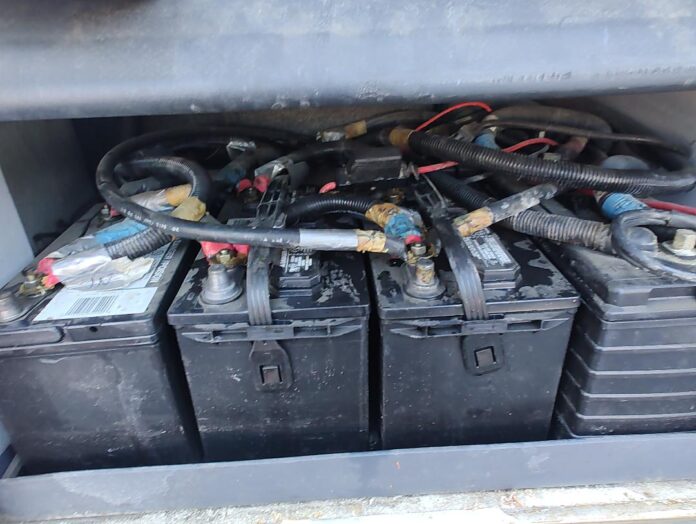
This is Part 4 of Dave Solberg’s “Everything you need to know about RVing” series. Today, Dave looks at 12-volt house batteries and tells you just about everything you need to know about them, whether this is your first or 101st RV trip.
- Part 1: Tips to make your first RV trip more enjoyable: Pre-trip preparation
- Part 2: The ABCs of RV terminology: Every word and term you should know as an RVer
- Part 3: Powering your RV: Essential 120-volt electricity tips and gadgets for every RVer
Many components in your RV are powered by 12-volt deep cycle batteries such as the interior lights, roof vents, onboard water pump, 12-volt compressor-driven refrigerators, and all appliances that run on liquid propane (LP).
Batteries have been a major point of frustration for RV owners for years, but with a better understanding of the different types/sizes, power requirements, and maintenance needed, you will have a much more enjoyable experience.
A deep cycle battery is designed to be drawn down and recharged, which is called a “cycle”. This is unlike an engine battery that is designed to stay charged all the time and create a burst of power for 30 seconds to start an engine and is rated in cold cranking amps (CCA). Deep cycle batteries are rated in amp hours (Ah), which is how many amps they can provide in a specific amount of time. More on that later.

Types of deep cycle batteries
Flooded lead acid (FLA) batteries have been the standard for years and come in either 6-volt batteries that require two batteries connected in series (positive to negative), which creates a 12-volt bank, or a standard 12-volt battery. You can identify these batteries by the number of cells or caps. A 6-volt battery has three cells and, as mentioned, requires two batteries to be connected in series, positive to negative, which creates a 12-volt bank.


A 12-volt deep cycle battery has six cells and can be used in a single application.


These batteries have lead plates covered by acid and require some maintenance to replenish the fluid level and clean the terminals. There has been a lot of debate about what battery is best for an RV. Six-volt batteries typically provide more amp hour capacity and have a longer life as they can cycle more times. However, you need two batteries connected in series (positive to negative) to create a 12-volt bank and also need two more if you want to increase the amp hour capacity.
12-volt deep cycle batteries have the advantage of running just one battery, if you do not dry camp that often, and are cheaper. The downside is there are fewer amp hours and lower cycle times, but you can add just one more battery to double that.
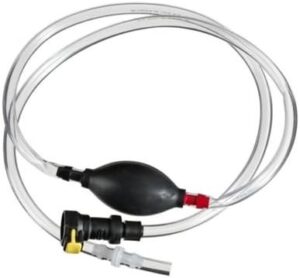
Tip: As FLA batteries are recharged, the higher voltage charge will cause gassing out of the vents in the caps. They will need to be kept in an exterior vented compartment and the water level checked frequently. Remember to only use distilled water to refill the cells of FLA batteries. You can use a simple rubber squeeze device like this. Terminals should also be inspected and cleaned periodically.

You could also use a battery filler jug with a shutoff like this.

If you have a tight space and cannot get the jug in to fill the cells, it would be good to install an auto-fill system like this one that replaces the existing caps in each cell with an auto shut-off valve and a hand pump.
Simply insert the supply hose into a gallon of distilled water and give it a few pumps and every cell is filled to the proper level.
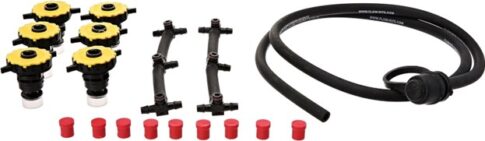
You can customize the system for the number of batteries and cells you have, but you will also need to purchase the supply hose with a hand pump.
Should you worry about battery sulfation?
Sulfation is a common issue with FLA batteries because sulfur coats the plates as the battery is drawn down. Typical converters and chargers do not “condition” or break up the coating as they provide a 13.6-volt charge and then drop to a maintenance charge of 13.2 volts.
Multistage chargers have a high voltage “bulk” charge of 14-16 volts that breaks up the sulfation and then an equalizing and float charge. A typical FLA battery should last 5-6 years, but most last fewer years than that due to sulfation.
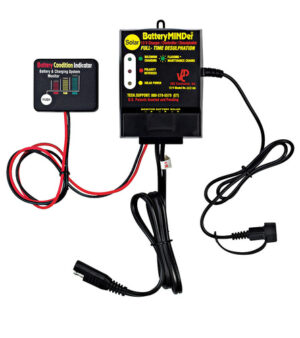
Larger units that have an inverter and a charger provide multistage charge and conditioning. Smaller units can use an aftermarket product such as the BatteryMINDer that sends high-impact waves to the battery to condition it and extend its life. I have found the best price at Northern Tool, which carries the smaller unit for one battery, or the larger unit for multiple batteries. But, of course, it’s also available on Amazon.
AGM “solar” batteries
Absorbed glass mat (AGM) batteries also have lead plates and acid but have fiberglass material incorporated into the design. They are less prone to sulfation and maintenance. They are completely sealed so you cannot add fluid. Lately, several companies have been labeling them as “solar” batteries, as they are a better option than FLA batteries when configuring a solar panel system.

Lithium iron phosphate batteries
Lithium iron phosphate (LiFeP04) batteries are completely sealed and use cells rather than lead plates and acid to store energy. Lithium batteries can be drained to 100%, so a 100 Ah battery will provide 1 amp per hour for 100 hours. They also have a much larger cycle life, some being over 5000. However, they are much more expensive. If you are not doing much dry camping, they are most likely not a good investment.

These batteries simply store power to run the various components and are rated in amp hours, or how long they can supply power depending on the amp draw of each component. It is important to understand what components draw power from the batteries and how much, if you are not going to be connected to a shoreline source. You can determine the amp draw from some of the major components listed on this chart.

Newer 12-volt compressor-driven refrigerators will draw 4-8 amps.
Which RV battery is best for me?
Check out this article on what battery is best for your camping application.
Tip: Flooded lead acid (FLA) batteries should only be drawn down to 50% while lithium batteries can be drawn down to almost 100%. Tip: Fully charged 12-volt FLA deep cycle batteries should read 12.6 volts while lithium batteries will read 14.6 volts. When connected to shoreline power, a typical converter/charger will provide a 13.6-volt charge to a low FLA battery and then drop to 13.2-volts.
12-volt power is provided by the house battery or batteries to the distribution center typically through automotive-type fuses. Here is an example of an all-in-one distribution center with the 12-volt fuses at the top, 120-volt circuit breakers below, and the converter/charger to the right.

Batteries have been a major point of frustration for RV owners for years. However, with a better understanding of the different types/sizes, your power requirements, and maintenance needed, you will have a much more enjoyable experience.
Tip: Many RVs have a battery disconnect switch located just inside the door or inside a compartment. This is designed to shut off 12-volt power to most components to reduce battery drain while the unit is in storage or not being used for a period of time. If a 12-volt component is not working, check the switch. However, typically the LP leak detector is wired directly to the battery bank and it can drain the batteries in less than three weeks even with the switch disconnected.
Your house batteries are charged by a converter or charger when plugged into shoreline power. The converter can be part of the distribution center such as the unit above, or a separate one such as this WFCO model that was installed under the bed in a Thor Challenger.

A typical charger will provide 13.6 volts when charging a low battery and drop to 13.2 volts for a constant maintenance charge. A multi-stage charger will provide an initial bulk charge of 14-16 volts to break up sulfation and then drop to an equalizing and float charge. Lithium batteries require a 14.6-volt charge, so a standard converter will not fully charge them and a multi-stage charger could do damage. If you are planning to swap batteries, read Part 2 and Part 3 of the lithium battery articles here.
Tip: Sulfated FLA batteries can show a full charge of 12.6 volts. However, this is just a surface charge and immediately drops voltage when a load is applied, such as slide room extension/retraction or running the jacks. If you have an issue with a 12-volt operation, plug the unit into a shoreline power and the converter should provide 13.2 volts to the system.
RELATED
- Should I carry a battery charger in my RV? If so, what brand?
- My RV needs a new engine battery. What brand and size should I get?
- RV lithium battery upgrades for beginners
Read more from Dave here.
##RVT1162
I’m actually wondering how accurate your info is, after purchasing a SoftstartUSA plug and play unit that was a nightmare that almost burned down my Class A. It ended up being a unit that had been recalled, additionally, the Owner of Softstart told me directly that the company is aware that their units are not compatible with Coleman Mach AC units. I would like to see a follow up on this issue! I went off your recommendation from previous articles!
What? Lawsuits coming.
Phil, I would say that is a little harsh wondering how accurate my information is when you claim to have taken my recommendation from a previous article? I have only recommended the SoftStartRV product that I personally installed in 3 different RVs and did the measurements and testing. This product is the box that is installed in the roof air conditioner, not the plug and play version which you purchased which is the SoftStartUp product. I have not researched this product much but have been in conversation with their engineers about how it would work on a unit with an on-board generator and an automatic transfer switch (ATS) which it doesn’t. I invite you to email me with your contact information and we will definitely do a follow-up with the correct facts which would require the make, model, and year of your Coleman AC and the exact model of the Soft Start Product. I spent a good amount of time on the phone this afternoon with one of their techs and it seems the Coleman Mach 13.5 BTU does not have a start capacitor, which is essential to the SoftStartUp working. Also, when you click the “add to cart” on the website it brings up a disclaimer that states it will not work on this model. I realize how important it is to get the facts and work very hard to research the products and procedures I write about rather than just generalizing or using AI which will get us all in trouble. Looking forward to working through this further.
Great info Dave! The one thing that I have learned was taught to me by a solar installation company in Quartzsite.
They said fully charged batteries do not freeze and are less vulnerable to sulphation. Also, never let a deep cycle battery drop below 50%.
I started leaving my rig plugged in at home and haven’t had an issue since.
Dave
Good info on the batteries.
Might be a good point to show the voltage of a FLA battery at 50% discharge.
Probably around 12.05vdc or so. Definetly not 6.3vdc…12.6 / 2 = 6.3.
Could be confusing to some.
Mike
Thank you, Dave! 🙂 This series is extremely useful; thank you for doing it! 🙂 My knowledge is limited, but the articles that you write (and those Dustin does) are slowly expanding my knowledge. Thanks again, have a great day, and SAFE travels! 🙂
We used Interstate.
This series has been great at reminding me of the things that I think I know about rv’s, and even better lessons for the things I never knew before. Thanks for keeping it going Dave, it is very much appreciated.