


By Dave Solberg
Hi, Dave,
We live in New England, so obviously we need to winterize our RV’s water system at the end of the season—blow it out, antifreeze, etc. This year, however, we will be traveling starting in mid-January, returning late February. Is there any way to perform a “winterization-lite” that will still protect the plumbing without having to go through the full process? If I blow out the lines and put a space heater in the camper, will that do the trick? Thanks so much. —Bruce, 2022 Gulfstream 189DD
Hi, Bruce,
I would be careful with the space heater as it can get very hot, draws a ton of electricity, and can overload an outlet. If you do use one, make sure it is on the lowest setting, as most have a high/medium/low setting with some drawing as high as 1500 watts or more.
“Winterization lite”
The best method to do a winterization lite, as you called it, depends on the location of water lines, tanks, and especially the water pump. Most smaller travel trailers like your Gulfstream have a 30-gallon fresh water tank. It is typically located underneath a dinette or other cabinet. It is above floor level, so the onboard furnace should protect that. You can identify the location by looking outside for the gravity fill cap—the tank should be right inside. Also, the water pump is typically located very close in the same location and would also be protected.

Most trailers also have the black and gray holding tanks strapped underneath and exposed to the elements. However, a couple gallons of RV antifreeze will keep them from freezing. This is a photo that has the low point drains coming out of the bottom, so you would want to make sure they were drained.

What worked for me
Over the years I have stayed in rigs in below-zero weather with trips to Colorado, and five years traveling around the country training dealers. I would drain the fresh water tank and water heater, and blow out all the lines to make sure there was nothing in them, even though most were above the floor level or in heated compartments.
I actually had water lines freeze at 20 degrees that were supposed to be heated. However, there was no cold air return in the compartment and the heater was not sufficient. When I asked the product development engineer (I use that term loosely), he stated they were heated, but not to keep them from freezing! He later became president/CEO. Go figure!
Carry bulk water in jugs
So, I would make sure all the water was out of the system and carry bulk water in gallon jugs. I put several in the shower pan, which could be used for the toilet and washing hands. There were a few in the refrigerator for drinking and using the sink. This way no water went through the lines and the antifreeze kept the holding tanks from freezing. You could also install a heat pad option to the underbelly, as some RV manufacturers do in a four seasons package.
Another option
Another option would be to install the Lippert “Floë” system. That is a 12-volt air compressor plumbed into your fresh water system. After draining the fresh water tanks and water heater, a flip of a switch will blow out all the lines. You can find it on Amazon here.
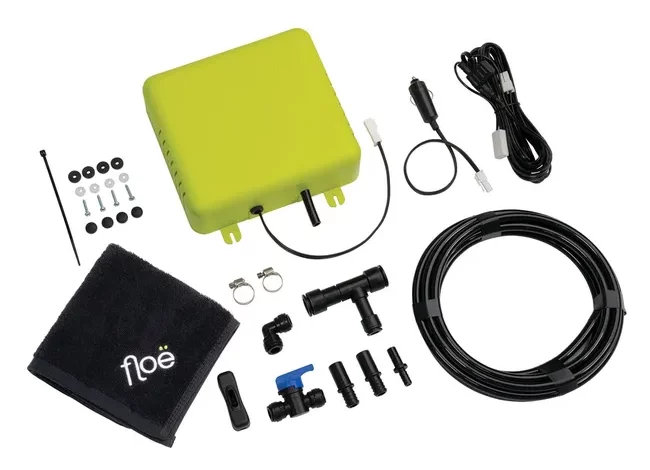
This would allow you to do a quick blowout of all the lines.
Let’s see what others have to offer for cold weather RVing.
You might also enjoy this from Dave
Five tips for easy RV winter camping
More RV owners are extending their camping season and even using their rigs in the winter. An RV can be a personal chalet for cross-country skiing, an elegant warming house for ice skating, or even a tricked-out icehouse for ice fishing! Note: I wouldn’t advise driving it on the lake, but I have seen it happen! Winter camping can be a beautiful and rewarding experience, but it also comes with its own set of challenges and risks due to the cold weather and potential for extreme conditions. Here are five tips to help you stay safe and enjoy winter camping.
DAVE HAS ANSWERED MORE THAN 1,000 readers’ maintenance and repair questions. Read a directory here. There is so much to learn!
Dave Solberg is a leading expert in the RV industry and the author of the “RV Handbook.”
RVDT2787

It takes a couple of gallons of RV antifreeze ($4/gallon) and less than an hour to winterize an RV. I think this is a pretty minimal “investment” vs. the costs associated with freeze damage in an RV. I don’t understand why so many seem reluctant to take these rather minimal steps to protect their RV. Seems to me like most RV owners spend much more time and $$ on other RV-related maintenance tasks, that have much lesser consequences.
GS189DD single axle TT has all but a short run from water pump to low-point drains inside the cabin. I used foundation foam and expanding foam under the rig to better insulate this line, shortened and insulated the low-point drains. Put 4″ soffit vents on each side under the bed and a 4″ USB fan at one soffit to circulate air at the tank & pump. RV anti-freeze in both waste tanks. By keeping the cabin above freezing (at least 55F, preferably higher) has kept the water system from freezing into the low 20sF. Firing the water heater 1-2 times a day also helps. (continued)
(resumed) Crack the door under the sink for cabin air to reach the water lines. When we have AC, we set our furnace thermostat around 55F. We have a small 500w space heater and a radio controlled remote thermostat (several on Amazon). The thermostat is near the bed and the heater mid-cabin. Set the heater at full tilt and let the thermostat control it. Rarely a problem keeping us at 67F. We have a tiny outlet mounted 100w heater for the bathroom.