


Dear Dave,
I have an ’03 45-foot Travel Supreme motorhome (dual inverters). If I use a dogbone [electrical adapter] down to 120v for charging purposes, does charging the batteries go to both banks of batteries through power sharing, or is it limited to just one bank? —Jim, 2003 Travel Supreme Select
Dear Jim,
I assume you have a 50-amp service since your Travel Supreme is one of the largest units of 2003. I also assume you are using an adapter to be able to plug your shoreline cord into a residential 20-amp outlet for storage. Whether you have 50-amp, 30-amp, or 20-amp service, they all have 120-volt power coming into the distribution center.

A 50-amp outlet will have two 120-volt lines going to the distribution center, Hot 1 and Hot 2. This provides enough power to run two roof air conditioners and well as most of the other 120-volt components without overloading the circuit.
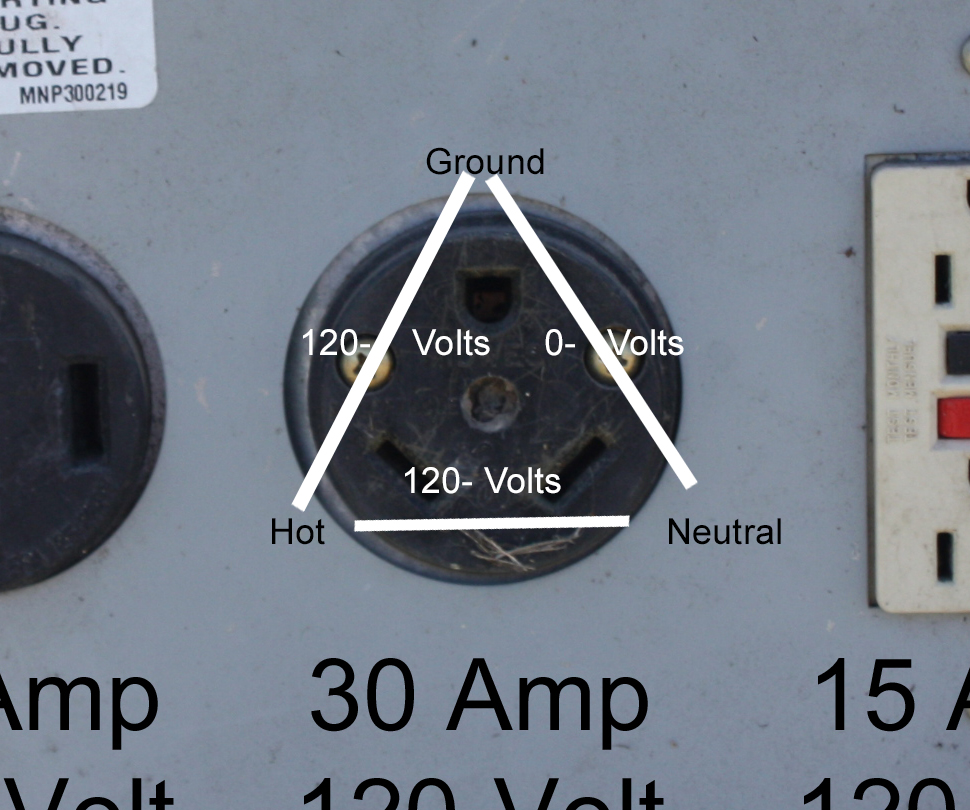
A 30-amp outlet has one 120-volt line providing 30 amps to the distribution center, which limits the use of both roof air conditioners at the same time but still enough power to run most 120-volt components. A 50-30-amp adapter simply reduces the power going to the distribution center and you would need to do some energy management.
A 20-amp outlet also has one 120-volt line but will only provide 20 amps to the distribution center. So, typically you don’t have enough power to run the roof air conditioner unless you have a SoftStartRV installed. So, they all provide 120-volt power, just different amperage.
Two inverters and two battery banks
You stated your rig has two inverters and two battery banks. Normally, there is one battery bank that supplies the interior components that are usually labeled the house batteries. These will be either 6-volt batteries connected in series and then parallel, or 12-volt batteries connected parallel. These are deep-cycle batteries designed to be drawn down to 50% and recharged, which is a cycle.
On the larger units like yours, the inverter draws 12-volt power from this battery bank and provides 120-volt power to specific components such as outlets for a residential refrigerator, TV, and other outlets. It also is the battery charger for the house batteries.
The second bank of batteries are typically cold cranking amp batteries that are designed to start the engine. They are commonly called the chassis batteries. These are charged by the engine alternator and not hooked to any inverter. I am not sure why your rig has two inverters. However, it may be that the original inverter installed was connected to a few outlets and another inverter was installed aftermarket to power something else. Sometimes owners had issues with an absorption refrigerator and replaced it with a residential model and had to install a second inverter to provide 120-volt power when not plugged into shoreline power.
How can you tell?
Use a multimeter and test the voltage of the batteries when the unit is not connected to shoreline power. Fully charged batteries should read 12.6 volts. Then plug the shoreline power into an outlet and even with a 20-amp version you should see them rise to at least 13.2 volts. This will verify the battery bank is getting a charge.
If by some chance you do have two banks of deep-cycle batteries for the house system and both are charged by an inverter, this test will also verify if you are getting a charge.
You might also enjoy this from Dave
RV batteries aren’t charging while driving. What should I look for?
Dear Dave,
While towing, it doesn’t seem that the truck power is charging the RV batteries. After driving for hours, there frequently isn’t enough juice to drop my front jacks. One battery came with the RV, the other was added last year. Thanks. —Jim, 2021 Keystone Montana 3761FL
Dave Solberg is a leading expert in the RV industry and the author of the “RV Handbook.”
Read more from Dave here.
HAVE A QUESTION FOR DAVE?
Send your inquiries to him using the form below.
##RVDT2366

Your statement “they all have 120-volt power coming into the distribution center” is misleading. For safety reasons, you should always mention that there is 240V in the distribution center for 50A service. It’s right there is the image you show. Put a finger on one 120V leg and a finger on the other 120V leg and you will get a 240V (potentially lethal) shock.
The 240v would be using two opposite 120v phases at the outlet. That would be the only place for a 240v potential. I am guessing a RV 50A to 15-20A adapter (dogbone) simply wires the outlet’s 120v single phase to the two RV 120v legs in parallel. Both legs in the RV wiring would now be on the same phase – much like having a 120v extension cord with two outlets. No chance for 240v anywhere in the system.
Thank you, Dave! 🙂 That certainly is a massive RV!?!?! Thank you for another electrical tutorial! 🙂 One day, I may finally have a competent understanding of RV electrical components. Thanks again and safe travels! 🙂