


Dear Dave,
Do “Tire Saver Ramps” work? I saw that these tire savers ($26 for four) will prevent my travel trailer tires from having flat spots from sitting for a length of time. You place the tire savers underneath each tire. What is your professional opinion? —Robert, 2022 Winnebago Voyage travel trailer
Dear Robert,
I have not personally used Tire Saver Ramps or any of the numerous curved underlayment products that have flooded the market, so I don’t have any actual “data” on how they would save a tire. For those that are not familiar with them, find them on Amazon here.
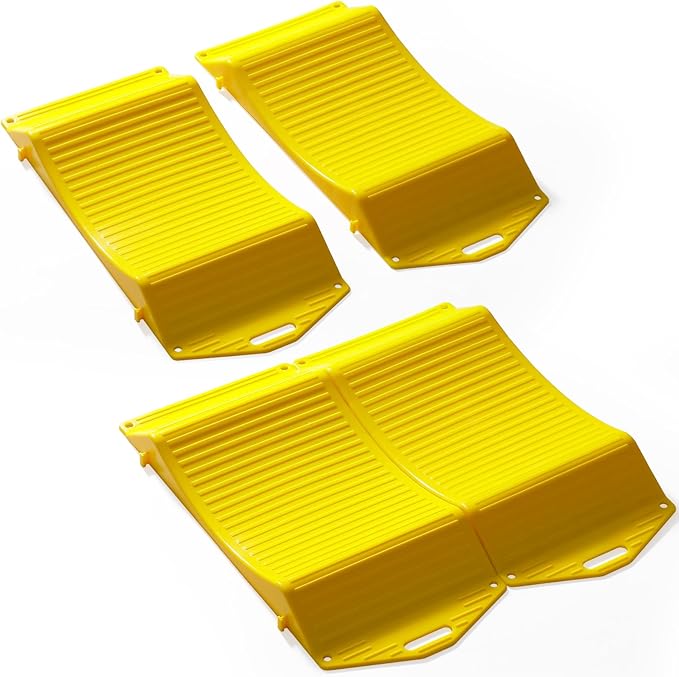
The short answer: No, I do not believe there is any data that shows the curve of these types of blocks will prolong tire life by assisting in the natural curve of the tire.
Here is the long answer
However, I have spent quite a lot of time researching tires starting back in the late 1980s, when I was marketing manager at Winnebago Industries. We were seeing quite an alarming number of tire failures on motorhomes. Michelin came in to help educate us on weight ratings, tire pressure, and tire maintenance.
I remember my parents coming back from their first caravan with the Winnebago Itasca Travelers (WIT) club. They stated they needed to get rid of their Michelin tires and replace them with Cooper Tires. The buzz around the campfire was Michelin had a soft sidewall and the Cooper had a higher “ply” rating and did not “blow out” as often.
Causes of RV tire failures
The fact was that more than 75% of units were over the Gross Vehicle Weight Rating (GVWR) and more than 75% had low tire pressure. Owners were overloading coaches and running on under-inflated tires, and were having enormous tire failures. Putting on heavier-ply Cooper Tires was masking the problem and was not the solution.
When I left Winnebago, I spent a lot of time researching tires with the RV Safety & Education Foundation and John Anderson. John retired and bought a large hauler and 5th wheel and had one tire failure after another. When the tire center finally weighed his rig, it was found that it was way over GVWR. He unloaded his rig and found the dry weight was actually right at GVWR.
Back then, nobody talked about weight ratings and what you could and could not put in the rig. So John started A’Weigh We Go and started weighing rigs at rallies and campgrounds to provide data for the tire manufacturers. He was ultimately responsible for RVIA mandating manufacturers to post dry weight and cargo carrying capacity.
Overloading and low pressure cause excess heat, which is one of the points Roger Marble stated in his post here.
Along with the weight data, John Anderson helped educate the industry with sidewall weather checking, proper tire pressure, and tire care and maintenance. There was a lot of discussion regarding how storing your unit would create a flat spot on the bottom of the tire and this would actually put a “kink” in the steel belts and ultimately contribute to tire failure.
There was discussion about using the jacks to get the tire off the ground or at least reduce the flat spot. Tire manufacturers stated that there was no proof that this flat spot would create an issue later as most tire failures are hard to pinpoint what actually caused the failure.
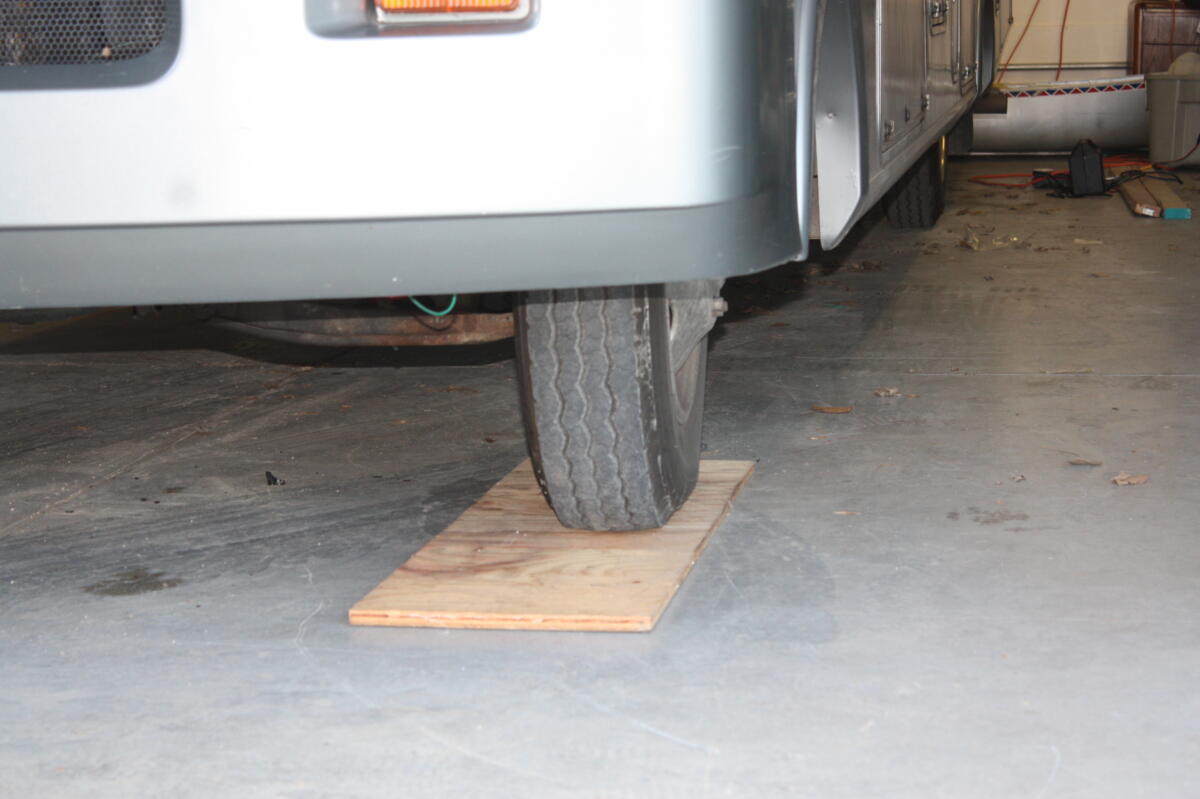
Recommendations from the Michelin Tire Manual
1. Store the recreational vehicle in a cool, dry, sealed garage, away from electric generators or transformers. Do not store in an area where welding is performed, or in a garage that has frequently used electric motors.
2. Place a barrier between the tire and the storage surface. Suitable barriers include plastic, plywood, cardboard, or rubber floor mats.
3. Before storing the vehicles, thoroughly clean tires with soap and water.
4. If outdoors, cover tires to block direct sunlight and ultraviolet rays.
5. Inflate tires to the maximum inflation pressure indicated on the sidewall.
6. If long-term storage exceeds 3 months, consider taking the recreational vehicle for monthly highway drives (about one hour of operational time). Driving the vehicle will give the tires an opportunity to generate internal heat which will promote long life. Before removing the vehicle from long-term storage, thoroughly inspect each tire, and restore all tires to the proper inflation pressure.
So, no, I do not feel the Tire Saver Ramps will actually help prolong tire life.
You might also enjoy this from Dave
Should RV be stored on jack stands to help preserve tires?
Hey Dave,
I love reading your articles in case something that has happened to others happens to me when I’m on the road. Since I have a Class A, I was wondering if it’s worth it to put the unit onto jack stands during the winter? It sits on a concrete pad. I have the capability to move it a few feet forward or backwards, but I’m not sure if that’s enough movement for the tires. Thanks so much! —Charles, 2018 Jayco Alante 29S
DAVE HAS ANSWERED MORE THAN 1,000 readers’ maintenance and repair questions. Read a directory here. There is so much to learn!
Dave Solberg is a leading expert in the RV industry and the author of the “RV Handbook.”
RVDT2782
Maybe run this one by Roger for his opinion?
As a tire design Engineer and as a failed tire Forensic Expert, I agree with the 6 points Dave posted. Latest data I have seen, shows that we still have a MAJORITY of tires in RV use being overloaded and or underinflated. I have also personally observed some tires being “supported” by ramps with the tire tread not fully supported. across the full face of the tread. This can do internal damage to the tire structure. Pictures in this post labeled “too narrow or Offcenter” are actually damaging the tires.
Thanks Roger. The ‘narrow support’ is right on. That’s the reason I use a 6 foot long 2X10. Easy to get both tires on without hanging over the edges.
BTW, when I bought my Adco cover, it came with tire covers made with the same material as the trailer cover. Stops the UV and are breathable to allow moisture to escape. They may not look as fancy as the vinyl ones, but they work. They are now 7 years old and still holding up.
Adco no longer has these tire covers though and I have never seen another company that makes them.
When these finally die, I’m going to have my niece make me a new set with some untreated canvass.
Some of the Michelin recommendations could use some explanation. Like why boards or mats under the tires while parked? And why inflate to maximum pressure? Most of all don’t park near generators or electric motors? (ours has it’s own generator)
Separating the tire from concrete, asphalt, and some kinds of gravel or earth reduces “leaching” of additive chemicals from the rubber that are there to extend tire life and/or strength. Tires lose pressure naturally over time, so inflating prior to storage reduce the chance they will lose too much pressure while in storage. And generators, motors, welders (while operating) generate ozone which is detrimental to tires.
Hands down, I’m now a fan of ‘flat spot’ tire ramps. In our case it isn’t the trailer that uses them, but the car we leave in storage for about 6 months a year. I cannot tell you one way or another if these ramps extend tire life. I can tell you that the car we pulled out of storage for 6 years had miserable ride flat spots. The 2 years the car was stored on the ramps, this did not happen. The car is now on the ramps for the 3rd winter.
Our trailer gets enough use year-round, it would not matter. Further, the stabilizers are down and the tire pressure routinely checked even when parked. The tires are covered if more than an overnight stop. But I’d use ramps if stored unattended.
I store my TT on 6 foot long treated boards covered with rubber mats.
The boards help keep the tires out of any ground water and the mats make it rubber on rubber.
Keep the tires covered while stored and DO NOT use any type of tire dressing. Most contain petroleum products to produce a shine, but also harm the rubber.
I only use Aerospace 303 on the tires. It’s water based and has UV inhibitors.
Thats too much trouble. I avoid it by going camping enough so the motorhome doesn’t sit for 3 months! Also, most of the time it is on the levelers so tires barely have any weight on them. If I did every anal thing recommended by all the manufacturers of parts and equipment, I wouldn’t have time to go camping. Normal vehicle maintenance, repairs of stuff that didn’t break because of lack of maintenance, and “improvement” modifications take up all the spare time I have.
I have my Class A parked on heavy rubber mats which have a design pattern with holes for drainage. They are about 3/4″ thick and abut 8w”x10L”. I inflate to 120lbs side wall psi in the fall. (LR-D) The MH is virtually empty over the winter.