


Hey Dave,
I love reading your articles in case something that has happened to others happens to me when I’m on the road. Since I have a Class A, I was wondering if it’s worth it to put the unit onto jack stands during the winter? It sits on a concrete pad. I have the capability to move it a few feet forward or backwards, but I’m not sure if that’s enough movement for the tires. Thanks so much! —Charles, 2018 Jayco Alante 29S
Hi Charles,
This question has been asked for the past 30+ years, and I have found both “yes” and “no” answers. Back when I was at Winnebago Industries, several tire manufacturers recommended getting the weight off the tires during storage. They stated the “flat” surface that the tires rest on would put a kink in the steel belts and eventually the tires would fail.
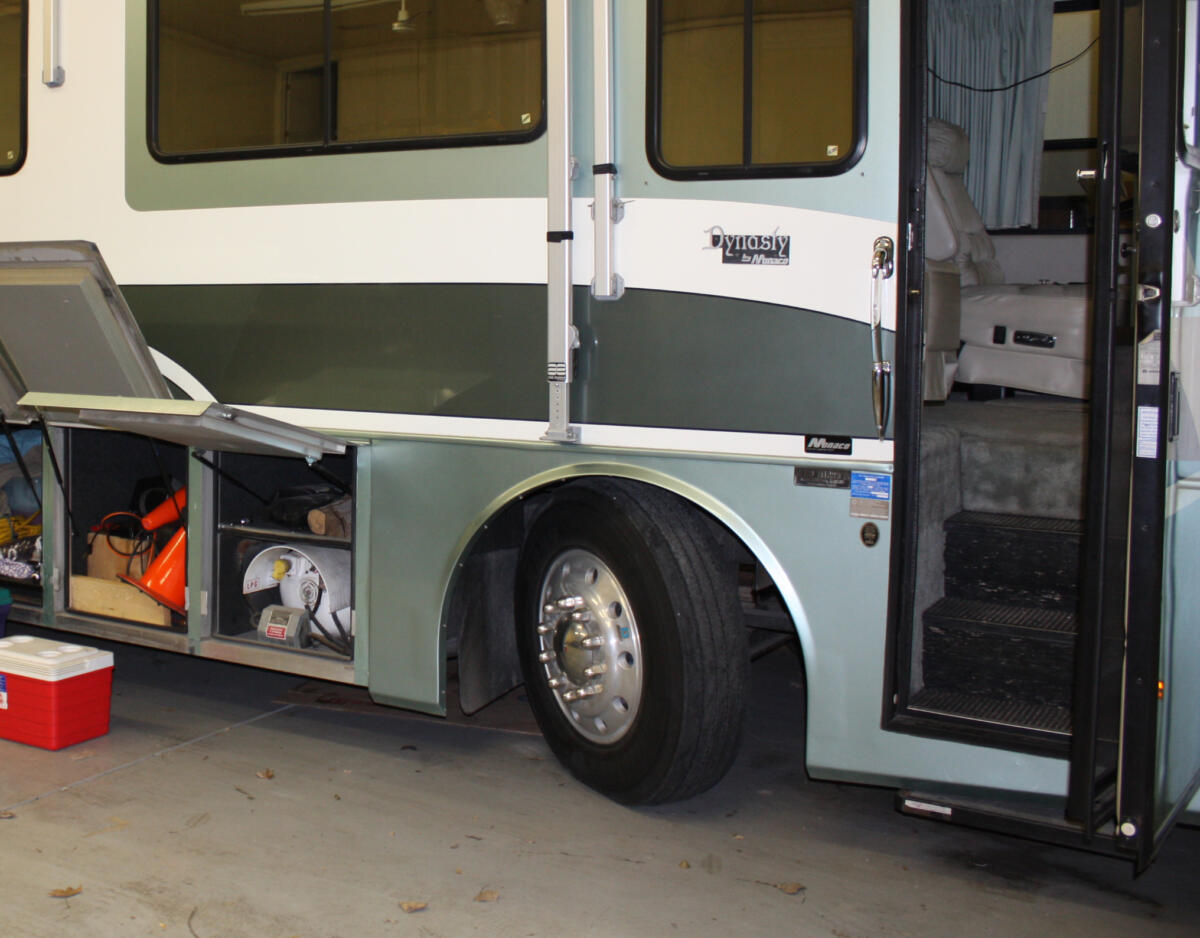
Also, when the Chevrolet P30 chassis was being used, many RV manufacturers recommended supporting the chassis, as this would take weight off the front suspension. The P30 had independent front suspension with coil springs and airbags inside those springs. Nobody checked the air in the bags. When they flattened, the coil springs would pinch the bag and create a leak. Someone had the bright idea of supporting the chassis to elongate the coil springs and that would keep the airbags from deflating—which it did not.
Recommendations from tire manufacturers
Over the years, the discussion has gone back and forth within tire manufacturers and their recommendations. Most agree that the pressure on a tire is not substantial enough to cause damage to the inner construction of the tire. Plus, most agree that it is impossible to pinpoint what condition actually causes the sudden loss of air in a tire unless it is an identifiable object such as a screw or a slice caused by something on the road.
Today we have the Ford F53 gas chassis with a leaf spring front suspension and no airbags, but rather shocks. Most tire manufacturers that I have discussed this with in the past few years, as well as the Executive Director of the RV Safety & Education Foundation, recommend filling the tire to recommended pressure and covering the tire if it is exposed to direct sunlight. It is also recommended to put a protective barrier under the tire such as clear plastic if the tire is exposed to any harsh chemical on the ground.
Recommendation from the Michelin Tire Manual
1. Store the recreational vehicle in a cool, dry, sealed garage, away from electric generators or transformers. Do not store in an area where welding is performed, or in a garage that has frequently used electric motors.
2. Place a barrier between the tire and the storage surface. Suitable barriers include plastic, plywood, cardboard, or rubber floor mats.
3. Before storing the vehicles, thoroughly clean tires with soap and water.
4. If outdoors, cover tires to block direct sunlight and ultraviolet rays.
5. Inflate tires to the maximum inflation pressure indicated on the sidewall.
6. If long-term storage exceeds 3 months, consider taking the recreational vehicle for monthly highway drives (about one hour of operational time). Driving the vehicle will give the tires an opportunity to generate internal heat which will promote long life. Before removing the vehicle from long-term storage, thoroughly inspect each tire, and restore all tires to the proper inflation pressure.
You might also enjoy this from Dave
Should I leave the RV’s scissor jacks extended or retracted during storage?
Dear Dave,
We’re in a seasonal campground (April through October) and are now getting ready to close up for the year. Sometimes I’ve done this, sometimes not, so here are my questions. Should the leveling jacks (scissor-type) be left down or up? And should I leave the camper level, or tilted towards the rear? I don’t cover it, BTW. Thanks. —Jerry, 2021 Forest River Wildwood 27RK
DAVE HAS ANSWERED MORE THAN 1,000 readers’ maintenance and repair questions. Read a directory here. There is so much to learn!
RVDT2740
Being snowbirds, the motorhome is parked in our driveway the great majority of the summer. Having it up on jackstands gives great access with a creeper for oil change, greasing, and a thorough inspection. It seems that every year I find one or more items that need repair under the bus.
For the trailers, I keep the stabilizers or levelers (I have 2 trailers and 1 of each type) down with the trailer just off level for better roof drainage. Tires are inflated to the cold max pressure and covered if parked for more than a couple days.
I also have a 2nd car that is stored in the garage over the winter when we head south. For years the tires developed flat spots that took most of the summer to relax. For 2 years (soon to be 3rd) I put plastic cradles under the tires. Those buggers work! No flat spots when we return in the spring.