

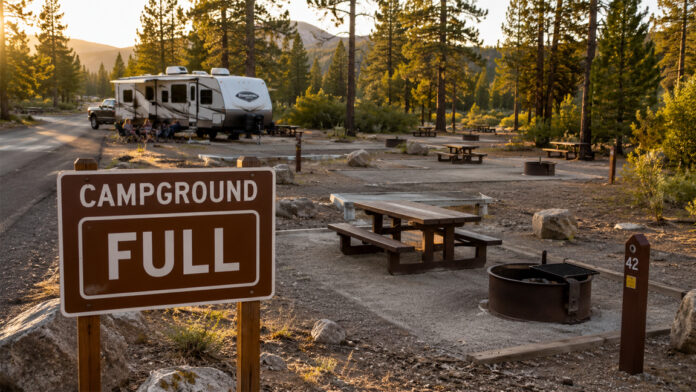
The campground was full—at least according to the reservation system.
Yet after checking in, you notice empty campsites scattered around the campground. No RVs. No tents. Nobody arriving after dark.
California officials say those empty campsites are one reason the state’s imposing tougher penalties on no-shows and last-minute cancellations beginning July 1.
California’s State Parks operate about 15,000 campsites, and many are snapped up months in advance during busy seasons. But officials say some campers cancel at the last minute—or simply don’t show up—leaving campsites empty while other travelers are still looking for a place to stay.
Under the new rules, campers who cancel less than two days before arrival will generally forfeit their fees. The same applies to no-shows. In addition, campers who rack up three no-shows within a calendar year can be barred from making reservations for the next 12 months.
“If we can get folks to cancel earlier, we have a better chance of getting our campsites fully occupied.”
The goal is simple: Encourage campers to release campsites they don’t intend to use while there’s still time for someone else to reserve them.
Why campgrounds can look full when they aren’t
The problem isn’t unique to California.
Many popular campgrounds allow reservations months in advance. Travelers sometimes reserve multiple weekends while they finalize plans, hold backup reservations in case weather changes, or forget to cancel when plans fall through.
The result can be frustrating.
A reservation system may show every campsite booked, yet some reserved sites remain vacant for part—or all—of a weekend. Those sites are effectively unavailable to other campers because they remain tied to an unused reservation.
For RVers, that can mean missing out on a campsite even though some sites ultimately go unused.
Will the new rules work?
That’s the big question.
California officials reportedly have not closely tracked no-show rates in the past and plan to begin gathering more data after the new rules take effect. It may take time before anyone knows whether the tougher penalties actually result in more campsites becoming available.
Some campers will likely applaud the change. Others may worry about losing money when illnesses, family emergencies, vehicle breakdowns, or weather events force last-minute cancellations.
Still, the frustration behind the new rules is easy to understand. Few things annoy campers more than hearing a campground is fully booked, only to discover empty campsites sitting unused.
For RVers, the new policy may be worth watching even if they never camp in California. If the rules succeed in reducing no-shows and encouraging earlier cancellations, other campground systems could eventually consider similar approaches.
The takeaway is straightforward: If your plans change, cancel as early as possible. Under California’s new rules, waiting until the last minute could become an expensive mistake.
Sources
SF Chronicle
California State Parks
RELATED
- How to score crowded National Park campgrounds reservations
- RVers cheating with reservations, says campground industry
- Reserved but empty campsites: The campground’s side of the story
- How I scored a National Park campsite on a weekend
RVT1267b


A 12-year old could write a program that returns the fee to the original camper who cancels the site if rented the same time period. Why cancel if they are keeping most of your money and then renting the site?
Back in the early 1980s I worked for California State Parks. The policy, through Ticketron, was if you didn’t contact us & didn’t show up you forfeiting your first night at a minimum. If you still didn’t show up, your entire reservation was cancelled & we made your site available First Come First served. Posted off a few people, but that’s what we did. I worked there 5 summers, always with that policy.
When we camp hosted in Wyoming State Park (2022) this was already part of their policy. We are all for it. Many state parks are very inexpensive so we feel it doesn’t bother them to loose the money when they don’t cancel. We know the pain of campers seeing empty sites. We have to tell them that it is paid for and can’t let anyone use it unless it’s canceled. 😞
No Show- No Refund unless illness, breakdown happens. BUT call to let the CG know even if on the day of expected arrival. It’s called “common courtesy”.
A lot of this has to do with people making reservations at two or three campgrounds for the same time period. Then picking the one most favorable to their plans. They then expect a refund. A lot of campgrounds now post a 72 hour cancellation policy.
Cancellations after that and no refund.
We’ve had few that wanted a 2 day deposit minimum.
As far as the empty sites, some these may be for campers that have paid a seasonal rate, reserving the site.
There are no “seasonal rates” at public campgrounds in the West, which is where we camp. Most public cgs. have 14-day stay limits. And, because they are relatively cheap compared to private RV parks, the public cgs. are the ones where most of the “no shows” and multiple bookings occur. So, we are definitely in favor of no refunds for no-shows!
I found when working at a campground that sometimes people don’t show up because they can’t read a map and set the GPS wrong and it will take them to a place 3 hours away. This happened more than once that someone called to say they were 15 minutes away then never show up. They did call and and say they were not coming but that didn’t keep others in the park from being mad when we had told their friends we were full up.
We encountered something interesting at Arches NP. This is a park where you have to book and pay for a special entry time. It’s a hassle. But people have figured out that if you book a campsite, you can come and go to and from the park whenever you please. We found this out because we wanted to camp but found the park always booked. When we visited the actual campground, however, about 80% of the sites were empty, but had reservation cards. It was infuriating to us and we decided the rangers didn’t care because it made their jobs very easy.
Thank you for the news, Russ and Tina. I applaud the effort to reduce the number of reserved-but- unused campsites. However, with no idea, no data for how much this happens, when, and where, there will be no real standard by which to measure the effect(s) of the planned changes. Once the changes have been implemented, then the effects of tweaks might be detected, but there will be no accurate way to know what the initial changes do. All the perceived effects may be due to entirely different reasons and have nothing to do with the new regulations. Have a great day and safe travels!