


Dear Dave,
I want to add an inverter to run the RV refrigerator only. I want it to run on shore power when plugged in and on inverter while traveling. What is the simplest but best way to do that? Any suggestions on inverter brand? —Eddie, 2016 Keystone Cougar 330RBK
Dear Eddie,
From what I can find online, it looks like your refrigerator is an 8-cubic-foot, two-door absorption refrigerator. That means it can run on LP mode or 120-volt power. There are several variables to this equation, including the ambient temperature inside the rig, size of battery bank your unit has, and the size/output of your alternator. According to what I can find online, the average 8 cu. ft. refrigerator draws approximately 300 watts.
Ambient temperature
During travel times, you will not be able to run the roof air conditioner, so the inside of the rig will get warmer as the temperature rises. That means your refrigerator will “cycle” more often and draw more power.
Engine alternator
Some tow vehicles have a single alternator that may only produce about 6 amps of charging voltage. That would not be sufficient to keep up with your power demands. However, some of the larger trucks—which I assume you might have to pull a larger 5th wheel—have dual alternators and can provide up to 20 amps charging power.
Battery bank
The variable here is the type of battery and the amp hours available. If you have flooded lead acid (FLA) batteries, you should only drain them down to 50% State Of Charge (SOC), while lithium can be drained down almost 100%. Plus, the more batteries you have, the more available amp hours that can be depleted. This means your inverter could provide power much longer even if your alternator cannot keep up with the power requirements.
I don’t have all the specific power requirements. However, Mike Sokol did an experiment with a residential refrigerator running on a 100 Ah lithium battery through a 1000-watt inverter and got 10 hours at 70 degree ambient temperature. This would mean an FLA battery would get approximately 5 hours.
From the test, Mike indicated that not only did the refrigerator draw power, but the inverter was the weakest link. However, you don’t have much of an option other than replacing the refrigerator with a 12-volt compressor-driven model connected directly to the 12-volt system, which got almost 40 hours!
Another variable to consider is solar charging. If your rig has solar panels mounted on the roof, this could also add charging power to the equation, if there is appropriate sunlight.
Size and type of inverter
Most of the people that I have talked with state that a 1000-watt inverter would be sufficient, and the battery bank is the most important issue. If you want the power to switch from the inverter drawing 12 volts from the battery, you will need an inverter with a pass-through feature, also called a transfer switch. It would have a 120-volt line coming in from the distribution center. When it senses 120-volt power, it transfers to that source. I would recommend the 1500-watt Go Power! model you can find on Amazon here.
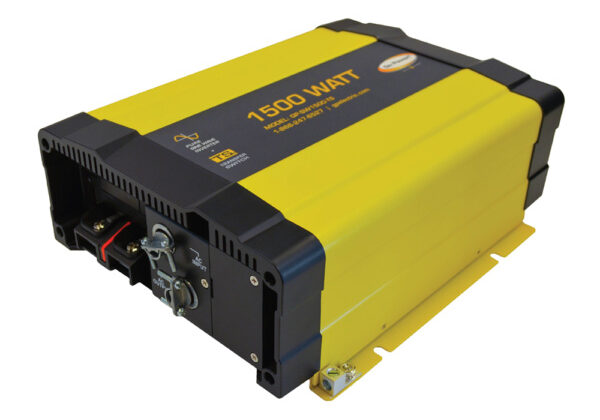
I do not see a 1000-watt model that has the transfer feature. Keep in mind that wiring both 12 volt and 120 volt would need to be spec’d and sized accordingly.
Can it be done?
So, can it be done? Yes, if you do the math and upgrade to what power requirements your refrigerator needs. Here is a photo of the Xantrex inverter that was installed in the 2016 Thor Challenger we worked on a few years ago.
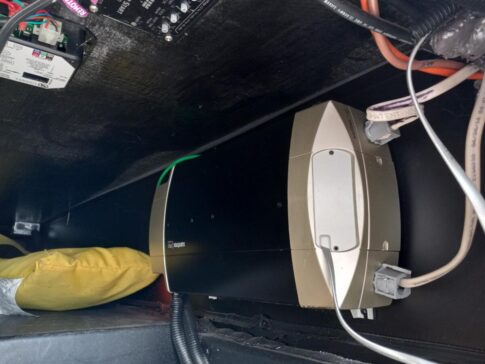
It is an 1800-watt inverter with the pass-through feature, as you can see the Romex coming in and out. The original setup would not keep up with the two Interstate batteries and we swapped them out for two Expion 360 100 Ah lithium batteries. It works well.
I’ll be interested to see what others have tried and what works.
You might also enjoy these posts from Dave
- Will these power sources keep my RV refrigerator running while driving?
- Will running RV refrigerator on propane while driving hurt it?
- How long will an RV 12-volt refrigerator run with two batteries?
- RV refrigerator hot weather tips; install fridge fan?
Dave Solberg is a leading expert in the RV industry and the author of the “RV Handbook.”
Read more from Dave here.
HAVE A QUESTION FOR DAVE?
Send your inquiries to him using the form below.
RVDT2656

Maybe buying a 1000 watt Jackery would be simpler and it would provide many more uses too.
I have 400 watts solar on my roof, 200 amp lithium. Been running with fridge on 120v traveling down the road on regular basis and works well.
The absorption refrigeration process uses 8 times more energy than the compressor process, so there is and will always be a tremendous amount of wasted energy used to operate it. Absorption refrigeration should NEVER be considered efficient. On propane, it is simply economical (to waste a lot of cheap fossil fuel energy). On electricity (either DC or AC), it should be considered extremely wasteful.
Operating an inverter is generally advertised to be ~93% efficient but inverter efficiency is very non-linear at low loads (below 40%). Below 30% load, efficiency drops off dramatically, bottoming out at around 30% at about 10% load. For needs that require long-duration operation (such as a refrigerator), it is wise to size the inverter to be loaded above 40% (better to be at 50%). In the case of operating a 300W load, a 1000W inverter is a bit too big. Something in the 600-800W range is more prudent.
Thank you for the question and answer, Dave! This RV electricity stuff is interesting. I’ll keep listening and sometimes remembering. Hopefully, one day I will fully understand. Meanwhile, thank you for so patiently going through this again and again. Have a great day and safe travels!