


Last November I received an email question from a reader who had a Toyota Tacoma and a nuCamp TAB trailer and wanted to know if she could tow it safely. I asked for specs on the Tacoma and to weigh the truck and trailer at a CAT Scale. Since it was stored for the winter, we waited.
And then I received this:
Hi David,
Here is the information you requested in order to address our original question regarding towing our T@B 400 with our 2023 Toyota Tacoma, double cab, 6-foot bed:
GAWR = 3,050# (FRT) and 3,280# (RR)
GVWR = 5,600#
GCWR = 11,290#
TWR = 6,400# (from owner’s manual)
From CAT Scale:
With trailer:
Steer axle – 2700#
Drive axle – 2980#
Trailer axle – 3400#
Without trailer:
Steer axle – 2940#
Drive axle – 2400#
We had the Anderson weight distribution hitch and sway control chains installed prior to weighing. We’re novices and learning a lot about towing capacity. We compared all the numbers but are unsure about the conclusions. We are concerned that we already exceeded or could easily exceed the GVWR as there was nothing in the truck bed when we weighed everything. The trailer should be close to what we would roll with as the water tank was full, etc.
Any conclusions, concerns, and options for resolving any safety or legal concerns would be so appreciated.
Thank you very much. —Rachel and Pete
Hi, Rachel and Pete,
First, I applaud you for the thorough weighing and doing the math. And I’m also mad that you are making me do the math. I hate math! Just kidding. It’s important to get all these weights. Even though it looks like you might be OK in almost every rating, there are a few concerns.
I am more of a visual person, so I developed an image of what your truck and trailer would have for weights on the scale. That way I could look at individual axles and compare weight ratings.
Here is a diagram of your truck with the TAB on the three platforms of a CAT Scale. Keep in mind the diagram is for reference only and the scale or size of the truck and trailer might not be exact, but it is a good visual reference.

According to the specifications for your truck, the Gross Axle Weight Rating of the front axle is 3,050 lbs. So your truck with the trailer weighs 2,700 lbs. and is 250 lbs. under that weight rating. The rear axle is 3,280 lbs. max and only weighs 2,980 lbs., so it is 300 lbs. under.
Most of these numbers look to be within specification except the GVWR of the truck. With the trailer connected, it is 60 lbs. overloaded. So we need to look at the weight of the truck without the trailer, which you did provide.
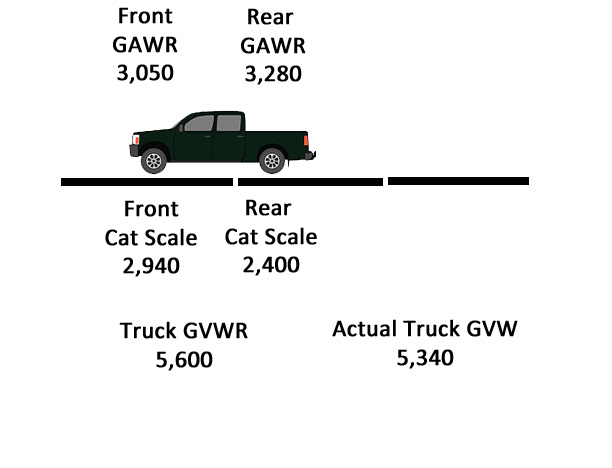
This shows that with the trailer connected and possibly the Anderson hitch, you are adding 340 lbs. to the rear axle. That puts it over the GVWR for the truck but not over the rear axle weight rating.
According to the nuCamp website, the unit should only weigh 2,911 lbs. dry and has a GVWR of 3,900 lbs. Your figures show it is only at 3,400 lbs., so that is good. It also shows a tongue weight of 399 lbs. dry.
Variables come into play
There are several variables that come into play here, such as the fresh water tank. You indicated in one of your emails that it was full. Water weighs 8.34 lbs. per gallon. It not only adds overall weight to the GVWR but can affect the weight of axles and tongue weight due to the placement of the tank and weight distribution. Also, did you weigh the unit with the 200 lb. topper?
Your weights are mostly within safe towing specifications except the GVWR of the truck. However, you do need an auxiliary braking system for the trailer. GVWR on the truck is over by 80 lbs., which some people would say is OK and call it the “fudge factor.” I am on the other side of the fence and would rather take 10% off what is rated as maximum, in the event I am pulling a unit in extreme heat or on a 6% grade and need to stop.
According to the nuCamp website, the TAB 400 Boondock has an unloaded dry weight of 2,911 lbs. So you have added 489 lbs. (3,400 – 2,911 = 489), plus another 580 lbs. that is on the rear axle due to tongue weight (2,980 – 2,400 = 580). This is a total of 1,069 lbs., which you could verify by just weighing the trailer not connected.
Water tank
From the photos I can find on various walk-arounds, it seems the water tank is in the back under the bed. If that is the case, and you have not filled it up, you could add some water to the tank to shift the weight off the tongue and still be under GVWR of the trailer, since it is rated at 3,900 lbs. and you are only at 3,400 lbs. 20 gallons of water would be about 167 lbs. and could shift the fulcrum point of the weight. Or you could move some cargo from the front of the unit to the rear while traveling.
Another weight factor I see on photos from review sites is the heavy metal platform with a diamond plate steel enclosure for the propane cylinders and batteries, which also adds weight.
So you have some options and I would try to get the actual weight of the truck down (GVW), even though it’s only 80 lbs. over the GVWR. I have gotten hundreds of comments from readers on posts such as this that stated they have been towing for hundreds of years with no problem. OK, maybe it wasn’t hundreds of years, but it seems like it. There are so many of these discussions on “can or can’t,” such as driving with propane on, the need for auxiliary brakes in a tow car, and many more. Yes, the percentages for an issue might be low; however, I don’t want to be that statistic.
*****
I sent the rough draft of the above to Rachel and Joe this weekend and got more information.
In an earlier email, Rachel stated that the topper was 200 lbs., and they had full water in the fresh water tank. According to the nuCamp website it is 25 gallons. That would bring the total with the 12 gallons to 37 gallons X 8.34 = 308.6 lbs.
Helper springs or airbags
Helper springs or airbags will not increase the weight capacities but are good to level the rig if your rear springs are designed more for a nice ride. Most half-ton trucks today are designed to look like the larger boys with a taller profile and hood scoops. But they have softer springs for a more comfortable ride, which I attribute to “hobby” farmers and cowboys who don’t like the Z71 package and the rough ride! I have seen quite a number of trucks that drop the back end when hooked up to a trailer even though all the weights are under specification—and that includes mine!
But I still recommend finding a way to take weight off the truck by either removing the topper (200 lbs.!) or shifting weight to the back of the trailer. I will not tell you it is OK to drive/tow with the truck over the GVWR. I don’t want to be that guy either.
You might also enjoy this from Dave
How do you determine proper truck towing capacity? Part 1
GCWR, payload, GAWR—so many terms and so much confusion. There has been an enormous amount of discussion and debate on what a truck can actually tow. For years there were publications such as the Trailer Life Guide to Towing and Ford’s and Chevrolet’s own towing guides published every year regarding truck towing capacity. It seemed pretty easy: Just find the make, model, cab configuration, and rear end ratio and the towing capacity was right there.
Dave Solberg is a leading expert in the RV industry and the author of the “RV Handbook.”
Read more from Dave here.
HAVE A QUESTION FOR DAVE?
Send your inquiries to him using the form below.
##RVDT2406


Payload was not discussed here. Driver’s side door sticker shows manufacturer-determined payload capacity, from which tongue weight should be subtracted before adding any extra weight in the truck (i.e. passengers, bikes, generators, food, etc.), which should also be subtracted from the payload number to determine safe and legal towing.
NEVER use the advertised cargo capacity from the manufacturer’s website to determine allowed hitch weight! That number is an “advertising truth”, which is GVWR – dry weight, without gas, oil, transmission fluid, etc. The door sticker is the only one that matters. In our case, we bought a 2023 Tacoma TRD Sport because the website said 1105 lb. The door sticker said 940! Then, subtract 65 lb. tonneau cover, 280 lb. occupants, 100 lb. equalizer hitch, and you are left with just under 500 lb.
We are trading it for a 2024 Tacoma with no tonneau cover and a 1200 lb. door sticker, and considering an Anderson hitch and lithium battery to further reduce weight.
Dave, Your 10% rule is spot on!
Since driving conditions are dynamic, it pays to allow 10% for pulling hills, braking for down grades, and extra loading. Great advice!
I wish everyone towing a TT or 5th wheel would read this Q&A. Anyone with a RAM 2500 should definitely read this Q&A. My 2024 RAM 2500 has a payload (CCC) of 2119lbs, as do most 5th Gen RAM’S. My wife, myself, 98lb dog and 31gal of diesel weigh 638lbs. That leaves 1481lbs of stuff I can add to the payload. The new 5th wheel I just bought has a pin weight of 1250lbs. I can add 231lbs to the payload without balancing, which I do! I’ve seen RAM 2500 owners towing 37-41 foot fivers. Pin weights are over 2500lbs, which means they can’t legally tow, but they do because the towing capacity of a RAM 2500 is 20k lbs, and that’s all they know.
Better to have more truck than too little. I had a new Toyota 4 Runner a few years ago and was told by the dealer it would tow my Jayco Hummingbird no problem. BULL HOCKEY…the 4 Runner was anemic at best and I promptly got rid of it and bought a F-150 with the 3.5…no problem now. Better safe than sorry.
This should be required reading for anyone looking to purchase a towable.
Last fall we sold our 29″ Wildcat TT. When the buyer showed up with a “New” Ford Ranger, I told him it was not adequate to pull the camper (we pulled it with a Cadillac Escalade ESV with a 6.0L V8, and it was a load). After comparing the weight of the camper to the truck’s towing capacity, he was convinced it was a “safe” combination. Had he not stated that the camper would be used as a seasonal at a local campground, I would not have sold it to him.
This article makes me wonder what percentage of truck/trailers on the road exceed the safe load ratings? I’m guessing most do.
Thank you, Dave! 🙂 This exchange is both interesting and helpful. 🙂 Have a great week and safe travels! 🙂
Hmmm. If the truck sags, it needs the WDH adjusted. If a WDH is properly adjusted, there should be no sag. Airbags don’t move weight to the front axle. The weights in the article show that there has not been sufficient weight shifted to the front axle, so steering and braking will be compromised.
There are reasons to properly adjust WDH. Don’t put a band-aid on (airbags). Go through the entire process to get them adjusted correctly.
You need a better WD HITCH. I tried the Anderson “chain type” hitch for over a year under every type of condition and my experience was that it is a terrible WD hitch. Utterly ineffective for WD. I’m a BSME and I know this stuff. Finally, I sold it and bought a real, honest to God bar-type WD hitch and it solved EVERYTHING!!!
Up the street from us, I occasionally see a nice, beefy-looking late model Tacoma hooked up to a smallish Forest River ePro. The poor truck is all squatted down in back. Yup, he’s using that ineffective Anderson “chain” hitch. He’s clearly getting no WD with that setup. I just roll my eyes and shake my head……