

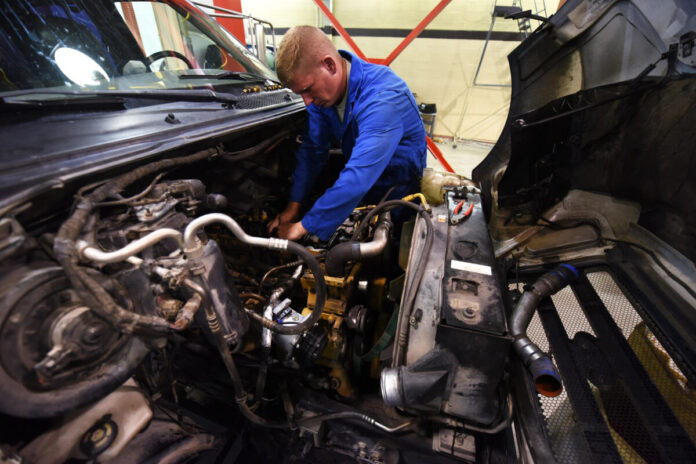
In the largest-ever-so-far settlement under the Clean Air Act, Cummins, Inc. is handing over $1.675 billion. In an agreement that admits no wrongdoing, the big engine company said it has already begun to recall some of the 630,000 Ram pickups that allegedly have illegal emissions defeat systems built into them.
Cummins and the emissions defeat devices
The Department of Justice says Cummins allegedly installed defeat devices on 2013 to 2019 Ram 2500 and 3500 pickup truck engines. It also allegedly installed undisclosed auxiliary emission control devices (AECD) on 330,000 model year 2019 to 2023 Ram 2500 and 3500 pickup truck engines.
Just what is an emissions defeat device? It’s a system that interferes with or disables emissions controls. It may be physical hardware, or it could be vehicle control software. In any event, the defeat device allows a vehicle to pass an emissions test, while in the real driving world allows the vehicle to emit pollutants that exceed lawful levels. It’s not clear what emissions defeat devices are involved in this settlement.
“No evidence anyone acted in bad faith”
For its part, Cummins released a statement on the matter. In part, it says, “The company has cooperated fully with the relevant regulators, already addressed many of the issues involved, and looks forward to obtaining certainty as it concludes this lengthy matter.” The statement adds that Cummins “has seen no evidence that anyone acted in bad faith and does not admit wrongdoing.”
Cummins engines cheat federal environmental laws
On the other side of the fence, the Department of Justice issued its own statement about the case. In part, the statement related information about the damage caused. “The types of devices we allege that Cummins installed in its engines to cheat federal environmental laws have a significant and harmful impact on people’s health and safety.
“For example, in this case, our preliminary estimates suggest that defeat devices on some Cummins engines have caused them to produce thousands of tons of excess emissions of nitrogen oxides. The cascading effect of those pollutants can, over long-term exposure, lead to breathing issues like asthma and respiratory infections.”
How are Ram owners affected?
If you own one of the involved Ram pickups, how will this case affect you? Cummins has already recalled model year 2019 Ram 2500 and 3500 trucks. It has initiated a recall of model years 2013 through 2018 Ram 2500 and 3500 trucks. Just how much time your truck will be away from you getting the needed adjustments isn’t clear.
But this may not be the end of the matter. In the infamous Volkswagen “Dieselgate,” the fallout was more than just having illegal defeat systems replaced. In 2015, the U.S. Environmental Protection Agency found some VW diesel engines were emitting high levels of nitrogen oxides. An investigation revealed VW had deliberately used defeat systems to allow the vehicles to test OK but, when on the road, dump pollutants out their tail pipes. Some 600,000 VWs in the U.S. were involved, and millions the world over.
There was more of a stench than just tailpipe emissions. VW had to pay billions to governments and VW owners in fines and compensation. VW’s reputation was marred, and it is still fighting lawsuits from disgruntled customers. Could the same thing happen to Cummins? Only time will tell.
Cummins’ astronomical fine put into perspective
As to the seemingly astronomical fines that Cummins will pay out to both the United States and to the State of California, for the common Ram truck owner, it may seem like a major hit for the engine manufacturer. Cummins told its stockholders that the company expects to charge a little over $2 billion in its fourth quarter 2023 to handle the problem.
But the Indiana Business Journal, a publication from Cummins’ home state, sheds a little more light on the matter. “To put the settlement amount in another perspective,” says a report from the journal, “Cummins booked annual profits of $2.2 billion on $28.1 billion in sales last year.”
For the man on the street, $2 billion to settle the emissions stink seems huge. For Cummins, it’s a drop in the bucket. But, as the saying goes, it may be that the fat lady hasn’t sung yet.
##RVT1137b


That 2.2 billion profit on 28.1 revenue is about 92% operating ratio. Pretty much in the ball park. Definitely not a drop in the bucket. Do your homework before you write the article. Yes, it’s a lot of money, but there are a lot of mouths to feed.
They seem to leave out certain details in their articles. It’s just a accepted practice in journalism today.
The thing you didn’t mention is that if they fix the problem, owners may find that their trucks now have far less power, and use more fuel, than before. For RV owners, that could be critical. Let the lawsuits begin…
These kinds of rumors flew all over during the Cummins SCR recall. People stated Cummins was installing software to derate engines as part of the recall process and other completely unfounded notions. No such things were happening…HP, torque, fuel economy, etc. were not impacted with the recall fix.
I’ll also state that my current “fully emissions loaded” motorhome gets slightly better fuel economy on a weight to HP ratio than my previous two DPs that were pre-emissions. Other than the potential for the dreaded derate if there is a system failure, I’ve noticed no negatives…and I’m not belching filthy black soot all over the toad.
Why in the world of business did Cummins think they would not get caught?
Are the CEO and upper mgmt still getting their year end bonus? That’d help pay the fine.
They will just raise the price of their trucks to make up for it
Another instance of “do what I say, not what I do”. The diesel trucks purchased by the federal government are ordered: “deleted”.
Deleted engines provide more HP, get better fuel economy, have less maintenance, and last longer.
Finally, when publishing MPG, DEF is not included.
Thank you, Russ and Tina! Yes, a bit more than a “drop in the bucket,” with most recently reported profits at slightly more than that. Have a great 2024! 🙂
So to put 2.2 billion in perspective, consider a “man on the street” with a small business. Cummins had profits of $2.2B on 28Bin sales or 7.86% and is paying $1.675B or 5.96%.
Now, if a small business owner with sales of $2.8M/year and 7.86% profit or $220,000.00 had to pay a fine of $166880.00 or 5.96% or 3/4 of your yearly income, that would hurt.
Not to mention the cost of the recalls and legal fees, etc; this will cost Cummins a year’s profit.
So, does this problem amount to more ‘pollution’ than back in the days of no DEF, no REGEN, and no diesel particulate filters and catalytic converters? What the government is asking (or mandating) is probably not realistic. You don’t suppose the ultimate goal is all battery powered vehicles do you? Another unrealistic ‘mandate’.
My 2016 Ram with the 6.7 has triggered the dreaded 5mph DEF system ‘limp mode’ twice. Both instances occurred in the Southwestern desert at 110 plus degrees while hauling a 5th wheel. Fortunately, in both cases I was able to drive to a dealer and a quick computer reflash addressed the immediate problem which has not reoccurred over the past 18 months. I just received my recall notice for the 67A software update. Fingers crossed on the outcome. The silver lining is that the notice does indicate possible reimbursement for anyone that has paid for the same repair. If, it’s the same repair, that is.
Silly rules for a silly Nation…🎅🥳🎊🎉✨
How can a gallon of diesel that weighs say 8 pounds put Hundreds of pounds of pollutants into the air? I guess they use molecular weight or something like that. When you look to the sky and see a large plane, think of the clean air equipment they have. NONE, AND a cross-country flight burns thousands of pounds of fuel that is very similar to diesel.
When a gallon of diesel is burned at high temperature and pressure as is the case in a high compression diesel combustion chamber, the heat of combustion takes a lot of that air pumped by turbocharges and similar, converting it into oxides of nitrogen. A diesel engine has no throttle plate, it is an excess air engine, and its power output is controlled by the amount of fuel burned. Black smoke is unburned fuel. Diesel particulate filters alone do not require DEF. Many NOx treatment devices do require DEF. And we have more powerful engines with lower emissions because the engines themselves must be more efficient too.
2013-2018 ram 6.7 recall requires a 1hour software update
My 2019 3500 had emissions problems from day one, but the dealer and service centers told me to ignore the lights and warnings and just drive. Soon the emissions warning lights went off and the truck ran fine. I traded it off at 20,000 miles, so I have no idea if it had a recall issued.
Thanks again, Russ and Tina! Glad our farm truck (1997 Dodge 3500 diesel) wasn’t part of the recall. 🙂 Happy new year! 🙂
So if these Cummins engines could pass an exhaust test, how did they get “caught”?
There was a recall for my 2016 F-350 Powerstroke a few years back. I finally agreed to have the software ‘upgrade’. Two days later the truck could barely move and I took it back to Ford. There it sat for eight weeks while they waited for parts. I won’t be doing that in the future.
I don’t like the extra expense, and it is sometimes a problem, to find DEF. But I am glad to have that technology as part of my motorhome. No black smoke and when I stand behind the RV I don’t smell the exhaust. I am very sensitive to exhaust from gas and diesel vehicles and glad that mine does not stink.