


Dear Dave,
I’m looking to put a battery maintainer on my two RV house batteries. Do I have to charge them separately or can I put a charge on both as they are connected together? Thanks. —Norm, 2021 NeXus Wraith
Dear Norm,
I have written numerous posts about proper battery charging; however, I don’t recall anyone specifically asking whether batteries need to be disconnected and charged individually.
Your house batteries should be deep cycle batteries and are typically either 12-volt or 6-volt models.
If you have 12-volt batteries, they are connected in parallel (positive to positive and negative to negative). This keeps the system at 12 volts while doubling the available amp hours.
If you have 6-volt batteries, they are connected in series (positive to negative). This also creates a 12-volt battery bank. When two identical 6-volt batteries are connected in series, the voltage doubles while the amp-hour capacity remains the same as a single battery.
There are many discussions about the advantages of each setup, but in either case, the batteries can remain connected while charging. They do not need to be disconnected and charged individually when using a properly functioning converter or battery maintainer.
Check the basics
- Make sure all connections are clean and tight to ensure a consistent charge.
- Confirm that the batteries are the same type, age, and condition. If one battery has lower amp hours, is a different brand, or is failing to hold a charge, you will experience charging and performance issues.
Verify battery type and charge profile
The battery type determines the proper charging profile:
- Flooded lead acid (FLA) batteries typically charge at approximately 13.6 volts during the absorption stage, then drop to around 13.2 volts in float once fully charged (about 12.6 volts at rest).
- Lithium iron phosphate (LiFePO4) batteries generally require about 14.4–14.6 volts during charging, usually for a shorter absorption period. Be sure your converter or maintainer is lithium-compatible and provides the correct profile.
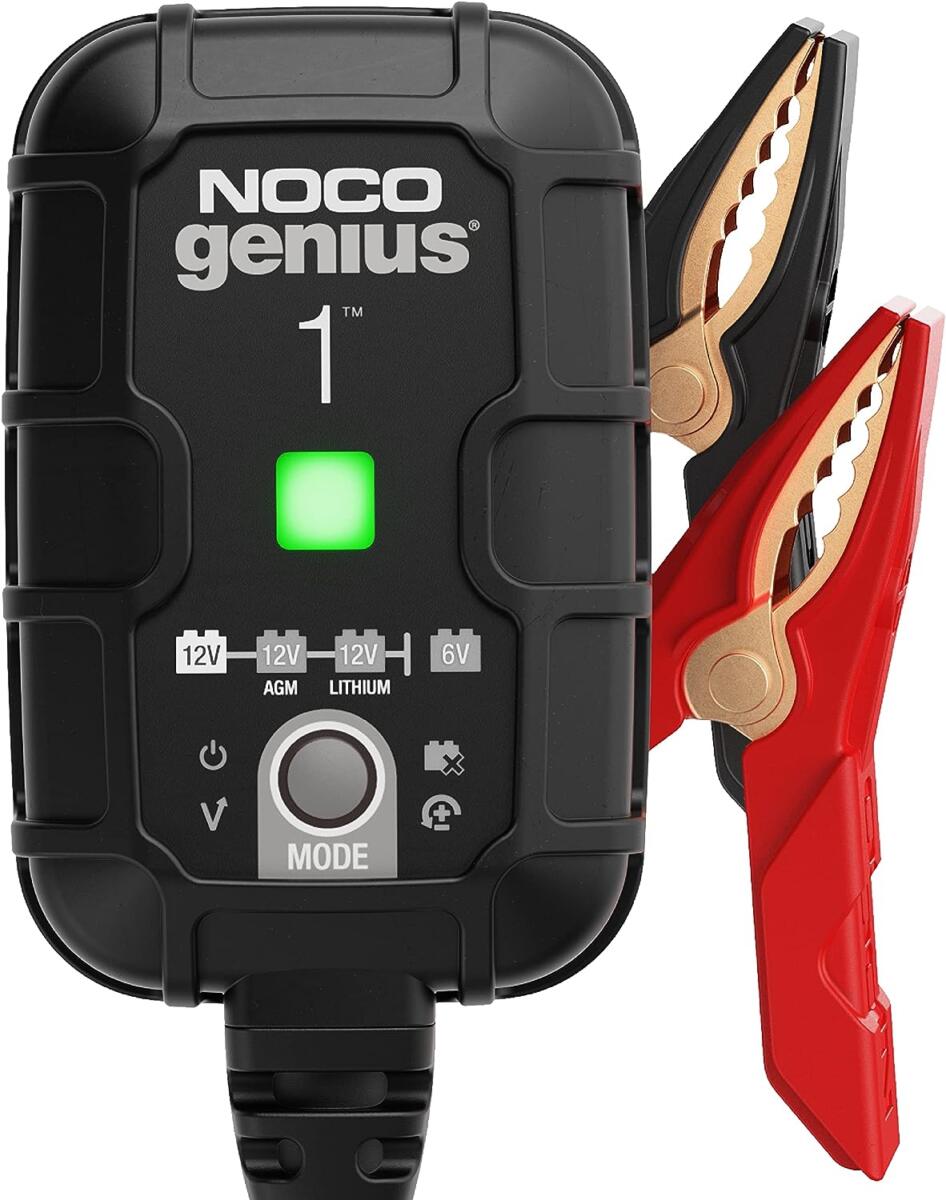
As I’ve mentioned before, I like the NOCO Genius 1 because it not only maintains the battery but also provides desulfation capability for FLA batteries. You can find it on Amazon here.
Proper charging procedure
- Set the battery maintainer to the correct charging profile.
- Connect the positive lead of the maintainer to the positive post on one battery
- Connect the negative lead to the negative post on the other battery.
This method helps provide a more balanced charge across the bank.
Lithium battery storage
If you have lithium batteries, you can simply disconnect the negative cable to eliminate any parasitic draw. Lithium batteries have a very low self-discharge rate and do not require continuous maintenance charging during storage. They also will not freeze like flooded batteries.
In our testing with Expion 360 batteries installed in a 2016 Thor, they were still at 90% state of charge after six months in storage.
You might also enjoy these posts from Dave
- RV batteries aren’t charging while driving. What should I look for?
- Why aren’t my solar panels charging the house batteries?
- Why won’t RV’s converter charge the battery unless reset button is pushed?
- Follow-up to post on RV converter not charging battery
DAVE HAS ANSWERED MORE THAN 1,000 readers’ maintenance and repair questions. Read a directory here. There is so much to learn!
Dave Solberg is a leading expert in the RV industry and the author of the “RV Handbook.”
HAVE A QUESTION FOR DAVE?
Send your inquiries to him using the form below.
RVDT2849

Do I have to charge them separately
They do not need to be disconnected and charged individually when using a properly functioning converter or battery maintainer.