


By George Bliss (Thank you, George!)
If you have a double- or triple-axle trailer, use blocks when a tire change is required. Blocking under a good tire will lift the bad tire off the ground. You’ll no longer need to search for the elusive jack or need to worry about your jack failing or falling over when the trailer is lifted. This works extremely well if you are stopped on ground that might be a little soft.
Another big plus to doing this is that you don’t need to crawl in the dirt, under your trailer, to put a jack in place. As jacks are inherently unstable, the wind of a semi-truck passing on a busy highway could push your trailer off a jack. With blocks, your vehicle is totally stable through the whole process of the tire change.
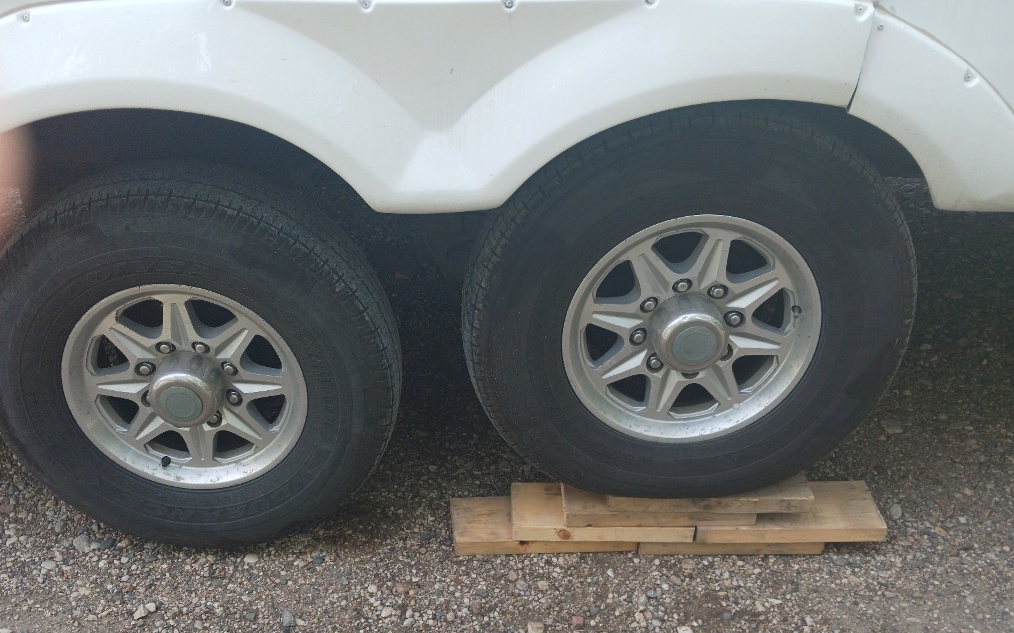
Never place a jack under an axle
You should never place a jack under the axle, as axles are very easily bent, throwing out your wheel alignment. Stack the blocks in a staircase configuration, as shown in the photos. If you have someone with you, they can either pull the trailer up on the blocks under your direction or direct you to stop when the good tire is on the top block.
If you are alone, it’s not difficult to judge when the good wheel is on the top block. (But if it’s a front tire that needs replacing, then put the blocks behind the rear tire and back onto the blocks.)
Be sure to loosen the lug nuts on the bad tire before lifting it off the ground.
Using blocks is much faster than trying to use a jack and much safer, cleaner, and easier.
As shown in the photos, four blocks are enough to lift the second tire off the ground on my trailer. The blocks shown are 2″ X 6″ and about one foot long. Your situation might require an additional block(s).
When the good tire is on the top block, before removing the bad tire, make sure the bad tire can totally rotate. This will ensure there’s enough clearance between the tire and the ground for the new tire to be installed. If not, add another block.
Bonus: To avoid having to physically lift the replacement tire onto the hub, use a shovel as a lever under the tire to lift it the needed inch or two. A 2X4 used as a fulcrum under the shovel usually works great.
RELATED
- Don’t ignore the danger—A slipping trailer jack foot could ruin your trip
- Using proper heavy-duty jack stands for heavy vehicles
- Know Your RV: Take care of your stabilizer jacks
- Trailer jack blocks broke. Why?
##RVDT2722
Shouldn’t be necessary to say this, but… When using this tip, #1, don’t unhitch from the tow vehicle; #2, set the parking brake on the tow vehicle to prevent its movement (Park is not enough, the vehicle is still able to move a couple critical inches); #3, chock the wheels on the opposite side of the trailer.
As to jacking on an axle… The manually adjusted brakes on our trailer needed adjustment and I found I didn’t have an appropriate tool. An automotive shop agreed to do the adjustment (less than 5 minutes once the tire is off the ground). The mechanic rolled his floor jack under the axle tube. I was so glad I was there to stop him!
Better try this at home first, it doesn’t work with all suspension types. Also consider that you are overloading the one axle that is now carrying all the weight, be quick about it.
I strongly disagree with today’s article o using wooden blocks to change a flat. Please read this article.
blob:https://www.rvtravel.com/a338e052-6c65-4551-9ba4-4f67c86c9720
Link doesn’t work.
I use a credit card, a cellphone and a roadside assist service but you might have a better way. 😀
Thank you for the suggestion, George! Seems a great idea! Have a great day and safe travels!
Trailer aid plus is too short. This repair ramp is rated for the load and won’t allow the trailer past the end of ramp like wood blocks can. MUCH MORE STABLE. With either you MUST keep the tow vehicle connected. Chock the opposite side and one truck wheel on the ramp side and set parking brake.
https://amzn.to/3VvU4AX