

By Russ and Tiña De Maris
RVs, being built light for easy (and economical) travel, are not “rock solid” in camp. The longer they are, the more they tend to rock and shake as folks move about inside. To that end, most travel trailers and fifth wheels are equipped with stabilizer jacks. How do you “care and feed” them?
Park on the level—where you can

On a fifth wheel, the “landing gear” acts as a stabilizer up front, but additional stabilizers are typically found at the rear. Travel trailer fans, if you unhitch from your tow vehicle and rest the trailer on the tongue jack foot, you’ll certainly know the lack of stability. Many travel trailers have at least four stabilizer jacks, some have more.
How can you safely and effectively use your stabilizer jacks? First, try to park on level ground as much as possible. That saves you from having to do a lot of wheel blocking. Prior to unhitching either a 5er or travel trailer, chock your wheels to prevent any rolling.
For stability—not for lift!
Stabilizer jacks are just that: They’re for stability, and many jack manufacturers warn that their product isn’t intended for leveling. You’ll need to handle that leveling process before deploying the stabilizers. Hopefully, you’ll have the jack manufacturer’s instruction manual available to you. If not, we provide some general guidelines.
It’s not a bad idea to slip a piece of wood between the bottom of the jack and the ground. You can find commercially produced “jack pads,” often made from plastic. Jack pads can protect asphalt from damage, and on mooshy ground, prevent the jack from digging into the terra-not-so-firma. HOWEVER, there is a danger of using too much blocking. What’s that?
We repent!

Here’s a position we’ve had to repent on: Scissor style stabilizer jacks have their rated strength ONLY after being extended out so far. Here’s a quote from one jack manual: “This jack’s weight capacity is 5,000 lb. only between 13-3/4” and 23-1/2”; the weight capacity drastically reduces as the height drops below this level. Do not apply a load to this jack below 13-3/4” in height.”
We know in the past we’ve used “high level” blocks under our jacks, in part because there was less work involved—don’t have to run the jack out so far. But with this information in hand, we now use much less in the way of blocking. Yes, scissor jacks can get “wobbly” if extended w-a-y out. Therefore, a higher stack of blocking might be in order if you have a long way to crank out the jack.
So crank out the scissor jack until you hit resistance. Then turn the crank another rotation or so and call it good. Don’t try to crank the trailer up, and NEVER use a stabilizer jack to raise your trailer for tire changing. If it “lets go” at the wrong time, serious damage to the jack (not to mention the jack’s owner) can occur.
Another possible “keep on hand”
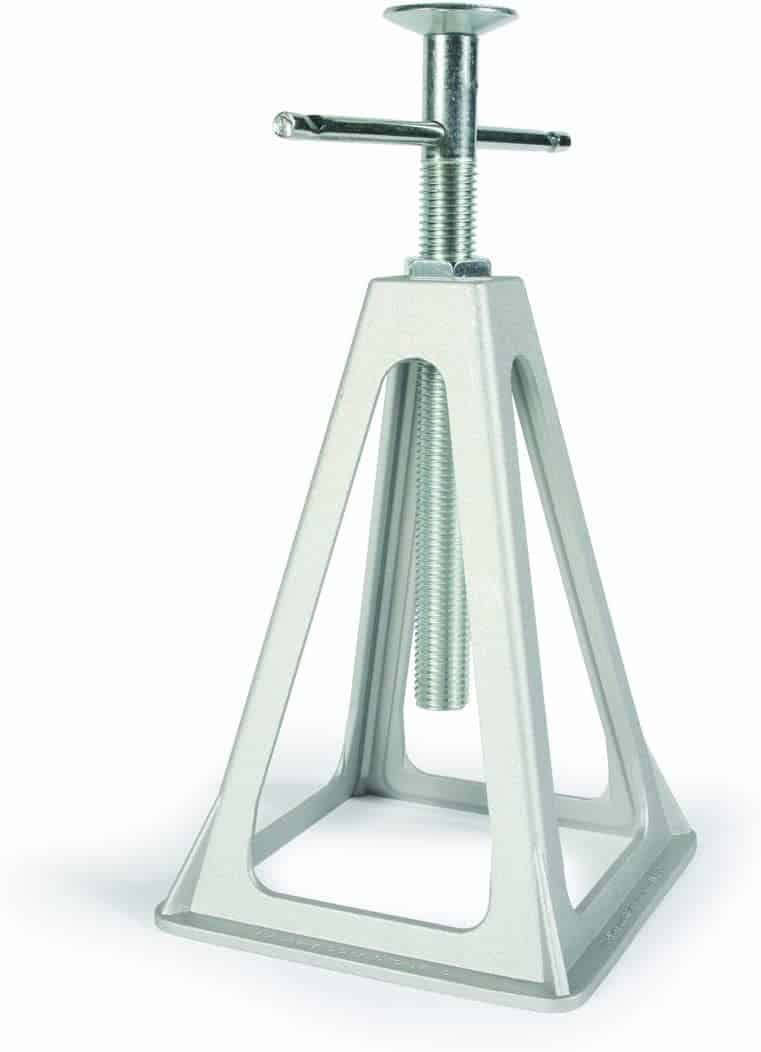
We also have a few “stacker” jacks that we stash away in our storage area. Sometimes called “pyramid jacks,” they stack together to take less space. These critters are portable units that use a screw-type device for assisting with stabilizing. Here, place the head of the jack directly under the trailer frame, NOT under an axle. Crank the jack to the resistance point, and then add another turn or two. You can find them at most RV supply stores or on Amazon.
Keeping them happy
Running stabilizer jacks up and down is a chore. Some RVers equip a portable drill with the appropriate size fitting to mate with their jacks. That’s OK, provided you DON’T OVER-TIGHTEN the jack when running it out for stabilizing. As we said earlier, the point is only to stabilize, not lift, the rig. Run it too tight and you can damage the jack.
If you use the old “arm-strong method” to run your jacks up and down, you’ll appreciate it if the threads on the jack run smoothly. Yes, lubrication is a plus. But don’t use just any old thing you have on hand. WD-40 is NOT the choice here. What the stabilizer jack doctor orders is a DRY LUBE. Yes, silicone spray will work. Other RVers tell us they find dry lube sold at a tractor or farm supply is great. Others swear by motorcycle chain lube. In any event, a dry lube won’t attract dirt.
Why is that important? A “new to us” travel trailer came equipped with stabilizer jacks that had been lubed—probably with WD-40. The first road trip with the “new” rig proved a major back pain as piles of dirt had to be worked off the threads. It took a long time to get those jacks freed up, and it reminded us why the older we get, the less our “bend-over” wants to work.
So shoot the entire length of thread on the jack with dry lube, and run the jack up and down a couple of times to clean out the crud and distribute the lube.
RELATED
- No leveling jacks on RV, so can I just use a block on the outside dual wheel?
- Don’t use a jack to change your tire; do this instead
- Trailer jack blocks broke. Why?
- RV scissor jack tools make leveling, stabilizing easier
RVDT2844

Your dry lube recommendation reasoning sounds logical but the paperwork that came with my stabilizers said to use White Lithium grease. Dry lube does not provide adequate lubrication to prevent wear on the threads.
Hmmm, that puts you between a rock and a hard place. I wonder if the genius that wrote your paperwork had ever used an RV for real. I used to use White Lithium, and can attest that it primarily works to create a dirt/grease mixture that gets everywhere.
I have been using Fluid Film’s anti-corrosion and lubricant on my scissor jacks (and a few other locations) for a few years.
That or any other gel type spray. Even motorcycle chain lube works great.
The ideal height for the jacks is when they look close to a square. Too little or too much height is weaker. In fact, too high will cause the trailer to move back and forth and eventually damage the jacks.