

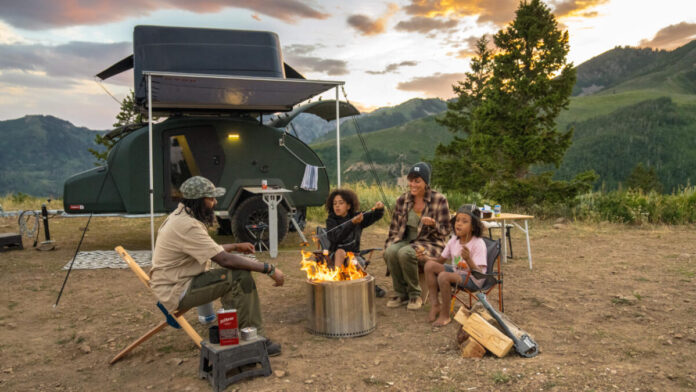
Today’s RV review is of the Escapod TOPO2 trailer. As a point of reference, what we have here is a teardrop trailer available in two variants and, while that description is certainly accurate, it’s by no means complete. What do I mean?
First, I have to say I heard about this company through the RV Entrepreneur podcast. I get a lot of input since coming back to RVtravel.com with ideas of RVs to share with all of you, from emails that you send through the form that I put at the bottom of all these articles to comments on social media to even people calling me. On the actual phone. As if that’s what that thing is for.
But listening to the story of this company and how they built these things really intrigued me. Even more, I like how they sell and service the trailers.
What is an Escapod?
I had mentioned that, at its core, an Escapod is essentially a fiberglass teardrop trailer. Though, again, that description is neither inaccurate nor anywhere near complete.
How many times have I suggested that you buy your next RV by starting underneath that RV? … Wow. That’s a lot.
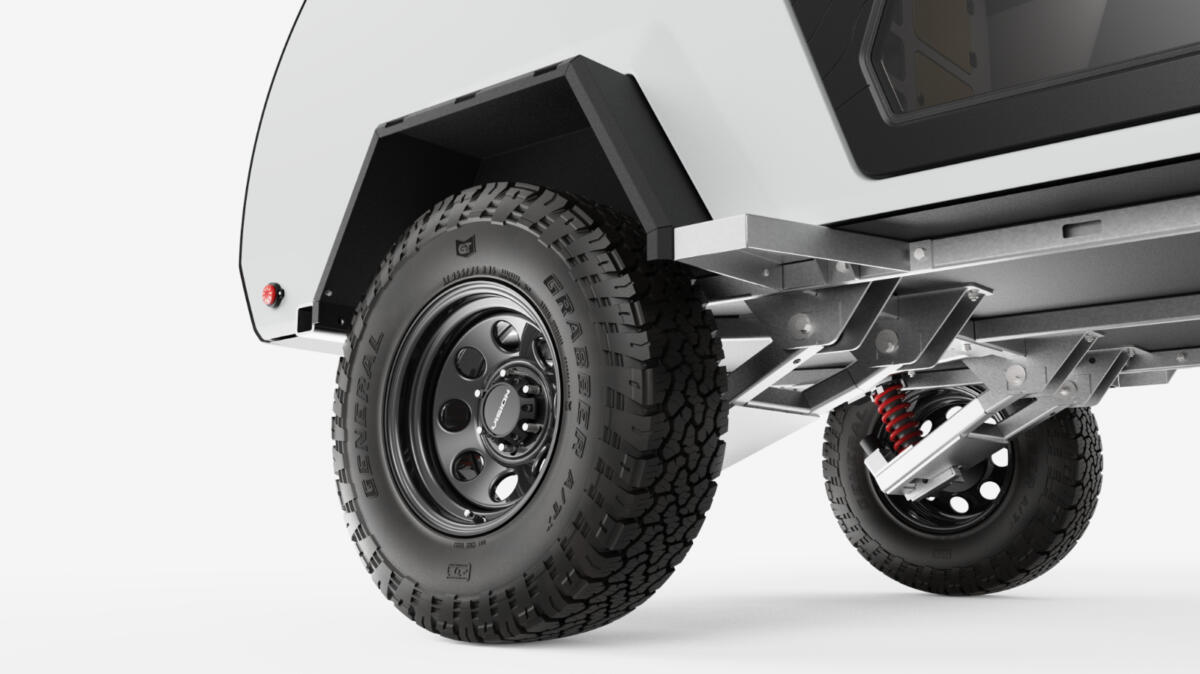
But let’s start under the Escapod, where the chassis is a tubular frame that is hot-dipped galvanized. That’s a good thing. But more remarkable is that Escapod actually designed and built its own unique axle-less suspension system. This gives the trailer the ability to traverse some rough ground without making it so tall that you can’t get it into your garage.
Yes, these are garageable. Well, unless you add a bunch of stuff to the roof. Which you can do.
While the chassis on this is good, the body is the secret to it all. These are built as a single piece using a fiberglassing process that was inspired by the aircraft industry. Essentially, the company can put in the components that make the shell and then use a vacuum infusing process such that the whole shell is a very rigid and complete unit.
The body is a single unit
By building the shells this way they don’t have any chance of delaminating or falling apart. There are no seams between the top and bottom of a clamshell to fail or wiggle loose over time. The body is effectively a single unit that can withstand all the off-roading and rough terrain without you going back there and wondering if things fell off in transit. And these are designed such that transit can include rather significant off-roading.
As company co-founder Chris Hudak put it, “Composites aren’t new. What is new is how we took a look at composites. We looked at the aerospace industry and incorporated infusion. They use a vacuum process to infuse the resin into the other components. The entire structure of the body is all one piece including the PT foam insulation.”
Part of that process was what co-founder Jen Hudak described when she said, “We looked at other trailers and asked, ‘What don’t we like about this?’”
There is no structural wood in the design, although there are wooden cabinet doors.
Two models of the TOPO2
There are actually two models to this: The TOPO2 Voyager and the TOPO2 Nomad.
The Voyager incorporates a pressurized water system but one that’s fully enclosed in the heated and insulated body of the trailer, enabling true four-season functionality. Heating the cabin and that water is done with a Truma Combi system that does both functions very well.
The Voyager also has a kitchen with a 12-volt-powered cooler and a propane stove.
The Nomad does not have a pressurized water system but, rather, has space for three of the Dometic GO Hydration Jugs. This makes a lot of sense—simpler is better for me.
You can also add a bunk in the main cabin, which is more spacious than you might think. This is helped by a large window above the bed, which really opens the space. Speaking of open, you can open this overhead window.




What’s inside
Essentially, the main cabin of this is simply a queen-sized bed which the company describes as a five-inch memory foam mattress. Looking at the Nomad, the cabin incorporates bins up front that house soft zippered totes. This makes loading and unloading the camper much simpler.
There are a lot of little spaces to put things, including cabinets with birch doors (nice). There is space along the sides of the mattress for the things we all inevitably have. Another unique thing is the mud room, which is a spot beside the bed that you can use to put on shoes and such should you go out in the night to see if the bears really do what they are purported to do in the woods. Or, perhaps, make your own contribution.
Kitchen area out back
Out back, as you would expect, is the kitchen area. Escapod has a nifty plastic table that serves as a cover for the shelves when the trailer’s in motion but can hang off the wheel well once you’re ready to camp. Like the rest of the cabinetry, this is a composite material.
If you’re into the Nomad, know that this area features a slide-out drawer for a cooler. That could either be a powered cooler or something like a Yeti cooler. I like these portable powered coolers. The trailer also comes with at least one lithium battery and you can add a second one as an option.
The Voyager actually has a full kitchen with a pressurized water system, including a hot and cold water sink. However, this is what’s called a direct dump-style sink, so you might want a capture tool like a buck or these portable water bags that I’ve become quite pleased with. It also features some nice cabinet space for stuff behind that portable table, along with a propane stove and portable 12-volt cooler.
Lots of options
As mentioned, the basic layout of these trailers shows a good understanding of the teardrop experience and what it would take to make it successful. But there are a ton of options the company offers to expand this. There are roof-top tents, roof-top storage rails, solar systems, a second lithium battery, screen rooms, portable toilet tents, awnings and more.
You could really elevate the experience by adding a tent to the side of this trailer that then becomes where you’d have gatherings or even use to change clothes or put a portable toilet.
Who is Escapod Trailers?
Escapod was founded by Chris and Jen Hudak. Essentially the couple wanted to build a better teardrop-style trailer, so they did. In Jen’s mom’s garage. But then people took interest in that trailer so they started taking orders. And the company grew. That’s the story told in that RV Entrepreneur Podcast I mentioned above.
Growing a company from two people building things to the point where they are today, with over 50 employees, is no mean feat. In the process they also gained two partners: Chris Eckel and Joshie Fishbein. Besides being part of the trailer building, they’re also a big part of telling the story of these trailers.
In fact, I look at a lot of websites from a lot of RV builders and, quite frankly, most of them are pretty lousy. No information. No way to “dig deeper.” Nowhere to get questions asked. That’s not true here. If I were to suggest something to RV builders it would be to make a YouTube/TikTok channel and make your websites not suck like one of those sewer-sucking vacuum trucks. Perhaps use Escapod as an example of how to do things well.
Something I really liked as I was building trailers to see what the process was like, was that the whole thing just worked so well. I recently bought a truck and navigating truck shopping websites and building imaginary trucks was so frustrating I almost didn’t want to complete the process. That wasn’t true here: The website is outstanding.
No RV dealers—almost
There are some great RV dealers out there—I know because I used to work for one. But there are also lots and lots and lots of stories of people having a terrible time with RV dealerships.
Like some other brands we’ve looked at here, this one primarily sells directly to consumers. That means you get to talk to the people who make the decisions and get your questions answered. The company has also gotten creative, as have many RV companies. One of the things they’re doing right now is a program where they’ll reimburse you up to $500 to come look at their trailer from out of state, if you decide to buy one. I think that’s pretty clever.
Plus, the past two RVs we’ve bought have been purchased in Indiana and road-tripping home with your new RV is something pretty special.
Dealerships that carry TOPO2
There are a few dealerships where you can also go for both service or to get your own Escapod: BTR Outfitters (Texas), RVs of America (South Carolina), and GTFO (California). Customers can buy trailers right off the lot from BTR Outfitters in Texas. For RVs of America and GTFO, customers can get a tour of the TOPO2 they have onsite, place an order with their team, and have the trailer shipped to their location for pickup!
So, how do you get service, if it’s even necessary to do so? Escapod has developed a network of repair professionals to handle this if one of the dealers, or the factory itself, is not in your neck of the campground.
And how do you actually see one of these if there are no dealers? Escapod has this covered, too. They have a network of owners who are so proud of their Escapod trailers that they’re willing to give you a grand tour. These owners are all over the place and you can find one on the company’s website.
Conclusions
While I’m not as much an outdoor guy in real life as I am in my imagination, I think I could make this work with the additional side tent so there’s a place for a potty and to just step outside before dressing in clothing appropriate for others to see. I really admire the clever storage and admirable build quality of these. In fact, I have had other teardrop-style trailers as my favorite for a while and I believe this usurps those.
These are not cheap, throwaway trailers, so they’re going to have a specific group to whom they appeal. The least expensive Nomad model starts at $33,990, and you can option the heck out of it. The Voyager’s base price is $43,990. The company does have some creative ways to save you some money on your purchase, including discounts and a program where they’ll reimburse you up to $500 for your travel expenses if you come to look at one from out of state and then make a purchase.
“These are lifelong purchases for a lot of people—they can really last for decades. These are products that you can hand down to your kids,” stated Jen Hudak.
The build quality of these absolutely justifies the price, and the clever use of space and logical layout of things further the reward.
I didn’t prepare a chart simply because the two trailers are different in functionality. But Escapod’s website is so good, the information for whichever model you’re interested in is pretty clearly presented.
More about these RV reviews
These RV reviews are written based on information provided by the manufacturers along with our writer’s own research. They are based on information from a single unit and may not reflect your actual experience. Shop your RV and dealership carefully before making a buying decision. We receive no money or other financial benefits from these reviews. They are intended only as a brief overview of the vehicle, not a comprehensive critique, which would require a thorough inspection and/or test drive.
Tony comes to RVtravel.com having worked at an RV dealership and been a life long RV enthusiast. He also has written the syndicated Curbside column about cars. He also works closely with a number of RV manufacturers to get an inside look at how things are done and is a brand ambassador for Rockwood Mini Lite with his wife, Peggy.
You can also check out his RV podcast with his wife, Peggy.
Got an RV we need to look at? Contact us today and let us know in the form below. Thank you!
-form broken-
##RVDT1133

Tony your proof reader needs a cup of coffee, in talking about the features you can’t make up your mind whether the voyager has water or not. Lol
Shoot – lemme go back to check it out but here’s the story: The Nomad does not have a water system, the Voyager does.
Right off the bat, I was a bit put off by the guy giving the tour referring to this teardrop trailer as a “travel trailer”. Not even close! Trailers like this are for folks finally deciding it’s time to get off the ground and into something a bit more comfortable – while still enjoying primitive travel. That, is not me. Not anymore.
…and $50,000. to boot. Expensive to just get off the ground. I like the innovations tho! Forward thinking….
We have seen a few older couples who travel with a teardrop in ID, AZ, and CO, where there is lots of sunshine and little rain. But most of the teardrop campers we have seen are 20-30 year-old couples without kids. And they have been in NPS, USFS, or state park cgs., or boondocking, not in RV parks. Those younger couples, likely moving up from a tent, may not continue with a teardrop for a “lifetime” of RVing. So, are very expensive, off-road teardrops really a lifetime investment or just a temporary substitute for even more expensive 4wd, off-road, camper vans? If the latter, they will likely move up as they age or have children. So, how do teardrops fare for depreciation and resale?
There is a huge “overlanding” community out there who go to specific overlanding shows and probably don’t spend much time, if any, in campgrounds. That’s specifically who this is targeted toward and I’ve seen people of all ages participating. Whether this gets passed down to one’s children might depend on the values instilled in those children. But all RVs have lousy resale value – they’re generally an expense. But the thinking that these don’t fall apart in five years is, in my opinion, admirable.