


(We are recycling this post from Roger from January 2023 because he is currently incommunicado, i.e., he’s somewhere without a computer.😉)
This is another version of the basic and recurring question about how much air pressure RV tires need, so let’s look at the facts. Previously I answered a question on how much inflation is needed on a smaller RV trailer. Similar questions for air pressure in motorhome tires need a slightly different answer.
Tire loads and proper inflation for motorhomes
Today’s key points: Know the minimum tire inflation based on tire industry guidelines. The basic instruction for your minimum RV tire maintenance is to check your inflation with a good gauge at least monthly and every morning before travel.
Tire inflation seems to be a topic that confuses some and has others believing in misleading or just plain incorrect information. Tire inflation is one item that directly affects the safety of your RV, truck, or car as you travel down the highway. Many of my posts have outlined information that you really should know and understand. The intent of these posts is to give you a better foundation of understanding more about tires. But if you only pay attention to one series of posts, this is it.
Tires do not carry the load
Some people have been led to believe that the load is carried by just the tire sidewall. This is not correct. Tires are just a container of air. It is the inflation air that does the work. Think for a moment of an impact wrench. It can’t do the work of loosening or tightening nuts on your wheels without the air. A tire can’t do the work of carrying the load or providing the traction needed to turn, start or stop if it doesn’t have air. The load a tire can carry is based on the air volume in the tire and the pressure of that air inside the tire. You can see this if you look at any Load & Inflation chart, as found HERE.
It is important to understand that these tables are essentially identical across all tire companies that are making the same size tire.
Load Range vs. Ply Rating
Some people believe that tires with a higher Load Range can carry more load at the same inflation. This is just not correct. Don’t forget that the term Load Range replaced Ply Rating with the introduction of radial tires to replace bias tires. You would be hard-pressed to measure the uninflated load capability difference between a Load Range D and E tire or between a G or H Load Range tire.
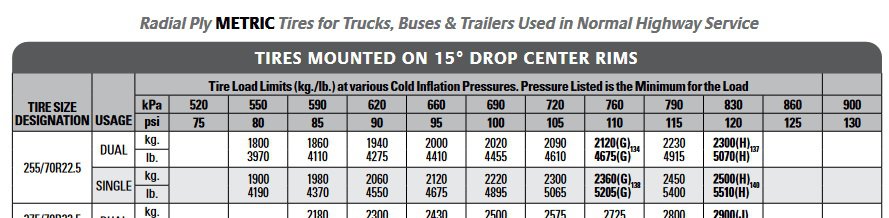
If you still think the load is supported by the tire construction, I would challenge you to find a Load vs. Construction table. Here is an example of a Load & Inflation table for a 255/70R22.5 and it covers both LR-G and LR-H tires in that size.
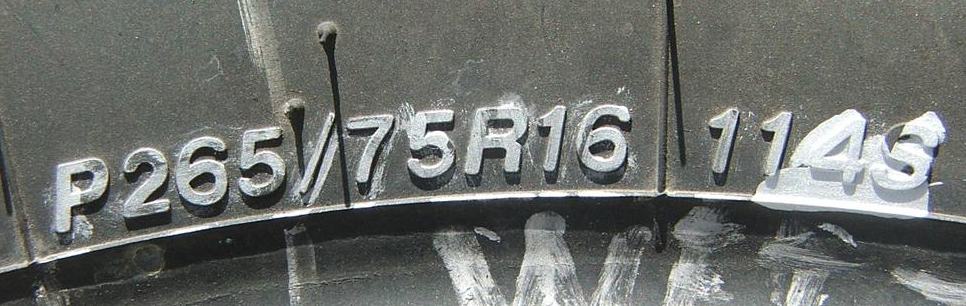
Sidewall stamping examples
Here are sidewall stamping aka “marking” examples from a large P-type tire showing the dimensions, along with Load Index and Speed Rating. An LT-type tire would look similar except that LT-type tires and Commercial Truck/Bus (22.5″) can be applied as single or dual (side by side). So they would have two sets of numbers for the Load Index (single and dual application). Commercial truck tires are not speed rated, but Michelin and Goodyear and others indicate a 75 mph Max operating speed in RV applications no matter what the tire rating is.
Here are the tire reinforcement materials, both type and quantity.

Next, we see the Load and Inflation ratings for this standard load P-type tire.

Nowhere do we see a statement on construction or Load Range for various inflations and different load capacities for different constructions.
The Load Range is marked on the sidewall of your tires except for Passenger-type tires, which are considered to have “Standard Load.” If you don’t see the words “Load Range,” look for “LR” followed by a letter, usually between C and G.
“Load Range” may not be in large letters, but you should be able to find them on your tires. “P”-type aka passenger-type tires are actually “B” or some are “XL” or Extra Load. Light truck, commercial, and bus tires all have a Load Range letter.
“Load Range” replaced “Ply-Rating” in the late 1970s with the introduction of radial construction. People really need to try and stop using the old nomenclature.
How much air is needed
The simple answer to how much air you need is on your data sheet. Depending on the year your RV was made, this information is on a label near the driver’s seat in your Class A or glued to the wall inside a cabinet or on the inside of your entry door if your RV is older than 2009. Class B and Class C will have the label on the driver’s door jamb, which is where it is in your car, too.
Wherever it is, you should also have the information in the stack of owner’s manuals you received when you bought the RV. Find this data sheet and write down the information for loads, minimum inflation, tire size, and load range, and place this info where you can easily find it. This inflation is the minimum based on what the RV manufacturer says is the maximum you can load on each axle.
Motorhomes have much lower Interply Shear forces, so that is why tire life on motorhomes, in general, is much longer, i.e., 6 to 10 years versus 2 to 5 years on trailers.
Read more from Roger Marble on his blog at RVtiresafety.net or on RVtravel.com.
##RVT1143


As always, Roger, good article. Wish more people would take the time to educate themselves properly.
Why do owners have such a problem with how much air to put in a tire? Mind boggling!!
I come from a vehicle maintenance and repair career, now retired. Simple, if an RV tire is not flat on the rim, it is good enough to go.
Thanks again for more great info Roger ! , and please keep up with your educating the public !!
Regardless of the air pressure our motor home tires need, they get the air pressure listed on the doorjamb tire inflation decal before we travel. Good enough.
Thank you, Roger! Safe travels! 🙂
We run our steer tires at 110 psi and our drive tires at 105 psi per Spartan Chassis. They weighed our coach in June 2023 and set the pressures of the tires and set the TPMS. (Our tire sizes are all 305/70R 22.5.)