

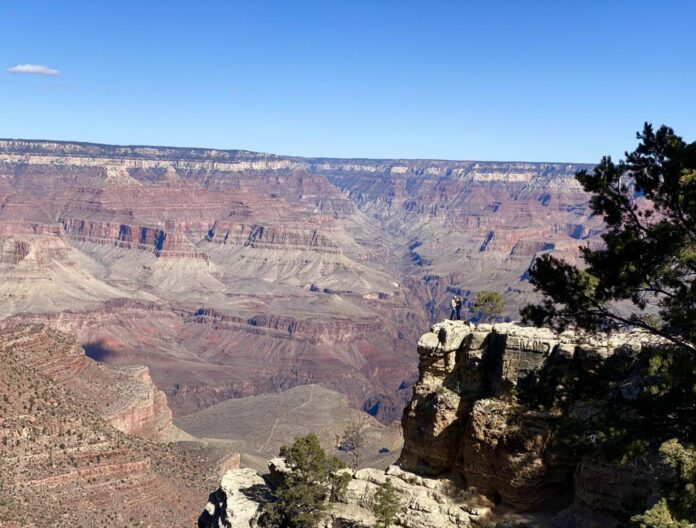
Oh, the joy of traveling without crowds! RVing in the off-season season in late October and November is outstanding. While it was chilly at times, there were no crowds anywhere! Both Grand Canyon National Park and Carlsbad Caverns were virtually empty. Lines at the Grand Canyon shuttles? Nonexistent! Vying for entrance tickets at Carlsbad? We had our choice of more than 300!
Grand Canyon
We meandered our way from Minnesota to Arizona in October and November. Today I rose at 6 a.m., dressed in multiple layers, and set off to Mather Point to see the sun rise over the Grand Canyon. As the sun lifted, I shared a special moment with a very small group of hearty souls.
Tip: Figure out where Mather Point is in the daylight before wandering around in the dark! I had to laugh as a group of us walking together all had the GPS on our cell phones, searching for walking directions to the point!
The shuttle buses were comfortable or practically empty on some lines and there was never a wait. Temps were unusually high, in the upper 60s, and sunny. It could go either way in mid-November at 6,600 feet. Everything in the park was still open. Shuttles don’t shut down for the winter until November 30th.
No problem getting a reservation to stay in the park either. There are several campgrounds to choose from.
Carlsbad Caverns
Carlsbad Caverns, long on my bucket list, has timed entry, as so many National Parks do now. We had our pick of times and days. Generally, there were more than 300 time slots available! Going into the caverns with no people gave us the ability to stop as long as we wanted and really see the enormity of the cave.
I liked to slow my roll through, although my husband practically ran. I promised him that he wouldn’t have to go in any more caves with me. Seems he was feeling a bit trapped, buried, and a little too close to hell! I will admit it was a little eerie, especially being so alone down there. I could imagine what the first explorers felt when first entering the cavern. It was a bit unnerving watching the elevator descend 750 feet through solid rock. Next time I would do the walk in-and-out trail!
Tips for shoulder season travel
- Check if campgrounds are open in the fall. Many close when schools open. Look for open and close dates on their websites. Almost all of the COE campgrounds were closed on our way down from Minnesota, along with a number of Forest Service campgrounds. Some northern state parks were already closed, too. Others remain open but with no hookups. If you can’t find the info on the parks’ website, be sure to call and ask.
- Fill your fresh water tank. Don’t expect that water will be on even if a campground is open.
- Protect your tanks from freezing. Ours are heated but only when the rear furnace is on, and it is too noisy at night to run. We put a flood lamp fixture with a reptile warming bulb in the wet bay. An old-style 100-watt bulb would work, too. You can still buy them as rough service bulbs on Amazon. I was a little uncertain about the reptile bulb, so I continued to monitor it with a heat gun I bought on Amazon.
- Carry a heated hose and protect water filters that are exposed. Our first time at Bryce National Park there was a freeze warning. We confidently put on our heated hose and went to sleep. In the morning we had no water. The water filters had frozen. We put the water filter on before the heated hose. Now we use this insulated drum band heater around the large canister water filters or arrange so the filters are inside the wet bay.
Note: Need a heated hose for your RV? These are the three best. - Stay warm! Bring enough clothes to layer. Layers keep you warmer and can be peeled off as the day warms. Remember hats, gloves, and sunscreen too! We have a propane furnace, but if we’re boondocking I know the fan takes a lot of power so we also carry a Big Buddy portable propane heater. It uses dispensable one-pound propane tanks and can be used in the RV. Be SURE to crack a window, though.
- Watch the weather! Tune in several times a day to check wind, rain and snow on your route. We have altered plans several times to avoid oncoming snow or wind advisories. We just need to see the reports of semis turned over on I-40 between Winslow, AZ, and Flagstaff, AZ, to make a hasty retreat to a southern route. Last year on our trip from Alabama to Arizona, we spent four days literally encased in ice in Abilene, Texas. At least we knew to hunker down and not try to go further.
- Enjoy! I have found that as we descend south we get to watch fall unfolding multiple times. I am then aware that time is limited and the years of brilliant displays of fall leaves are not promised.
RELATED
- Bucking the trend: Heading north for winter camping—something to consider?
- Bucking the trend: Heading north for winter camping (Part two)
- Keep warm while winter RVing with these 17 cold weather tips
##RVDT2263


I see the same heated line mistake frequently wintering in Texas. Your water system heating is only as good as its weakest point. You need to heat everything above ground that is outside heat space in your RV.
I run our heated hose up the park’s pipe, come over the top by the spigot and back down next to the regulator and water filter. I have one of those big grocery store frozen food bags over the works with a 5 gallon bucket over the top. The sensor for the heated hose is outside this insulated space. You might need something different, like a rug to cover at some locations.
Another freeze point on many rigs are the low-point drains. The bare lines dangle and scream “freeze me!”. The ice will quickly climb into the RV and create a block even if the rest of the system is fine. I cut my lines shorter and zip-tie foam pipe insulation around them – I found rose & powder blue ‘pool noodles’ at a $ General for $1 each, so my lines are still color coded.
We have heated tanks, so we only use the fresh tank in cold weather, never the city water line. Many years ago, we left the city water hose connected one night when nighttime temps got below freezing. That was the first and only time we made that mistake!
We also use heat lamps in the wet bays when temperatures dip. We deploy wireless remote temperature gages set to alarm at 33° (alarm sounds in coach) so we can fire up the furnace if the lights can’t keep up. Normally they maintain above freezing temps.
Thank you, Nanci! If you get to the Chattanooga, Tennessee area, or plan to go there, we can host you at our Boondockers Welcome site — Davis Farm. Just give us some warning and we’ll close it to others for however long you want to stay.
Neal, Thank you so much for your kind offer! I always enjoy reading your comments and emails. Would love to visit someday.