


Dear Dave,
We are upgrading our stellar find of a 1989 Winnebago, garage-kept, with 20k miles. Yes, the statement is real… It is like a time capsule. The previous owners used it to travel to Disney and the beach, and were very conscientious about cleaning. Everything is in great shape.
We are swapping out the fridge and A/C with the 12v models Dometic DCM 4101 and OutEquipPro 11500 inverter. We have tried to see the A/C in action but nobody has it in their showrooms.
I was wondering about your thoughts on this and the products chosen. Any feedback you have would be greatly appreciated as this is new territory for us. We’re just trying to make the ride more efficient and quieter. —Ali, 1989 Winnebago Warrior
Dear Ali,
Congratulations on the “vintage gem” you have found. In 1989, the Warrior model was available in a Class A on the Chevy P30 chassis, a Class C on the Ford or Chevy cutaway chassis, and a “Micro Warrior” on the Toyota cutaway chassis.
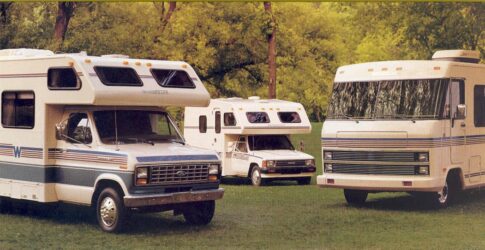
From the old Winnebago brochure I see that the Class A came standard with a three-way refrigerator and two deep-cycle batteries, and a 13,500 BTU air conditioner was optional. The Class C also had a three-way refrigerator standard. Some had smaller single-door models, one deep-cycle battery with an option for a second on the 420RG, and two on the others. The 13,500 BTU air conditioner was also optional.
Compartment size for fridge
The reason I mention this is the size of the compartment for the new refrigerator and the battery capacity you will need. The Class A batteries were under the entrance step, while the Class C were typically in the outside compartment just behind the passenger side cab door. In other words, you don’t have much room for anything more than two batteries.
I have been doing seminars at RV Shows for the past 20+ years. In the last two years I have found it very difficult to get a unit with an older absorption-type refrigerator which works on LP or 120-volt power. Everything has gone to either residential or 12-volt compressor-driven models.
Research on compressors
Most of the models that I have researched use the Danfoss compressor and have performed very well. I believe Dometic has their own proprietary compressor, so I did more research.
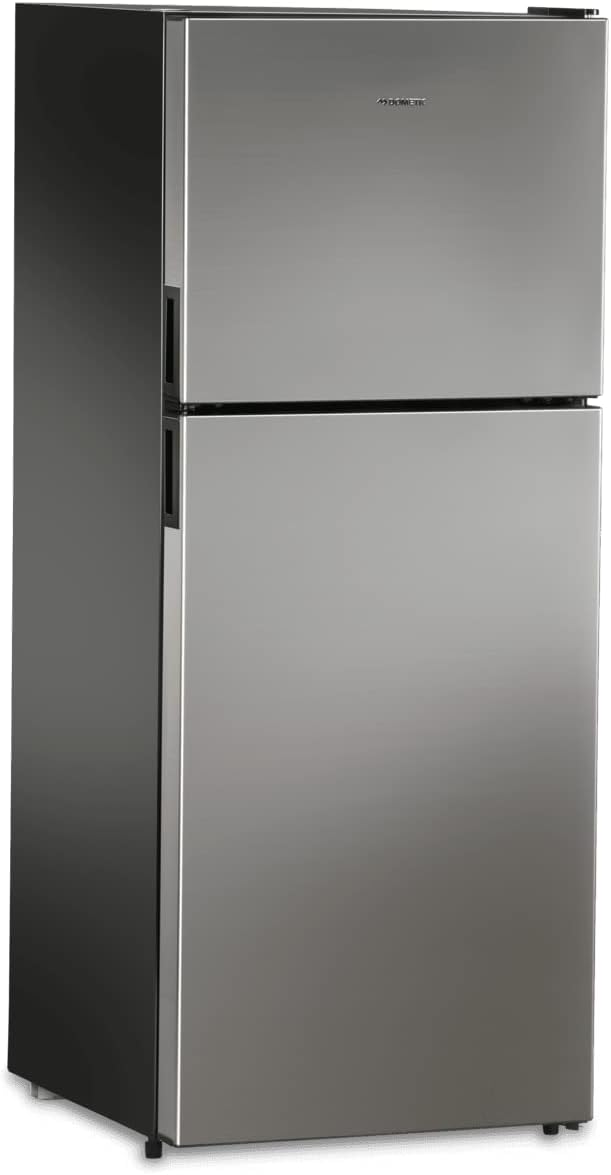
The first place I went to was Amazon, which sells this model; there were 18 reviews. Some were great and others said do not purchase as it did not last more than a year and they could not get service. This, in my opinion is one of the issues with Amazon and a large item purchase. It’s easy to send back a shirt or pair of shoes, but getting service work done on a refrigerator locally is difficult.
Then I went to the RV forums and the reviews were fairly good. Some of the comments were regarding the configuration of the door shelves and not being able to put a gallon of milk in the unit. So take some time to review the shelving and what you will be putting inside.
Gaps around new refrigerator
Other comments regarded the fact that replacing the old absorption refrigerator created a gap on the sides, and also regarded the open vent in the back. So, there was some modification required to keep heat from coming into the rig in the summer, and cold coming in in the winter.
One thing I noticed in the installation guide was the recommendation for heavier wiring that can handle a 20-amp draw. That is due to the defrost cycle drawing more than what seems to be a typical 8-amp running draw. You most likely will need to upgrade the wiring.
Another issue is noise, as there are two fans: one for the freezer, the other for the refrigerator compartment. When they are both running, it is much noisier than the absorption refrigerator. It’s not unbearable—just a little louder, if that makes a difference to you at night.
Power consumption and battery bank
Beware of your power consumption and battery bank. Most people think they can run forever if they have solar panels or when traveling down the road and the engine alternator charges the house batteries. I do not know the size of your Chevy P30 alternator. However, I am sure it is not as high-charging or efficient as those available today. Plus, you need to verify the type of house batteries and amp hours. This all pertains to dry camping and driving down the road running your new refrigerator.
Mike Sokol did a test on residential versus 12-volt compressor-driven models. The Everchill with the Danfoss compressor ran off a 100 AH lithium battery for almost 40 hours at 70-degree ambient temperature.
Several comments were posted about the inefficiency of ECO and Silent modes not freezing items in the freezer, only the Performance mode. Several of these posts had flooded lead acid (FLA) batteries. One even had Duracell which, in my opinion, is a great battery for my TV remote, so why not an RV? However, there were a few posts with owners that were using lithium and not getting good results in the freezer on anything but Performance mode.
OutEquipPro
As for the OutEquipPro 11500, again, I have had little or no experience with this model so I did more research. Amazon lists this and the reviews are almost all 5 star. One review had a few precautions that were very interesting.
The unit is a high energy draw and with 360 Ah lithium batteries they are only able to run it at max cool for 6 hours. Your current air conditioner was wired for 120-volt power and also a 12-volt line for the thermistor and control board. As with the refrigerator, this wire is most likely not heavy enough for the power required for the new unit, which could be 50 amps at max cool.
However, I did not see a negative comment about the unit, just a few about shipping and an Amazon issue. So, again, I would consider purchasing from someone that will provide service if needed.
My initial question is how often will you be boondocking or dry camping without being able to plug in? Even with a huge lithium battery bank, having a 12-volt refrigerator and air conditioner, it will be a short time before they are drained. I do like the idea of a 12-volt refrigerator. However, a 12-volt air conditioner will have limitations and not provide much benefit for being quiet. I believe your old air conditioner is a Coleman brand and most likely very noisy and not very efficient. I would recommend replacing that with a more efficient Furrion or even RecPro model.
You might also enjoy these posts from Dave
- Dealer told me RV’s solar panels could run almost everything. Is that true?
- My RV’s absorption refrigerator died. What replacement would be best for dry camping?
- I want to install a 12-volt-powered fan in my RV refrigerator. What are my options?
- How long will an RV 12-volt refrigerator run with two batteries?
- Replaced RV’s absorption refrigerator with a 12-volt; remove vents?
- What to use to power RV roof air conditioner when dry camping
- RV has 2 roof air conditioners, 1 battery. Is this enough power to boondock?
Dave Solberg is a leading expert in the RV industry and the author of the “RV Handbook.”
Read more from Dave here.
HAVE A QUESTION FOR DAVE?
Send your inquiries to him using the form below.
RVDT2693

Thank you for your extensively researched and educated reply, Dave! Seems like a whole lot of work may be required to incorporate a currently available refrigerator into an RV built the year DW and I married. Adding enough lithium iron capacity to run the refrigerator while boondocking seems certain to require repositioning the battery storage area. Hopefully they retain their enthusiasm for their vintage RV through this process. Have a great day and safe travels!