


By Russ & Tiña De Maris
Got a new-to-you RV? Live where the outside temperatures drop below freezing? Then you need to winterize your RV. Like you learned in science class, when water freezes it expands. If it expands inside your RV’s plumbing, you could be in for some serious damage. It doesn’t take long to winterize your RV, and it’s a whole lot cheaper than fixing broken pipes.
More than one kind of antifreeze
 For many RVers, winterizing requires antifreeze. You’re probably familiar with automotive antifreeze—the stuff you put in your car radiator. While automotive and RV antifreeze keep the water from freezing down to a lower temperature, using automotive antifreeze in your RV plumbing is a recipe for disaster. Car antifreeze is TOXIC, where the RV stuff isn’t.
A trip down the aisle of your favorite RV supply store will show you that most RV antifreeze is pink. But not all “pink stuff” is the same. Two contenders duke it out in the world of nontoxic RV antifreeze. The primary components are either ethanol or propylene glycol. You may remember from your high school chemistry class that ethanol is the “kick” in Kickapoo Joy Juice—grain alcohol. Yes, ethanol is a good antifreeze (but not in your bloodstream) because it lowers the freezing point of water.
Propylene glycol is also an alcohol of sorts. Technically a “double alcohol,” this is not like a “double shot.” But like grain alcohol, it also raises the freezing point of water.
In trying to keep our pipes from breaking, either one will do the job. At that point, frugal RV logic would ask, “What’s cheaper?” Some retailers would have you believe that the ethanol-based antifreeze is less expensive and, hence, the product of choice for winterizing.
Could be the taste that counts
Put money considerations aside. Some RVers have reported that using ethanol-based antifreeze kept their pipes intact, but unexpected side effects cropped up. One RVer, when spring rolled around, said the taste from the plumbing was bad. He says it took quite awhile to flush the unwelcome spirit out of the system. Some warn that rubber plumbing seals can be adversely affected by contact with ethanol. Since ethanol antifreeze is combustible, if you decide to use it, by all means keep it away from flame.
Is propylene glycol antifreeze the choice for RVers? In a news release touting its own brand of propylene glycol antifreeze, Dow Chemical warns against similar products made by others—ones that could possibly be made with recycled products. Envision RVers with buckets, catching those precious drops of antifreeze, and shipping them back to some chemical plant for recycling. Nah! Some outfits actually do recycle propylene glycol: airports. Planes are often “de-iced” with propylene glycol. In some cases the runoff is captured and sent to a recycler. The recycled product, warns Dow, could come to you along with other chemical nasties that might not be so potable.
How do you know if your brand of propylene glycol RV antifreeze might contain recycled materials? You wouldn’t, from looking at the label. Dow, of course, makes a big noise about its materials being strictly “virgin” in every jug of DOWFROST™. To save you trouble, we checked with manufacturers of other popular RV antifreeze brands. Shop at Walmart? Its house brand, Super Tech RV and Marine Antifreeze, is virgin pure. Likewise is Camco’s Easy Going -50 brand. Keep a weather eye open on its other brand, Arctic Ban -50. It is made with ethanol.
Maybe you don’t need antifreeze to winterize the RV
Do you really need to use antifreeze? When we winterize, we use air pressure to blast water out of our pipes. Here’s how one RVer does it.
1) Open the drain valve on your water heater.
2) Open faucets, shower, toilet hose (wrap hose trigger with rubber band to keep it open) and start your water pump. Let the pump run a few minutes until the shower and sinks are mostly sputtering air, then turn the pump off.
3) Screw a blowout plug onto water inlet—right where you fill your rig with water. Here’s one on Amazon.
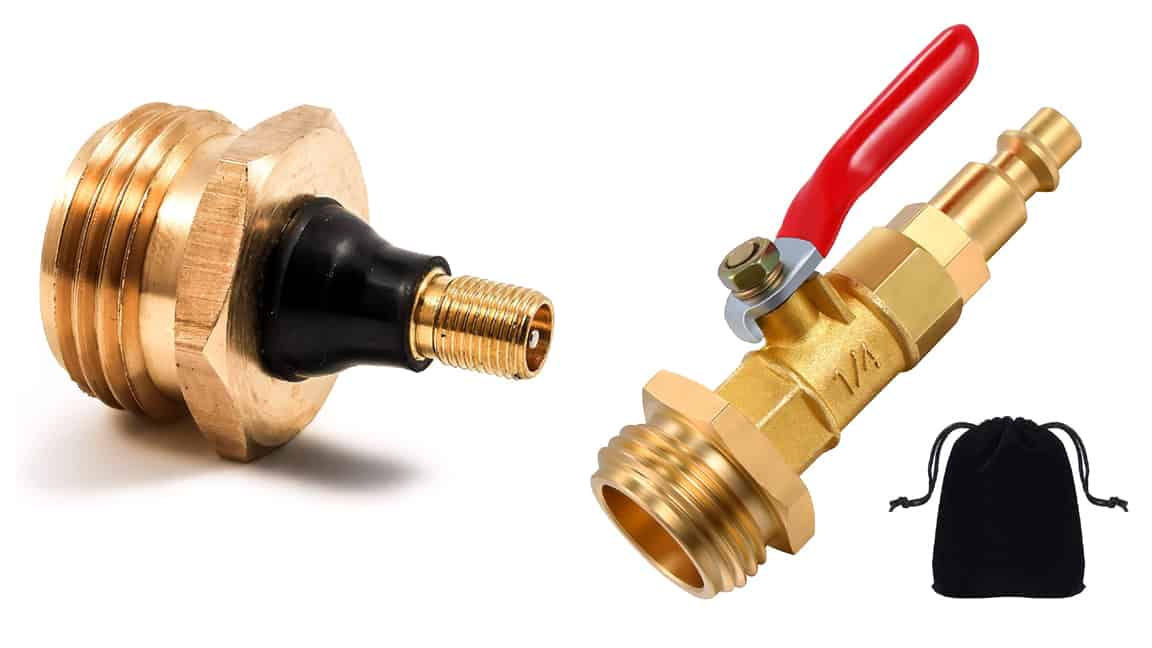
These blowout plugs have either quick connect (for construction-style compressor hose connection) or tire (Schrader valve) connection to use with automotive-style tire pumps or small compressors. Let your compressor run for a few minutes to finish pushing water out. The pressure should be 40 to 60 psi to prevent damaging water pipes.
4) Leave faucets, water heater plug, and fresh water drain open during storage so that remaining water can dribble out.
5) Pour about 8 ounces of RV plumbing antifreeze in each of the sink and shower drains and toilet (flush it). You don’t need much.
If you have an icemaker in your fridge, or a washer on board, you’ll need to separately purge those critters. Follow the manufacturer’s instructions on how to proceed.
Reverse the course in spring!
When spring comes and you’re ready to RV, it’s simple to get ready to go. Close all the faucets, fresh water tank, and water heater valves and refill your water tank. You might consider adding a sanitizing solution (could be your own bleach mixture or something like Camco “Drinking Water Freshener“). Not everyone wants a nasty chlorine taste in their tank, so some forgo this step.
Note, if your rig has an Aqua-Hot or Oasis floor heating system, the air “blow out” method may not get all the water out of the copper coil. If you break that, you’ll be in for a VERY expensive fix. As one reader says, “A few gallons of RV antifreeze seems a cheap price to pay!”
For us, what little antifreeze we use goes down the plumbing drain p-traps. I promise you this: We’ve never tasted what comes out of there!
Other stories by Russ and Tiña De Maris
##RVT1183

Four years of owning a 5th wheel in Canada. I use compressed air to clean out all the lines, including our washer dryer. I use an antifreeze solution to pour down the drains to keep the valves and J-traps from freezing. Don’t forget to remove the water heater plug and drain the fresh water tank as well!
Leave next week for Az., and can’t wait to hit the road!
Happy trails Leonard! Good reminder about the water heater!
Thank you, Russ and Tina! Great winterizing primer! Have a great weekend and safe travels!