


This week’s news recap looks at a few interesting animal stories, how the RV industry’s use of a wood product may affect animals (and people), and a cool new RV A/C.
The bear necessities
A bear near Yellowstone’s Mystic Falls attacked two brothers on May 4. Also in Glacier National Park, a 33-year-old hiker was killed near Lake MacDonald. While bear attacks remain extremely rare, they obviously do still happen. According to some park officials, bear attacks tend to happen when the mothers are surprised by humans, so the recommendation is to be noisy on hikes so you don’t surprise them. You should also carry bear spray.
In the case of the brothers, they are expected to make a full recovery.
A while back, I had the chance to speak with Steve Searles, who is considered to be the “Bear Whisperer”. He had some pretty great tips for being in spaces where bears call home.
The original source for this story is from RV Miles, where you can learn more about these bear encounters.
 A coyote on Alcatraz

Apparently, a coyote was spotted on Alcatraz. No, seriously. So, that got park officials curious as to where the coyote came from (perhaps a failed Acme device) and how it got there. While us normal people would just live our lives in a state of curiosity, when you have government money, things are different.
Coyote poop was sent to UC Davis Mammalian and Ecology Unit of the Veterinary Genetics Laboratory, where it was analyzed. It was determined that the critter simply swam over from Angel Island. Now, this is no short jaunt.
In another story from RV Miles, Bill Merkle, Park Service Wildlife Ecologist, is credited with saying that the assumption was that the coyote made the swim from San Francisco just because it’s closer to the former prison island.
As quickly as the coyote was discovered, it has now also disappeared.
The concern by Alcatraz folks was for the welfare of the larger population of nesting sea birds, which is probably also what prompted the coyote to take to the water.
The original source for this story is from RV Miles.
We hate your wood, bro
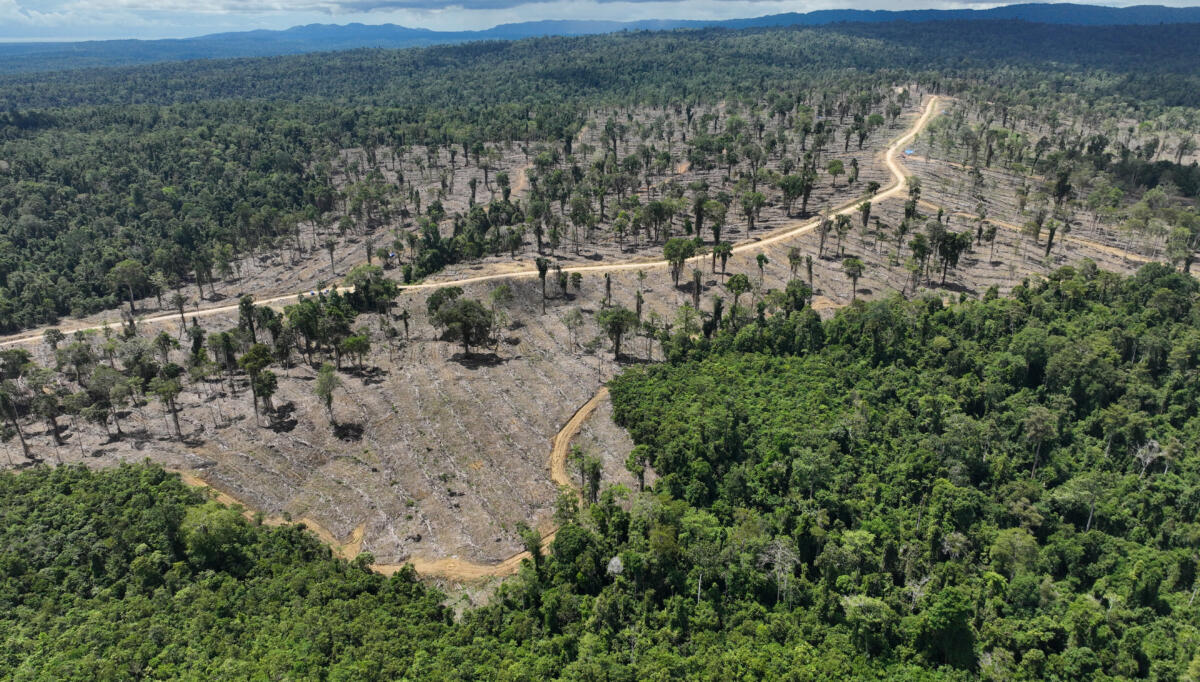
If you’ve ever read my RV reviews, you know that I’m no fan of luan (aka lauan) in the build of RV walls, but, apparently, neither is Mighty Earth, an activist group. The organization states that the luan sourced from Patrick Industries comes from the rainforests of Borneo and is a significant contributor to the deforestation of that area. (Russ and Tiña De Maris covered this earlier this year.)
The group hired one of those trucks with a big digital billboard to drive around Elkhart and display messages criticizing Thor, Winnebago and Forest River for helping with the deforestation.
One screen read, “Your RVs are deforestation on wheels!” Activists following the truck carried signs displaying messages like, “RVs shouldn’t kill orangutans.”
“As it turns out, the RV industry is the largest consumer of tropical wood in the U.S.,” said Amanda Hurowitz, a senior director for Mighty Earth on its forest commodities team. “They’re a major consumer of this wood, but they don’t have any sustainability standards.”
Hurowitz said one RV can have as much as 700 square feet of tropical wood, called meranti or luan, in it.
RV manufacturers should adopt sustainability standards
The activists want the companies to adopt the same sustainability standards as Lowe’s or Home Depot, meaning any wood they source must come from an area certified by the Forest Stewardship Council (FSC).
Apparently, Mighty Earth is also dropping off signed petitions at the three RV companies, but you wonder why they didn’t also hit Patrick Industries, which is the wood supplier.
Quite honestly, the RV industry can do better. But they’re motivated by numbers more than almost anything. So we, as consumers, have to be aware of this and make demands in our purchases.
To me, the fact that RVs, which are enormous fuel suckers, have stickers on them about protecting forests and other malarkey has always been a complete joke anyway. The stickers about saving the planet are such a complete farce that even a first-year marketing student who’s failing their classes would know better than to make such a ludicrous statement.
Original source for this story is at ABC 57 in Indiana.
Do you hate your RV’s air conditioner?
A while back, I shared that I had installed a Furrion Chill Cube RV air conditioner in my RV for a variety of reasons. It’s pretty great.
Well, it turns out, Coleman Mach isn’t sitting on their hands in this area either, and it was announced recently that they, too, have an inverter A/C unit in the Coleman Mach Everest VS-18.
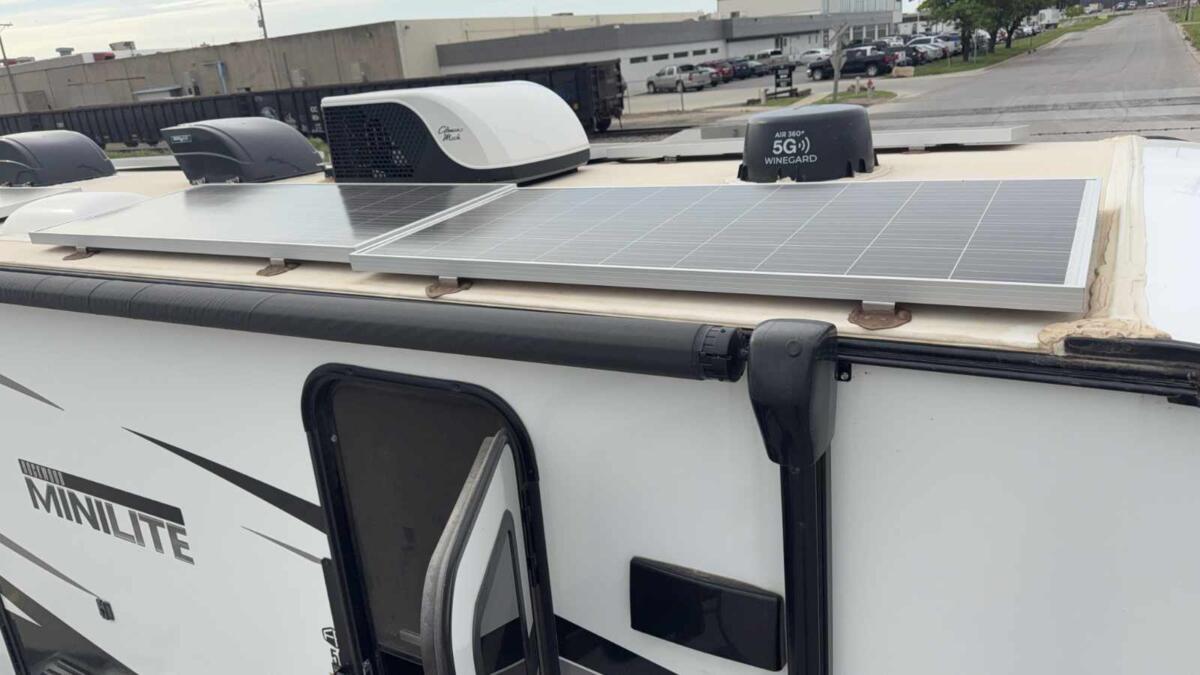
Part of how I know this is because I was at Airxcel in Wichita, Kansas, last week. I had one of these put on my own RV so I can help get the performance and power consumption numbers. Of course, I will share this with you all once I get more information.
There are more details in the story linked below, but I can tell you that I was running the A/C on battery power alone and actually bringing in more energy through the 1,200 watts of solar on the roof of my RV than I was consuming with the A/C. To be fair, the conditions were pretty ideal, but this shows how efficiently these new A/Cs can run.
This unit, and the Chill Cube, are significantly quieter than the A/C units of yore (probably that yore is on your roof) and remarkably more efficient, but also run differently.
The bottom line: If you’re thinking of a new A/C for summer, the Coleman Mach Everest VS-18 or the Furrion Chill Cube are examples of real progress in the RV industry, which is encouraging.
Original source for this story is RV Pro.
Catch up on all the latest news for RVers here.
RVT1261b

One thing I read about these new and better A/C units is that some put the temperature sensor up in the unit and it should be on the wall in the thermostat. Up in the unit causes short cycling and incomplete temperature regulation.
Yes. That noisy yore is on our roof and we are considering anything quieter in the near future. Right now it makes me feel like we have a lawn mower up there. I’ll be trying to find the decibels for each of those in the article
I already have an article about the Chill Cube here and am doing the number crunching and all of that for the story and video about the Coleman-Mach Everest. Thus far even on “turbo” mode I’m getting about 67dB at about 3′ distance from the Everest. Nice.
We recently installed an 11,500 btu 12v OutEquipPro unit on our 26 foot class A rig. We have 400 amps of LiFePO4 batteries and 1200 watts of solar. We haven’t had really scorching weather yet, but the early results with the cooler have been great in more moderate mid 80′ temperatures with shaded morning and late afternoon, with very sunny middays. We chose the model with the heat pump and also really like that feature too. Sound levels over the old Dometic Penguin 13,000 btu unit are dramatically less, especially on lower fan level settings.
Pat, do you realize that the cooling potential of your new unit is about 10% less than your old unit? Perhaps some of its lower noise level could be due to that. I have read that RV roof ACs can only achieve at most a cooling gradient of 20° from ambient.
What the Coleman Mach Everest VS-18 AC-Heat Pump model needs is to have a remote control thermostat that can be mounted to the wall. This way you don’t have to hope you can fish thermostat wires.
Tony, I was wondering, do R/V Air Conditioners have EER ratings ?
I’m sure they do but I’ve never really seen one. I know I was shopping mini splits for my house in NM and was obsessed with those numbers.
I could be wrong but I believe rv s are exempt from both eer & seer ratings.
As for luan, I pointed this out with the last article here; it’s estimated that the logging and export of luan is tied to 3-5 millions jobs in Indonesia. It’s easy to take an environmental stance on something when it’s not their jobs on the line.
Hey Luan activists, here’s something your parents neglected to teach you; Don’t complain unless you have a solution. Without a solution, you’re just a whiner.
The Solution is to only use wood certified by the Forest Service Council, according to the article
Instead of using wood like luan or other rainforest woods, just switch to bamboo as it is stronger than most hardwoods, lighter and grows quickly. Bamboo is beautiful when polished.
I’m really looking forward to seeing your impressions of the Coleman-Mach Everest. I’m hoping to replace our old Coleman-Mach unit this year, but I’ve been holding off to see what’s new on the market this year.