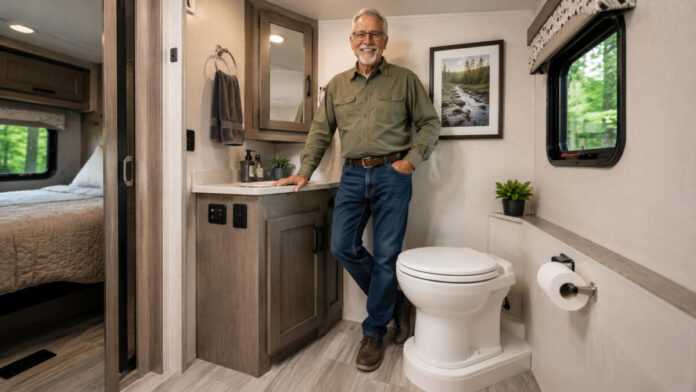
Here’s something many RVers discover as the years go by: That RV toilet seems to get lower every year. Or maybe gravity is simply getting more aggressive.
Of course, the toilet isn’t really shrinking. But knees, hips and backs have a way of reminding us that getting up from a low seat isn’t as easy as it used to be.
Many older RVs came with low-profile toilets. They save space, but they can make your joints work harder every time you sit down—or stand up. Fortunately, there are a few ways to make life easier, ranging from simple toilet risers to full replacement toilets. In other words, help may be closer than you think when it’s time for liftoff.
Before spending any money, measure your current toilet. Many newer RVs already come equipped with residential-height toilets, so a riser may not be necessary.
Why a few inches can make a big difference
The difference between an RV standard-height toilet and a residential-height toilet may only be a few inches. But those inches can reduce the effort required to sit down and stand up.
A few extra inches can make a surprising difference if getting on and off your RV toilet isn’t as easy as it used to be.
A lower toilet can turn into a daily annoyance, especially if you’re dealing with arthritis, bad knees, a hip replacement, neuropathy, or balance issues.
Many RVers focus on major upgrades such as solar systems, lithium batteries, and suspension improvements. Yet some of the most appreciated mods are the ones that make everyday life more comfortable.
“That RV toilet seems to get lower every year.”
Option 1: Install a toilet riser
One of the least expensive solutions is an RV toilet riser.
These devices fit between the toilet and the floor and typically add about 2½ inches of height. It may not sound like much, but when your knees start negotiating every trip to the bathroom, those extra inches can help your toilet rise to the occasion.
If you’re reasonably handy, installing a riser is a manageable DIY project. The hardest part may be working in a bathroom barely big enough to turn around in.
We previously published a step-by-step guide showing how we installed a toilet riser in our own RV. You can read that story here: “Make your toilet rise to the occasion — Install a riser.”
There are also toilet seat risers available. No DIY necessary, except setting it on the existing seat.
For many RVers, a riser offers a relatively inexpensive way to gain some extra height without replacing the entire toilet.
Option 2: Replace the toilet
Sometimes replacing the toilet makes more sense than adding a riser.
Many modern RV toilets are available in residential-height versions. Some offer taller seating positions, improved flushing performance, and even porcelain bowls.
A replacement toilet will usually cost more than a riser, but it may provide a cleaner-looking installation while eliminating the need for additional parts between the toilet and the floor.
Don’t overlook grab handles
Height isn’t always the entire problem.
Sometimes, a simple grab handle mounted in the right spot can help just as much as a taller toilet. After all, not every bathroom problem can be solved from the seat up. A secure handhold can improve stability and reduce the effort required to sit down and stand up.
This can be especially important for RVers dealing with balance issues or leg weakness.
Small upgrade, everyday benefit
Solar panels are more exciting. So are lithium batteries and fancy electronics.
But if getting off the toilet has become a chore, a few extra inches of height may be one upgrade you’ll appreciate every single day.
A taller toilet won’t make your RV faster, quieter or more luxurious. But when it’s time to leave the throne, a little extra height can help keep your journey from going down the drain.
RELATED
- How to adjust your RV toilet seat height
- As I get older, RV toilet has gotten ‘shorter.’ What are options for quality tall toilet?
- How to replace your RV toilet
- Not every RVer uses their RV’s toilet the same way… Wait, what?!
RVT1267